
Plan Set vs. As-Built Drawings: What Solar Installers Need at Every Project Stage
Stop Losing Projects to Document Confusion — Here’s What You Actually Need
If a permit rejection, a failed AHJ inspection, or a last-minute document scramble has ever cost you time and money — you already know the frustration. US solar installers and EPCs consistently run into one of the most avoidable problems in the industry: document confusion. Specifically, mixing up what a solar plan set is versus what as-built drawings are, and when each one belongs in your workflow. These two document types serve completely different purposes, and dropping the wrong one at the wrong project stage can stall your timeline by weeks. The good news? Once you clearly understand the difference, your solar installation documentation becomes far easier to manage — and your projects move faster from permit to PTO.
What a Solar Plan Set Does for Your Project Before Installation Starts
A solar plan set is the engineered document package your team submits to the Authority Having Jurisdiction (AHJ) before installation begins. Think of it as the blueprint your project lives or dies by during the permitting phase. It tells the AHJ exactly what you plan to install, where it goes, and how it meets local code and safety standards — all before a single panel touches the roof.

A complete solar plan set typically includes:
- Site plan showing property layout, roof orientation, and setback dimensions
- Electrical single-line diagram (SLD) detailing the full system electrical configuration
- Roof plan with panel placement, structural attachment points, and equipment locations
- Equipment specifications — datasheets for modules, inverters, and racking systems
- Structural calculations when the AHJ requires them
- PE stamp, which many jurisdictions mandate for residential and commercial systems above a certain size
Without a properly prepared solar permit drawing package, your permit application simply won’t move forward. Moreover, a poorly prepared plan set triggers back-and-forth corrections with the AHJ — burning time and money on every single project.
As-Built Drawings Solar: What They Capture and When Your Project Needs Them
As-built drawings work differently. Your team creates them after installation wraps up. They document what your crew actually built — not what the original design called for. In a perfect world, the as-built matches the approved plan set exactly. In practice, field conditions change things: a different inverter gets substituted, panel placement shifts around an unexpected roof obstruction, or conduit takes a different route than the drawing showed.

Your solar project needs as-built drawings for:
- Final inspection sign-off by the AHJ
- Utility interconnection applications, where the utility verifies what’s actually connected to their grid
- O&M documentation for commercial and industrial systems
- Warranty and insurance records that follow the system across its entire lifespan
Skipping or rushing as-built drawings delays your Permission to Operate (PTO). That means your customer misses incentive timelines, and you don’t close the job on schedule. No installer or EPC can afford that pattern repeatedly.
Solar Plan Set vs. As-Built Drawings: The Key Differences Side-by-Side
Knowing which document belongs at which stage keeps your projects on schedule. Here’s a quick breakdown every solar installer should keep handy:

Additionally, many jurisdictions require a formal redline review — where your field team marks up the original solar permit drawings to capture any changes made during installation, which then becomes the official as-built package. Understanding your specific AHJ’s requirements ahead of time eliminates last-minute surprises.
Documentation Mistakes That Solar Installers and EPCs Keep Making
Even experienced solar installers and EPCs fall into the same documentation traps. Here are the most common missteps across US solar projects — and how to sidestep them:
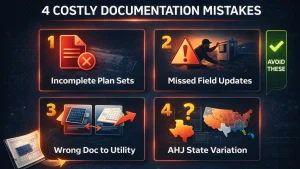
1. Submitting incomplete solar plan sets Missing equipment datasheets or an unsigned PE stamp top the list for permit rejections. Every page of your solar engineering drawings needs to be review-ready before you hit submit.
2. Skipping as-built updates after field changes When your crew swaps an inverter model on-site without logging it, your as-built won’t reflect reality — and your utility interconnection review will catch it immediately. Always track field substitutions in real time.
3. Sending the wrong document to the utility Some installers accidentally send the original permit plan set to the utility instead of the as-built drawings. Utilities want confirmation of what’s actually running on their grid — not what you planned six weeks ago.
4. Underestimating AHJ variation across states What clears permitting in California won’t necessarily pass in Texas or Florida. Solar permit drawing requirements vary significantly by jurisdiction. Working with a national engineering partner who knows local nuances gives you a real competitive edge.
Why Clean Solar Engineering Documents Protect Your Business Long-Term
Beyond compliance, keeping accurate solar installation documentation protects your company in several concrete ways. Clean records reduce your liability in any system failure or insurance claim. They also speed up future service calls, since technicians reference accurate as-built records rather than guessing how the system ties together. Furthermore, commercial clients increasingly expect complete solar engineering drawings as a standard part of project closeout.
As the US solar market grows and AHJ scrutiny increases — especially for systems tied to the ITC and state-level rebates — the quality of your documentation package will separate the competitive from the rest.
How EnergyScape Renewables Delivers Solar Plan Sets and As-Built Drawings Across the US
This is where EnergyScape Renewables makes a direct impact on your workflow. EnergyScape delivers professional PE-stamped solar plan sets, permit-ready solar engineering drawings, and as-built documentation services built specifically for US solar installers and EPCs. Whether your team handles residential rooftops or multi-site commercial rollouts, EnergyScape produces accurate, AHJ-compliant solar permit drawings that move through approval faster.
Their engineering team covers the full project lifecycle — from initial solar plan set submission all the way through final as-built documentation — so your crew stays focused on installations while EnergyScape owns the engineering paper trail. For installers looking to scale without building an in-house engineering team, that kind of support turns into a direct competitive advantage.
If you want to tighten up how you track solar projects from sales through installation, check out Sunscape Solar — a solar CRM and project management platform built specifically for installers and EPCs.
Getting your solar plan set and as-built drawings right isn’t about checking regulatory boxes — it’s about running a tighter, more professional solar business. Installers and EPCs who treat documentation as a core workflow element consistently hit faster permit approvals, cleaner inspections, and quicker PTO timelines. With the right engineering partner in your corner, documentation should never be what slows your projects down
sjayakanth@energyscaperenewables.com