
Solar Permitting Timelines: State-by-State Guide for Solar Installers and EPCs

Why Solar Permitting Timelines Are Costing Installers Real Money
You’ve got panels on the roof. The homeowner is excited. Your crew is ready to flip the switch. But you’re still waiting on a permit that’s been sitting in a city building department queue for three weeks. Sound familiar? Solar permitting timelines are one of the most painful variables in residential and commercial solar projects across the US. They shift dramatically from one jurisdiction to the next. Moreover, when delays hit, they don’t just push back PTO dates — they cut into your margins, slow your pipeline, and frustrate customers.
Fortunately, understanding what drives these delays helps you plan smarter. It also helps you communicate better with customers and choose the right engineering partner. Therefore, this guide breaks down state-by-state solar permitting timelines, the biggest causes of permit delays in 2026, and what top-performing installers are doing to stay ahead.
How Solar Permitting Timelines Differ Across the US
There’s no national standard for solar permit approvals. Consequently, that’s a major part of the problem. Depending on the AHJ, you could wait anywhere from 24 hours to 12 weeks. Here’s how it breaks down by region:

Fast States: 1–5 Business Days
Florida, Texas, and Arizona consistently turn permits around fast. Many municipalities in these states use SolarAPP+ — an automated solar permitting platform that issues permits almost instantly for code-compliant residential systems. For example, Austin and Houston now process most residential solar permits in 1–3 business days. As a result, installers in these markets can maintain a high project volume without permitting becoming a bottleneck.
Mid-Range States: 1–4 Weeks
Georgia, Tennessee, Ohio, and Colorado fall in the middle tier. These states have made progress with streamlined solar permitting processes. However, manual review is still common — especially in smaller counties with limited staff. Furthermore, if your plan sets don’t meet local code requirements or are missing PE-stamped engineering documents, expect a resubmission. That alone adds another 1–2 weeks to your solar project timeline.
Slower States: 4–8+ Weeks
California, New York, New Jersey, and Massachusetts are the most challenging markets. In California, NEM 3.0 transition requirements and utility interconnection backlogs make delays worse. Similarly, New York’s interconnection approval process — especially in Con Ed and PSEG territories — routinely adds 6–10 weeks beyond the permit itself. In short, EPCs working in these states must build longer lead times into every project schedule.
The Biggest Causes of Solar Permit Delays in 2026
Knowing the causes of solar permit delays gives your team a real advantage. Here are the top reasons permits stall today:

Incomplete or Non-Compliant Plan Sets
This is the number one reason permits get rejected. AHJ reviewers flag plan sets that don’t meet NEC 2023 or local code amendments. They also reject submissions missing structural calculations or PE-stamped documentation. In addition, states transitioning to NEC 2026 requirements are creating new compliance gaps for installers still using older plan set templates. Therefore, getting your documentation right the first time is not optional — it’s essential.
AHJ Staffing and Backlog Issues
Not every building department has a dedicated solar reviewer. In rural counties and smaller municipalities, solar applications sit in a general queue behind HVAC permits and structural remodels. This is especially common in the Southeast and Mountain West, where solar adoption is growing faster than AHJ capacity. As a result, even a clean, complete plan set can wait two to three weeks simply due to staffing limits.
Utility Interconnection Delays
Even after your permit clears, the utility interconnection application adds more time. Utilities like PG&E, National Grid, and Duke Energy are managing backlogs that stretch 60–90 days in certain interconnection queues. Accordingly, experienced EPCs now submit interconnection applications early — often at the same time as or even before the permit application. This overlap strategy alone shaves weeks off total solar project timelines.
Missing PE Stamps and Engineering Documents
Many AHJs now require a licensed Professional Engineer’s stamp on structural and electrical plan sets. If your workflow doesn’t include a fast-turnaround PE stamp service, you’re adding unnecessary time to every project. Specifically, enforcement of PE stamp requirements has tightened significantly in 2025–2026. In some states, this applies to systems above a certain kW threshold. Still, it’s better to stamp every set than to guess which AHJ will ask for one.
What Fast-Moving Installers Are Doing Differently
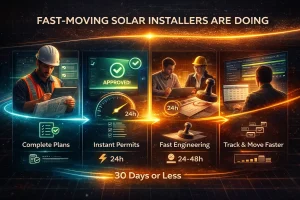
The installers and EPCs hitting 30-day or faster timelines in complex markets share a few common habits. First, they submit complete, AHJ-specific plan sets on the first attempt. This single step eliminates the most common cause of resubmission delays. Second, they use SolarAPP+ wherever available. The platform now covers a growing number of US jurisdictions and cuts permit approval to under 24 hours for qualifying residential systems.
Third, they partner with an experienced permitting and engineering firm. A good partner understands local AHJ quirks, state code amendments, and utility interconnection requirements. For instance, getting PE-stamped plan sets back in 24–48 hours — rather than waiting a week — fundamentally changes how fast you can move. Fourth, they track permit status proactively. A solar-specific CRM helps teams catch stalled applications early and follow up before small delays become big problems.
Reduce Solar Permit Delays With the Right Engineering Partner
Solar permitting timelines will always have some variability. Nevertheless, the right systems and the right partners make a measurable difference. Installers who treat permitting as a strategic function — rather than an afterthought — consistently outperform those who don’t.
This is precisely the problem that EnergyScape Renewables solves. EnergyScape delivers PE-stamped plan sets, AHJ-specific permitting support, and interconnection application management across all 50 states. Their 24-hour PE stamp turnaround keeps engineering off your critical path. Additionally, their team knows the documentation standards that get permits approved the first time — without costly back-and-forth with reviewers.
Whether you’re scaling residential volume in a fast market like Texas or managing a complex California interconnection, EnergyScape’s expertise keeps your projects on schedule.
To manage your solar projects from permit submission to PTO in one place, explore Sunscape Solar — a CRM and project management platform built specifically for US solar installers and EPCs.
sjayakanth@energyscaperenewables.com