
Residential Solar Permitting vs Commercial Solar Permitting: Why You Cannot Use the Same Process
Why Mixing Up Residential and Commercial Solar Permits Costs You Projects
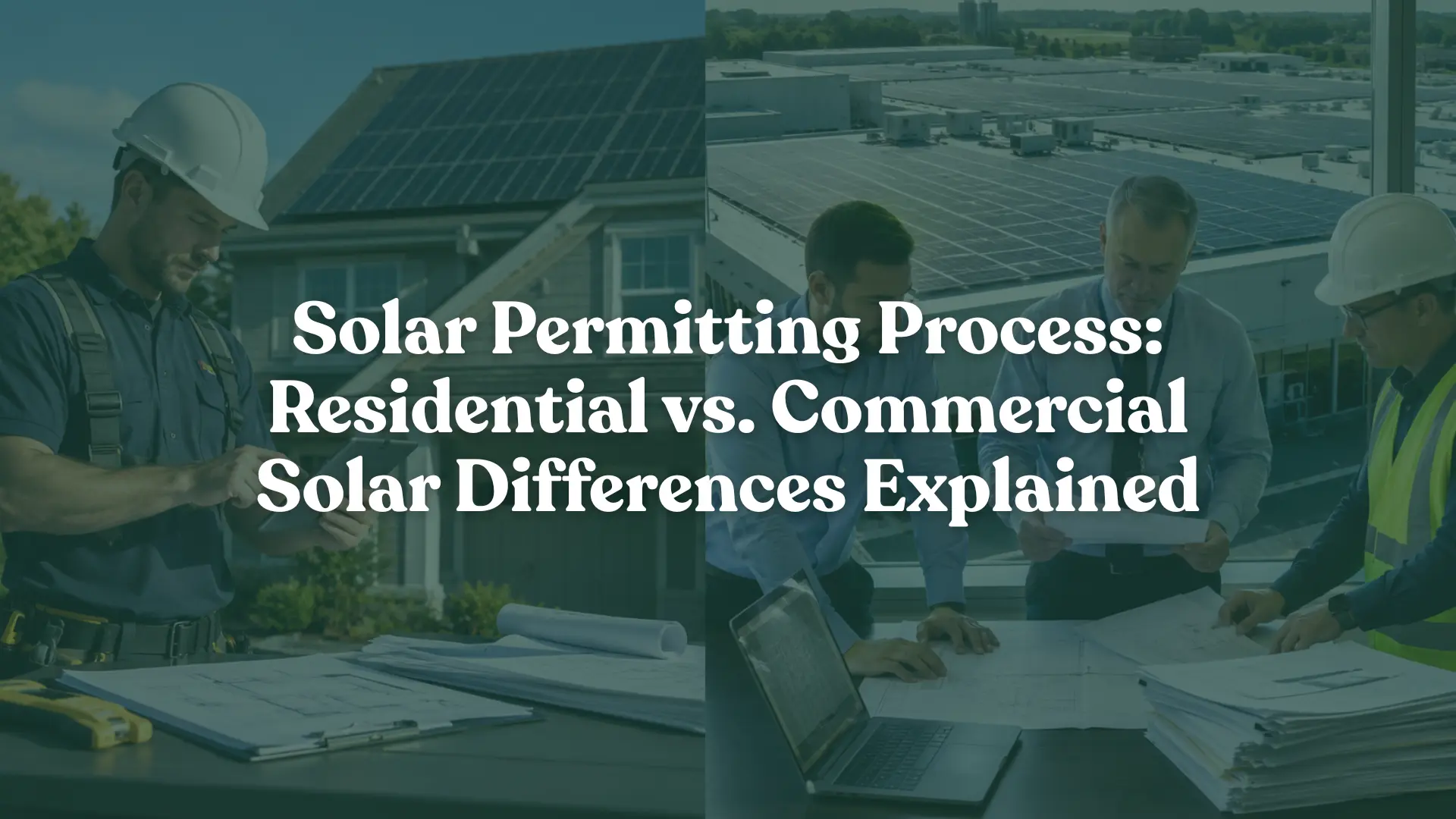
If you’ve ever treated a commercial solar permit the same way you’d handle a residential rooftop job — you probably found out the hard way that it doesn’t work. The solar permitting process is not one-size-fits-all. Residential and commercial projects carry entirely different documentation requirements, review timelines, and AHJ expectations. Without knowing these differences upfront, you risk failed inspections, project delays, and frustrated clients.
The good news? Once you understand exactly where residential and commercial solar permitting diverge, you can build a repeatable workflow that keeps projects moving — and keeps customers coming back.
The Core Differences in the Solar Permitting Process
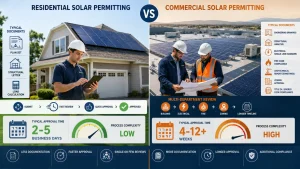
The solar permitting process on a residential job can feel straightforward. You submit your plan set, a structural letter, and a load calculation. Many jurisdictions approve these within a few business days. It’s predictable.
Commercial solar permits, on the other hand, require a much heavier documentation package. Most AHJs want full engineering drawings, stamped structural analysis, fire code compliance details, electrical single-line diagrams, and sometimes a geotechnical report. Additionally, commercial projects often go through multiple review departments — building, electrical, fire, and zoning — which can stretch the review timeline significantly.
Furthermore, commercial solar permit requirements in states like California frequently trigger Title 24 or energy code compliance reviews. That’s a layer most residential installers simply never encounter.
Residential Solar Permits: Faster, But Don’t Get Comfortable
What Residential Solar Permit Requirements Typically Include
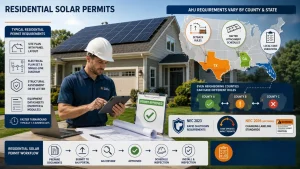
Residential solar permits are generally more streamlined. Many jurisdictions operate simplified permitting programs — especially for systems under 10 kW on standard pitched roofs. Key documents usually include a site plan with panel layout, an electrical plan set with a single-line diagram, a structural assessment or PE letter for non-standard roofs, and product datasheets for the inverter and modules.
That said, residential solar permit requirements still vary by AHJ. Some counties in Texas, Florida, or Georgia may have specific setback rules or rafter attachment schedules that differ from neighboring jurisdictions. Moreover, NEC 2023 and the upcoming NEC 2026 adoption are changing rapid shutdown requirements and labeling standards from one municipality to the next.
Because of this, residential installers should never assume that what worked in one county will pass in the next. Always verify local AHJ requirements before pulling a permit.
Commercial Solar Permits: More Complexity, More at Stake
Why the Commercial Solar Permitting Process Demands More Documentation
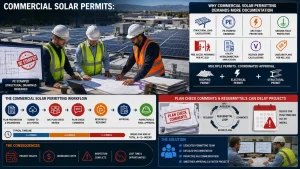
The commercial solar permitting process is a different animal entirely. Larger system sizes place more structural load on roofs and ground mounts — and AHJs take that very seriously. In most cases, a licensed PE must stamp the structural drawings. A generic structural letter won’t cut it here.
Beyond structure, commercial projects routinely require arc-fault and ground-fault protection documentation, fire access pathway compliance per IFC 2021, a utility interconnection application submitted concurrently, voltage drop calculations for longer wire runs, and detailed labeling plans per NEC 2023.
Consequently, the commercial solar permitting process involves more back-and-forth with AHJs. Plan check comments are common, and resubmittals can push timelines out by weeks. EPCs without a dedicated permitting team often get caught flat-footed at this stage.
In addition, commercial projects may need separate permits for roofing penetrations, electrical work, and structural modifications — all of which must coordinate carefully to avoid inspection conflicts.
Key Differences at a Glance
Knowing these distinctions upfront helps your team plan and bid more accurately. Here’s the quick breakdown:
Residential: smaller system sizes, standard plan sets, AHJ fast-track programs available, PE stamp sometimes optional, shorter review windows of three to seven business days in most markets.
Commercial: larger system capacity, full engineering package required, PE stamp mandatory, fire code review standard, multi-department approvals, longer review timelines, and utility coordination required simultaneously.
The solar permitting process for commercial work can take three to eight weeks in many jurisdictions — sometimes longer in dense urban markets. Residential permits in streamlined markets, by contrast, can be approved in under a week.
Mistakes Installers Make When Crossing Between Project Types
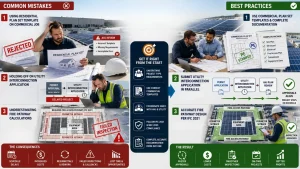
Transitioning between residential and commercial solar permits trips up even experienced teams. Here are the most common problems that show up in the field.
First, using a residential plan set template on a commercial job. AHJs spot this immediately, and the resubmittal burns your schedule. Second, holding off on the utility interconnection application until after permit approval. On commercial projects, these must move in parallel — not sequentially. Third, underestimating fire pathway calculations. IFC requirements for commercial rooftops are strict, and getting them wrong means a failed inspection and a callback.
Therefore, make sure your team — or your permitting partner — fully understands the project type before the first document is drafted.
How EnergyScape Renewables Keeps Your Solar Permitting Process on Track
Whether you’re installing a 7 kW residential system or a 500 kW commercial rooftop array, the solar permitting process demands precision at every step. EnergyScape Renewables handles both residential and commercial solar permitting across all 50 states. Their team manages full plan set preparation, PE stamping with 24-hour turnaround, AHJ coordination, and interconnection applications — so your crew stays focused on installations rather than paperwork.
For solar installers who want to track projects from permit submission to PTO in one place, Sunscape Solar offers a purpose-built CRM and project management platform designed specifically for US solar contractors. Together, these two platforms give your business the operational edge to scale without the growing pains.
sjayakanth@energyscaperenewables.com