
Why the Same Plan Set Passes in One County and Fails Two Counties Over
Solar Permit Requirements Change the Moment You Cross a County Line
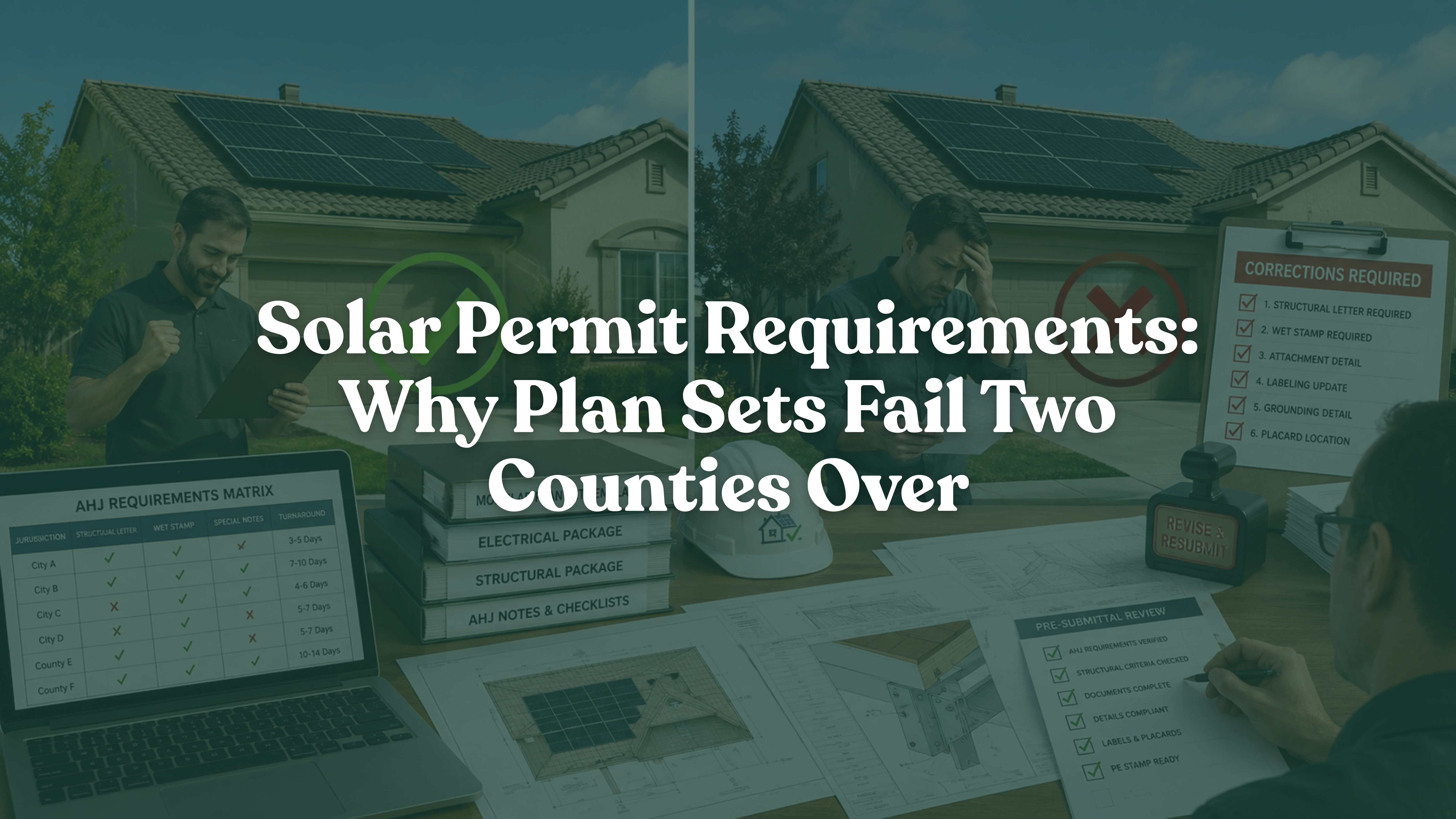
You sold two nearly identical 8.4 kW rooftop systems last month. Both used the same modules, the same inverter, and the same racking. Your team pulled one template, dropped in fresh site data, and submitted both packages the same afternoon. First, one cleared review in four days. Then the second came back with six correction items plus a request for a wet-stamped structural letter. Nothing about the array changed. Only the jurisdiction did. In short, local solar permit requirements shift block by block, and most installers never map those gaps until a rejection notice lands. Fortunately, the fix is not more hours in AutoCAD. Instead, it starts with a documented AHJ matrix, a modular plan set template, and a review step that catches local quirks before submittal.
What Actually Drives Solar Permit Requirements at the Local Level
Solar permitting in the US is not federal, and it is not truly statewide either. Roughly 20,000 authorities having jurisdiction each write their own rules. Because of that fragmentation, three forces create most of the variance your team feels in the field.
Code Adoption Cycles Never Line Up
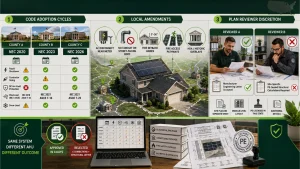
States adopt National Electrical Code editions on their own schedule. For example, one county may still enforce NEC 2020. Meanwhile, its neighbor has moved to NEC 2023, while a third already reviews under NEC 2026 language. Each cycle changed rapid shutdown labeling, conductor sizing, and DC arc-fault language. Therefore, a compliant one-line diagram in County A can read as noncompliant twelve miles away.
Structural review follows the same pattern. Some AHJs still work from IBC 2018 wind maps. Others use IBC 2021 or ASCE 7-22. As a result, your snow and wind load calcs may pass one desk yet fail the next on identical roof geometry.
Local Amendments Stack on Top of the Model Codes
Model codes are only the starting line. Counties and cities layer amendments on top of them. For instance, one AHJ might require a visible AC disconnect within ten feet of the meter. By contrast, another bans conduit on street-facing roof planes. Fire setbacks vary widely too — three feet at the ridge in one town, thirty-six inches on all sides in another, and full IFC 2021 pathways somewhere else. Moreover, HOA and historic-district overlays add a layer that never appears in the county code book.
Plan Reviewer Discretion Is Real
Even when two AHJs enforce the same code edition, reviewers read it differently. One accepts a manufacturer engineering letter for a mounting system. Another demands site-specific calcs sealed by a PE licensed in that state. Certain desks want the site plan on its own sheet. Others want string layouts called out module by module. Although these preferences rarely appear in writing, they still drive real correction cycles.
Where Clean Plan Sets Break Down Most Often
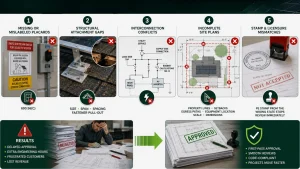
Across thousands of submittals, the same five items generate the bulk of corrections:
- Missing or mislabeled placards. Rapid shutdown signage under 690.56(C) shifted between code cycles, so reviewers check it first.
- Structural attachment gaps. Rafter size, span, spacing, and fastener pull-out values must match the actual roof rather than a generic detail block.
- Interconnection conflicts. Load-side taps, supply-side connections, and busbar calcs under 705.12 get scrutinized differently by each utility.
- Incomplete site plans. Property lines, setbacks, egress paths, and equipment locations all need scale and dimensions.
- Stamp and licensure mismatches. A PE stamp from the wrong state stops review immediately.
Each correction cycle costs real money. Typically, a single round trip adds seven to fifteen business days. Multiply that across a pipeline, and your cash conversion slows while crews sit idle.
How to Build Plan Sets That Survive Different Solar Permit Requirements
Build a Living AHJ Requirements Matrix
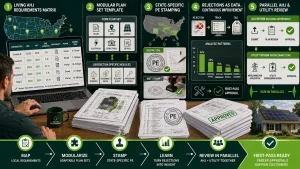
Start with your top twenty jurisdictions by volume. For each one, record the adopted NEC and IBC editions, fire setbacks, disconnect placement, submittal format, portal type, and typical review timeline. Then add a notes column for reviewer preferences your team learns the hard way. Finally, update it after every rejection. Within two quarters, that matrix becomes your most valuable operational asset.
Modularize the Plan Set Template
Rather than maintaining one master template, build a core set — cover sheet, site plan, layout, electrical, structural, details. After that, swap jurisdiction-specific sheets in and out as needed. Also keep placard blocks, setback callouts, and disconnect details as separate library components. Consequently, adapting a package to new solar permit requirements takes minutes instead of hours.
Handle PE Stamping by State, Not by Habit
Professional engineers hold state licenses. Since that is true, your California-stamped structural letter does nothing in Arizona. Line up stamping coverage before you enter a new market. In addition, confirm whether the AHJ accepts digital seals, because several still demand wet signatures.
Treat Rejections as Data
Log every correction comment in a shared tracker. Next, tag it by AHJ, code section, and root cause. Review those tags monthly. Patterns surface quickly, and usually three or four recurring issues drive most of your delays. Once you fix them at the template level, first-pass approval rates climb.
Check Utility Rules Separately
Interconnection runs on a parallel track. Utilities set their own forms, single-line standards, and export limits. A package that satisfies the building department can still stall at the utility. Therefore, run both reviews at the same time rather than back to back.
How EnergyScape Renewables Solves Solar Permit Requirements Across All 50 States
Most installers do not lose deals on price. Instead, they lose margin on rework. That gap is exactly what EnergyScape Renewables was built to close. Our engineering team delivers permit-ready plan sets for residential, commercial, and utility-scale projects nationwide, backed by in-house PE stamping in all 50 states. Because we track code adoption and reviewer preferences jurisdiction by jurisdiction, your package reflects local solar permit requirements before it reaches a plan checker.
Furthermore, we handle the full back office: permitting submittals, revisions, interconnection applications, site surveys, and AHJ follow-up. As a result, your team stays focused on selling and installing. Meanwhile, we manage the paperwork that slows everyone else down.
Want that same visibility inside your own operation? Pair our engineering services with Sunscape Solar, a purpose-built CRM for US solar installers and EPCs that tracks permits, revisions, and milestones in one place.
Ultimately, guessing which county will push back is a losing strategy. Reach out to EnergyScape Renewables and get a plan set built for the jurisdiction you are actually working in.
sjayakanth@energyscaperenewables.com