
The Most Common Site Survey Mistakes That Cause Solar Permit Rejections and How to Fix Them

Why Most US Solar Permit Rejections Start with Poor Site Surveys
You submit the permit package. Days later, it comes back rejected. Sound familiar? Unfortunately, solar permit rejections are one of the most frustrating bottlenecks facing US solar installers and EPCs today. Not only do they push timelines back, but they also inflate project costs and damage client relationships fast. Yet, in most cases, the problem traces back to one specific place — the site survey.
A rushed or incomplete site survey creates downstream errors that no amount of good design can cover. Moreover, the bigger issue is that these mistakes repeat across projects because teams don’t always know what triggered the rejection. The encouraging part, however, is that most of these mistakes are entirely preventable. In this blog, therefore, we walk through the biggest site survey mistakes that trigger permit rejections and lay out practical fixes your team can start using today.
Inaccurate Roof Measurements Are a Silent Permit Killer

First and foremost, inaccurate roof measurements are behind a large share of solar permit rejections. Many surveyors, for instance, lean heavily on satellite imagery alone. That approach, however, misses real-world pitch angles, irregular ridgelines, and accurate setback distances. As a result, AHJs flag these inconsistencies quickly and consistently.
Fix it: Always take physical measurements on-site. Specifically, capture the exact pitch, ridge-to-eave distances, valley positions, and any rooftop obstructions. Additionally, use a laser measure or measuring wheel for precision. Most importantly, match every field data point to your permit drawings before submission. In short, consistency between on-site measurements and plan sets is what keeps solar permit rejections off your desk.
Missing Electrical Data Triggers Solar Permit Rejections
Similarly, leaving out electrical details is another leading cause of solar permit rejections. In particular, AHJs need specific information — main panel amperage, bus bar rating, available breaker slots, and meter socket type. Without this data, furthermore, your single-line diagram is incomplete, and inspectors will send it straight back.
Fix it: Therefore, record every electrical detail during the site survey. Specifically, note the main breaker size, available panel capacity, and whether you need a load-side or line-side interconnection. Moreover, this information shapes your entire permit package and your single-line diagram. Consequently, skipping it forces redesigns, resubmissions, and lost project days. In other words, thorough AHJ permit documentation starts with thorough electrical data collection.
Incorrect Setback Calculations Derail Solar Permit Packages
Beyond measurements, setback errors are surprisingly common — and costly. For example, some AHJs require a 3-foot perimeter setback, while others mandate specific fire access pathways of at least 18 inches. Therefore, when your survey doesn’t capture exact roof dimensions or you apply the wrong local code, solar permit rejections follow quickly.
Fix it: First, research AHJ-specific setback requirements before you step on-site. In addition, check both local building codes and fire department rules. When requirements are unclear, furthermore, call the AHJ directly — it takes 10 minutes and saves days of rework. As a result, adding setback verification to your solar site survey checklist as a non-negotiable step prevents one of the most avoidable permit rejection triggers entirely.
Poor Photo Documentation Consistently Leads to Permit Delays
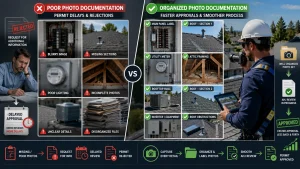
On the other hand, site survey photos often get treated as an afterthought. In reality, however, AHJs and plan reviewers actively use photos to verify roof conditions, panel layout feasibility, and equipment details. Consequently, blurry, missing, or disorganized photos regularly trigger requests for additional information — and sometimes outright solar permit rejections.
Fix it: Instead, treat photo documentation as seriously as your measurements. For instance, capture the main panel label, utility meter, all roof sections, attic framing when accessible, and any rooftop HVAC or existing equipment. Additionally, label each photo clearly and organize them before including them in your permit package. As a result, organized, high-quality photo sets noticeably speed up AHJ approval timelines.
Skipping Structural Assessment Consistently Invites Solar Permit Rejections
Furthermore, many solar installers rush past structural assessments, especially on residential re-roof projects. This is a critical oversight. Indeed, AHJs routinely reject permit packages that lack documentation supporting the roof’s load-bearing capacity. Without solid structural data, moreover, a PE engineer cannot accurately stamp your project.
Fix it: During the survey, therefore, assess rafter or truss spacing, member sizes, and overall roof condition. Also, flag any rot, damage, or atypical framing immediately. Subsequently, pass this data to your structural engineer so they can produce an accurate PE-stamped letter. As a result, a thorough structural assessment removes one of the most consistent triggers for solar permit rejections and prevents costly PE revision cycles.
Overlooking Utility Interconnection Data Creates Critical Permit Gaps
Meanwhile, site surveys that focus only on the physical install and ignore utility requirements create real problems downstream. Specifically, utility companies have metering and disconnect requirements that feed directly into your permit package. As a result, missing this information creates gaps that hold up both AHJ approval and interconnection processing simultaneously.
Fix it: Accordingly, during every solar site survey, record the utility provider, meter location, disconnect requirements, and available panel capacity. In addition, confirm net metering eligibility with the local utility. Not only does this information feed directly into your interconnection application, but it also aligns your permit package with AHJ requirements from the start — rather than scrambling to patch it later.
No Standardized Site Survey Checklist Means Inconsistent Solar Permit Packages
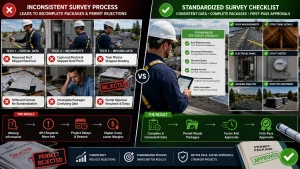
Above all, many solar permit rejections come down to team inconsistency. In fact, when every surveyor captures different data, your permit packages become unpredictable. For example, one technician measures pitch while another skips it entirely. Consequently, the result is incomplete submissions and unnecessary, avoidable rework that eats directly into your project margins.
Fix it: Therefore, build a standardized solar site survey checklist and enforce it across your full team. Include roof measurements, structural data, electrical details, shading analysis, photo requirements, and utility information. Moreover, a consistent process produces permit-ready packages every time. Ultimately, consistency is what separates teams that get first-pass approvals from teams stuck in resubmission cycles.
How EnergyScape Renewables Helps US Solar Installers Eliminate Solar Permit Rejections
At EnergyScape Renewables, we understand that solar permit rejections aren’t just paperwork headaches — they’re direct revenue losses. That’s exactly why, as a result, our team specializes in delivering PE-stamped structural letters, AHJ-compliant permit packages, and full interconnection support, all built on field-verified site survey data.
Furthermore, we work with solar installers and EPCs across the US to get permit submissions right the first time. Whether you manage high-volume residential projects or large-scale commercial installs, our technical team is built to keep your projects on schedule. In short, we help you get off the rejected pile and stay off it.
Ready, therefore, to take the frustration out of solar permitting? Additionally, pair your site survey workflow with a smarter project management platform. Check out Sunscape Solar — a CRM purpose-built for US solar installers and EPCs to manage permits, designs, and project pipelines all in one place.
sjayakanth@energyscaperenewables.com