
Top 10 Reasons Solar Permits Get Rejected in 2026
Solar Permit Rejections Are Quietly Killing Your Install Timeline
Every installer knows the feeling. The contract is signed, the crew is booked, and then the AHJ kicks the package back. Solar permit rejections remain one of the biggest hidden costs in the US market this year. Each correction cycle adds seven to twenty-one days. Meanwhile, your customer gets nervous and your revenue slides into the next quarter. Fortunately, these denials follow predictable patterns. Plan reviewers flag the same handful of errors over and over, so a tighter pre-submittal check solves most of them. Below, we break down the ten most common reasons permits get denied in 2026, plus what to fix before you hit submit.
The Top 10 Reasons Solar Permits Get Rejected in 2026
1. Incomplete Plan Sets and Missing Documents
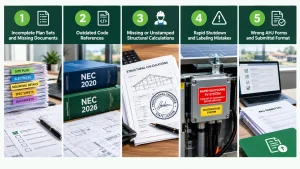
This is still the number one cause of solar permit rejections nationwide. Reviewers want a complete package on day one: site plan, electrical single-line, mounting details, spec sheets, and datasheets for every listed component. However, many submittals arrive missing a single attachment. The reviewer stops right there. Therefore, build a jurisdiction-specific checklist and confirm every document before upload.
2. Outdated Code References in the Solar Plan Set
Code adoption moves unevenly across the country. Some AHJs now enforce the 2026 NEC cycle, while others still sit on 2020. As a result, a plan set that references the wrong edition gets flagged immediately. Always verify the adopted code year with the building department first. In addition, list that edition clearly on your cover sheet so the reviewer sees it fast.
3. Missing or Unstamped Structural Calculations
Roof-mounted systems need proof the structure can carry the load. Many jurisdictions require PE stamped structural calculations covering dead load, wind, and snow. Without them, your solar permit application stalls. Furthermore, some counties reject out-of-state stamps outright. Because of this, confirm that your engineer holds an active license in that specific state before submitting anything.
4. Rapid Shutdown and Labeling Mistakes
Article 690.12 compliance still trips up experienced crews. Reviewers check module-level shutdown equipment, controller placement, and the exact wording on placards. Moreover, label size, color, and mounting location all matter. A missing rapid shutdown placard alone triggers a correction notice. Therefore, include a dedicated labeling sheet in every plan set and match it to the installed equipment.
5. Wrong AHJ Forms and Submittal Format
Each jurisdiction runs its own AHJ plan review process. Some use SolarAPP+ for instant approval, while others demand wet signatures and specific PDF layer settings. Consequently, solar permit rejections often happen for purely administrative reasons. Nothing about the design is wrong. Instead, the format is. Keep a living database of AHJ requirements, and update it every quarter.
6. Site Plan Errors, Setbacks, and Fire Access Pathways
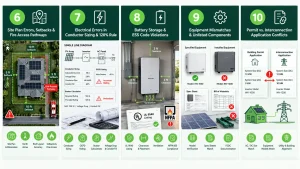
Fire code compliance draws heavy scrutiny in 2026. Reviewers measure ridge setbacks, perimeter pathways, and access clearances against IFC requirements. However, many site plans arrive without dimensions or a north arrow. Others show array layouts that conflict with the actual roof. For that reason, use accurate satellite or survey data and label every setback clearly on the drawing.
7. Electrical Errors in Conductor Sizing and the 120% Rule
Interconnection math causes a large share of solar permit rejections. Common flags include undersized conductors, incorrect OCPD ratings, and busbar calculations that violate NEC 705.12. Additionally, reviewers check voltage drop and conduit fill. Show your work on the single-line diagram. When calculations appear directly on the drawing, the reviewer approves faster and asks fewer questions.
8. Battery Storage and ESS Code Violations
Storage attachments now appear on most residential proposals. Unfortunately, ESS designs get denied for siting issues, missing UL 9540 listings, and NFPA 855 separation problems. Garage and interior installs face the tightest scrutiny. Therefore, document the battery’s listing, clearances, and ventilation on a dedicated sheet. Above all, verify local amendments, since many cities restrict indoor placement.
9. Equipment Mismatches and Unlisted Components
Supply chain swaps create paperwork chaos. Your plan set lists one inverter, but the crew installs another. Similarly, FEOC documentation requirements now add another layer of review on some projects. Reviewers cross-check model numbers against submitted spec sheets. Because of this, lock your bill of materials before the solar permitting process begins, and revise drawings whenever equipment changes.
10. Conflicts Between the Permit and Interconnection Application
Building departments and utilities do not talk to each other, yet they compare notes more often in 2026. A system size on the permit that differs from the interconnection application raises an instant red flag. Consequently, both packages get held. Therefore, assign one person to reconcile AC size, DC size, and equipment models across every submission.
How to Reduce Solar Permit Rejections Before Submittal
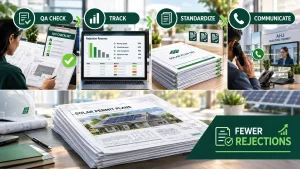
First, build a pre-submittal QA gate. One reviewer should check every package against an AHJ-specific checklist before it leaves your office. Next, track your rejection reasons in a spreadsheet or CRM. Patterns show up quickly, and the same three issues usually drive most of your delays. In addition, standardize your plan set templates so drafters stop reinventing sheets. Finally, keep direct contact with plan reviewers. A five-minute phone call often prevents a two-week correction cycle. These habits cut solar permit rejections sharply and protect your install calendar.
Cut Rejections With the Right Engineering Partner
Clean permits come from disciplined engineering, not luck. Energyscape Renewables delivers permit-ready plan sets, PE stamped structural and electrical calculations, and interconnection support across all 50 states. Our team tracks AHJ requirements, code adoption cycles, and jurisdiction quirks daily, so your packages land right the first time. In short, we handle the back office while your crews stay on roofs. We also support site surveys, permitting, and full BPO services for growing EPCs. Pair that with a purpose-built platform like Sunscape, and your permitting, project tracking, and installation pipeline finally run in sync. Ready to stop losing weeks to corrections? Let’s talk about your next batch of projects.
sjayakanth@energyscaperenewables.com