
Permit Approval Strategies: How Top EPCs Hit 90% First-Submission Approval Rates

Why Strong Solar Permit Approval Rates Decide Your Bottom Line in 2026
Every solar installer knows the sting of a rejected plan set. One missed code reference, one wrong detail, and your queue slot disappears. Meanwhile, your crew sits idle and your customer keeps waiting. Strong solar permit approval rates fix that pain at the source. In fact, top EPCs now hit 90% first-submission approval on purpose — not by luck. So this guide breaks down the exact strategies behind those numbers. As a result, you can stop losing cash to resubmissions and start protecting your pipeline.
The Real Cost of Weak Solar Permit Approval
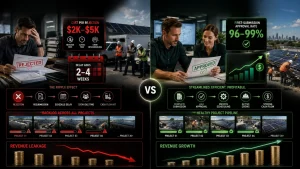
First, let’s talk money. A single permit rejection costs most US installers between $2,000 and $5,000. That figure covers revision fees, admin time, and crew rescheduling. However, it ignores the bigger hit. Each resubmission adds two to four weeks to your schedule. During that window, your crew either sits idle or jumps to another job. Consequently, one rejection creates a backlog across every active project. For an EPC running 30-plus jobs, that ripple gets expensive fast. So weak approval rates are a cash flow problem, not just a paperwork problem. By contrast, top engineering teams hold first-submission approval rates between 96% and 99%, while budget providers often fall below 80%.
5 Proven Solar Permit Approval Strategies for Top EPCs
The best teams don’t get lucky. Instead, they follow a repeatable playbook. Below are the five strategies that separate 90% performers from everyone still stuck in revision cycles. Each one is simple to adopt, and together they compound across your whole pipeline.
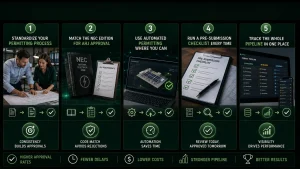
Strategy 1: Standardize Your Solar Permitting Process
Top performers treat permitting as a system, not a scramble. To start, they build template plan sets for each common system type. They also build separate templates for each high-volume AHJ. As a result, designers stop reinventing the wheel. Clean, code-ready drawings then sail through review. Moreover, fewer mistakes mean fewer resubmittals. And fewer resubmittals mean faster solar permit approval. In short, a repeatable solar permitting process is your first lever.
Strategy 2: Match the NEC Edition for AHJ Permit Approval
Next, watch your codes closely. NEC code mismatches cause roughly 30 to 40% of all solar permit rejections nationwide. Here’s the catch: the same template can pass in one state and fail in the next. California enforces NEC 2026 right now. Meanwhile, many North Carolina jurisdictions still reference the 2020 NEC. Therefore, confirm the edition in force for every new jurisdiction. Do it every single time. This habit alone lifts your AHJ permit approval rate.
Strategy 3: Use Automated Permitting Where You Can
Automation is reshaping the game in 2026. SolarAPP+, the NREL-built platform, issues instant permits for code-compliant residential systems. On average, those projects get permitted and inspected 13 days sooner than traditional ones. California leads adoption, and Houston runs it for systems under 25 kW. So where it’s available, use it. Beyond SolarAPP+, AI-assisted plan review is spreading fast. Many AHJs now screen submissions with software first. Thus, clean, structured plan sets score higher and improve your solar permit approval odds.
Strategy 4: Run a Pre-Submission Checklist Every Time
Now for the most controllable variable. A simple checklist catches the errors that trigger solar permit rejections. Before any package leaves your desk, verify a few core items. Every sheet needs a consistent title block. List the project address, APN, designer license number, and revision date. Name the exact NEC edition too. In addition, confirm your structural calculations and PE stamps match local rules. For commercial and battery jobs, build in FEOC documentation. Run it, and your solar permit approval improves on the very next submittal.
Strategy 5: Track the Whole Pipeline in One Place
Finally, visibility ties everything together. You can’t fix what you can’t see. When dozens of projects move through utility queues at once, scattered spreadsheets fail you. Instead, top EPCs track every milestone in one dashboard. They monitor permit status, resubmission deadlines, AHJ notes, and interconnection steps together. That single view is the difference between a four-week PTO and an eight-week one. Ultimately, organized teams approve faster because nothing slips through the cracks.
Bringing It All Together for Consistent Solar Permit Approval
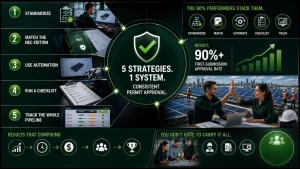
So here’s the bottom line. None of these five strategies works in isolation. Instead, the 90% performers stack them. They standardize their plan sets, match every NEC edition, lean on automation, run a checklist, and track the full pipeline. Over time, those habits compound into a real competitive edge. Therefore, consistency beats one-off wins every single time. Still, building this engine in-house takes licensed PEs, code expertise, and the right software. That’s a heavy lift for a growing team. Fortunately, you don’t have to carry all of it yourself.
How EnergyScape Renewables Powers 90% Solar Permit Approval
You don’t have to build all of this alone. EnergyScape Renewables delivers PE-stamped, NEC 2026-compliant plan sets across all 50 states. Residential turnaround runs 15 to 24 hours, while commercial work ships in 24 to 48 hours. More importantly, their team holds a 99% first-submission AHJ approval rate across 188,000-plus completed projects. Every package includes structural and electrical stamps, FEOC documentation, and interconnection details. As a result, you skip the local PE hunt and preventable rejection cycles. To manage the operations side, pair that engineering with Sunscape Solar, a CRM built for US installers and EPCs. Together, they cover both the engineering precision and the pipeline visibility your team needs. So you can finally treat solar permit approval as a system you control.
Frequently Asked Questions
What is a good solar permit approval rate for EPCs?
A strong first-submission approval rate sits between 96% and 99%. Top EPCs aim for at least 90% on the first try. Anything below 80% usually signals a process or code problem worth fixing fast.
Why do solar permits get rejected most often?
NEC code mismatches drive 30 to 40% of all solar permit rejections nationwide. Missing sheets, wrong title blocks, and absent structural calculations follow close behind. Fortunately, a pre-submission checklist catches most of these errors.
How much does a solar permit rejection cost?
Each rejection costs US installers roughly $2,000 to $5,000. That covers revision fees, admin time, and crew rescheduling. On top of that, resubmissions add two to four weeks to your project timeline.
Does SolarAPP+ improve solar permit approval speed?
Yes. SolarAPP+ issues instant permits for code-compliant residential systems, and those projects finish about 13 days sooner. However, adoption varies by state, so always confirm availability in your AHJ first.
How does outsourcing improve my AHJ permit approval rate?
Specialized engineering partners deliver NEC 2026-compliant, PE-stamped plan sets built for each jurisdiction. As a result, you avoid template errors and code mismatches. That precision is exactly how firms maintain a 99% first-submission approval rate.
sjayakanth@energyscaperenewables.com