
Solar Permit Submission Checklist for Multi-State EPCs: What to Verify Before Every Submittal

Are Permit Rejections Quietly Draining Your Multi-State Solar Pipeline?
Running solar permits across multiple states is one of the hardest operational challenges any EPC faces. You nail the install side. Crews are trained, your pipeline is full, and customers are ready to move. Then a solar permit package comes back flagged — missing a structural letter, citing the wrong NEC edition, or carrying a PE stamp format the jurisdiction won’t accept. Just like that, your timeline shifts two to three weeks. The crew sits. Your customer calls. Your margin takes a hit.
The solar permit submission checklist you use before every submittal is the most controllable variable in this process. For multi-state solar EPCs managing volume across different jurisdictions, first-attempt approval isn’t a luxury — it’s a financial strategy. Therefore, this blog walks you through what to verify before any permit package leaves your desk, regardless of the state or AHJ on the receiving end.
Confirm AHJ-Specific Requirements First — Every Single Time
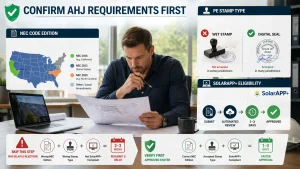
This is the step most growing EPCs skip when they’re moving fast. They pull the permit package template that worked in their last three markets and fire it off to the new jurisdiction. Sometimes it clears. Often, it doesn’t.
Every AHJ has its own solar permit requirements. Before any submittal, confirm the following directly with the AHJ:
Which NEC edition the jurisdiction currently enforces. In 2026, NEC adoption remains fragmented across the country. California actively enforces NEC 2026. Most North Carolina jurisdictions still reference NEC 2020 with state amendments. Submitting a plan set built to the wrong code edition is one of the fastest ways to trigger a resubmission cycle.
Whether the AHJ accepts a wet stamp or a certified digital PE seal. This one trips up out-of-state EPCs regularly. Texas has no statewide PE stamp framework — requirements shift city by city. Florida requires a PE stamp on virtually every installation. Submitting a digital seal to a jurisdiction that requires wet ink burns weeks on a package that was otherwise ready to go.
SolarAPP+ eligibility for your target jurisdiction. Florida, Texas, and Arizona process many residential permits in one to three business days through automated tools. Your plan set needs to comply with that platform’s requirements — not just general AHJ standards — if SolarAPP+ is active there.
Verify Your Solar Permit Plan Set Against NEC 2026
More jurisdictions adopt NEC 2026 every month. If your plan set templates haven’t been reviewed against the 2026 code cycle, they’re creating compliance risk on every new submittal.
The 2026 NEC introduced several field-level changes that directly affect solar permit drawings. Section 690.4(G) added a rounding rule that impacts PV system calculations. Updated Isc calculation requirements affect conductor sizing under NEC 690.8. Arc-fault and rapid shutdown labeling standards have also evolved. Moreover, inspector-facing label placements are increasingly tied to what AHJ reviewers see in mobile review tools.
For multi-state solar EPCs, a single outdated plan set template creates a real liability. The correction cycle cost alone — $2,000 to $5,000 per rejected project, before crew rescheduling — adds up fast across a high-volume pipeline.
Check PE Stamp Documentation Before Submission

PE stamp errors are among the most preventable causes of solar permit rejection. Nevertheless, they remain one of the most common mistakes EPCs make. Before submitting any permit package, verify three things.
First, confirm the stamping engineer holds a current PE license in the project state. A multi-state PE licensing network covers this automatically. However, if you’re coordinating locally, confirm licensure status before your team builds the package around that engineer.
Second, match the stamp format to what the AHJ actually requires. A certified digital seal uses a cryptographic certificate tied to the engineer’s verified identity. A basic image of a seal dropped onto a PDF doesn’t meet the standard most jurisdictions now enforce. That distinction has caught experienced EPCs off guard in 2026.
Third, include both structural and electrical stamps when the project requires them. California requires structural PE stamps for rooftop systems over 10 kW and electrical stamps above 50 kW. Missing either one on a larger commercial system sends the whole package back.
Include Interconnection Documentation Early in the Solar Permit Checklist

One of the biggest shifts in solar permit submission requirements for 2026 is timing. Many utilities — especially in California, Texas, and New England — now expect interconnection application numbers referenced directly on the permit plan set before AHJ approval. EPCs who wait until after permit approval to file interconnection applications build avoidable delays into their own workflows.
High-volume EPCs now submit interconnection applications in parallel with the permit package. That overlap alone can shave four to six weeks off a project’s close-to-PTO timeline. For commercial projects chasing the ITC safe harbor construction deadline of July 4, 2026, that time simply isn’t recoverable after the fact.
Add Battery Storage and FEOC Documentation When Applicable
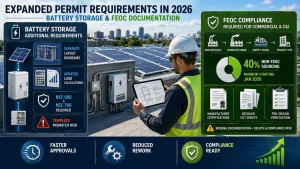
Battery storage projects require two additional documentation items that regularly trip up multi-state EPCs in 2026.
Battery systems need separate layout diagrams, updated load calculations, and NEC 706 references alongside NEC 690. AHJ reviewers flag battery integrations that rely on standard residential solar plan set templates without these additions. Don’t assume your existing template covers it.
For commercial and C&I projects, FEOC compliance documentation now belongs in every permit package. Starting January 2026, commercial systems must source at least 40% of manufactured product value from non-FEOC suppliers — a threshold that rises annually. Build FEOC verification into your pre-design checklist. Cut sheets without manufacturer certifications will create problems downstream, even if the AHJ doesn’t flag them at submission.
How EnergyScape Renewables Helps Multi-State EPCs Stay Ahead
For EPCs managing solar permit submissions across multiple states, doing this piecemeal carries a real operational cost — local PE searches on every new market, code verification on every jurisdiction, and revision cycles when something doesn’t match.
EnergyScape Renewables solves the multi-state solar permitting problem end to end. Their engineering team delivers PE-stamped structural and electrical plan sets with 15 to 24-hour turnaround for residential projects and 24 to 48 hours for commercial work, across all 50 states. Every plan set follows NEC 2026 standards, and FEOC documentation gets built into every commercial package. With a multi-state PE licensing network, you never search for a local engineer again. Their 99% AHJ first-submission approval rate and 188,520+ completed projects make EnergyScape the right partner for EPCs who can’t afford rejection cycles.
Once your permits are moving, Sunscape Solar keeps your entire project pipeline visible — from permit submission and interconnection application through AHJ inspection, meter upgrade, and PTO. No manual handoffs. No dropped milestones. One platform built specifically for US solar installers and EPCs.
sjayakanth@energyscaperenewables.com