
Wet Stamp vs Digital PE Seal for Solar Permits: What Each State Actually Requires in 2026

Your Solar PE Stamp Format Determines Your Permit Timeline
You’ve built a clean permit package. Your client is ready to move. Yet, two weeks later, the AHJ sends it right back — wrong stamp format. That scenario plays out across the country every single day. Not surprisingly, permit rejections cost anywhere from $2,000 to $5,000 per project. That’s before crew rescheduling and client delays factor in. For solar installers and EPCs, getting the right solar PE stamp format is no longer optional. Moreover, in 2026, this one detail directly controls your approval timeline and your project margins. Fortunately, the fix is straightforward — once you know exactly what each state requires. This guide breaks down both options clearly. It also shows you what to verify before your next AHJ submittal.
What Is a Wet Stamp Solar Plan Set?
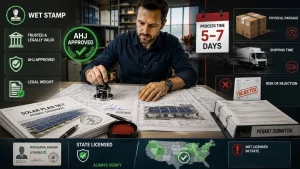
First, let’s cover the basics. A wet stamp solar plan set carries a physical inked or embossed PE seal on paper drawings. A licensed Professional Engineer reviews the design first. Then, they apply their seal alongside a handwritten signature and date. That combination is what AHJs have trusted for decades. Furthermore, a wet stamp solar submission carries real legal weight — especially in jurisdictions with older permitting infrastructure.
However, wet stamping has notable drawbacks. Traditional packages can take 5 to 7 business days. That includes physical preparation and overnight shipping. For high-volume EPCs managing multiple active projects, those delays add up quickly. Additionally, if the stamping engineer isn’t licensed in the specific project state, the stamp is worthless. The AHJ will reject it outright. Therefore, always verify active state licensure before you build your permit package around any engineer. In short, wet stamps remain the gold standard in several states — but they’re not always the fastest path forward.
How the Certified Digital Seal Actually Works
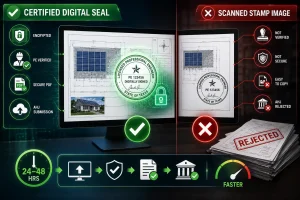
More jurisdictions now accept a digital PE seal solar submission every year. In fact, some actively prefer it. A certified digital seal applies the engineer’s stamp electronically to a PDF. Specifically, it includes a cryptographic certificate tied to the engineer’s verified identity. That distinction matters far more than most installers realize.
A basic image of a stamp dropped onto a PDF does not meet the standard most jurisdictions now enforce. As a result, that detail has caught even experienced EPCs off guard in 2026. Therefore, when you request a digital seal, always confirm you’re receiving a certified version — not just a scanned image placed on the file.
The time savings are also significant. Digital PE seal solar submissions typically arrive in 24 to 48 hours. Compared to wet stamps, that’s a major difference across a busy project pipeline. Consequently, more solar companies are shifting to digital-first workflows wherever their AHJs allow it.
Solar PE Stamp Requirements by State in 2026
There is no single national standard. Instead, each AHJ sets its own rules. Here is where the major markets currently stand.
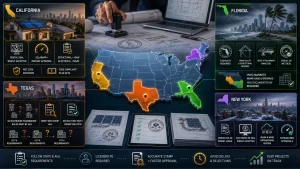
California: Tiered Thresholds and Fast Digital Approvals
California generally accepts digital PE seals across most jurisdictions. Structural solar PE stamps apply to rooftop systems exceeding 10 kW. Similarly, electrical stamps are required for systems over 50 kW. Below those thresholds, many jurisdictions process permits through SolarAPP+, which issues near-instant approvals for eligible residential systems. Additionally, NEC 2026 is now actively enforced statewide. Therefore, plan sets built to older code editions will trigger resubmission cycles — and that’s a costly delay you can easily avoid.
Florida: Engineering Review Required on Every Installation
Florida is the strictest solar permit market in the country. Under Florida Building Code requirements, a licensed Florida PE must review and stamp virtually every solar installation. Wind uplift calculations, roof attachment analysis, and structural assessments must all carry that seal. Moreover, HVHZ markets — Miami-Dade and Broward counties — add NOA documentation requirements on top.
Most Florida jurisdictions do accept digital seals. Nevertheless, always confirm before you submit. Specifically, sending a digital seal to a jurisdiction that still requires wet ink can cost you two to three weeks on a package that was otherwise ready to go.
Texas: No Statewide Framework — Verify With Every AHJ
Texas remains the most unpredictable market of all. Because there is no statewide solar PE stamp requirement, rules shift city to city. Austin and Houston move most residential permits quickly. Other jurisdictions, however, apply much stricter standards. Consequently, you must verify with the specific AHJ on every single Texas job — no exceptions. SB1202 also gives installers a state-approved third-party permitting pathway when a difficult AHJ creates unnecessary bottlenecks.
New York: Streamlined Permits and Broad Digital Acceptance
New York has streamlined approvals through its Unified Solar Permit for systems under 25 kW. As a result, electronic PE stamp AHJ submissions are widely accepted across the state. However, NYC and upstate jurisdictions with heavy snow and wind exposure still require full engineering review. Therefore, skipping the engineer on a Northeast project remains one of the fastest ways to earn a rejection.
Wet Stamp vs Digital PE Seal: Making the Right Call Every Time
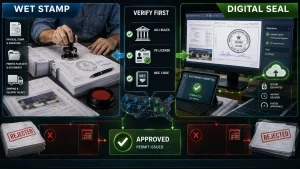
The choice between a wet stamp solar submission and a digital PE seal isn’t about preference. Instead, it’s entirely about what your specific AHJ actually requires. Before any submittal, verify three things. First, confirm the stamp format the AHJ accepts. Second, verify that your engineer holds an active PE license in the project state. Third, confirm whether the jurisdiction enforces NEC 2023 or NEC 2026 — because submitting to the wrong code edition also triggers its own correction cycle. Above all, never assume that what worked in your last market will work in the next one. Requirements vary far more than most installers expect.
How EnergyScape Renewables Handles Your Permit Package
Indeed, this is where EnergyScape Renewables eliminates the guesswork for solar installers and EPCs nationwide. Their engineering team holds active PE licenses across all 50 states. Moreover, they deliver PE-stamped structural and electrical plan sets in 15 to 24 hours for residential projects and 24 to 48 hours for commercial work. Wet stamp or digital seal — EnergyScape matches exactly what your jurisdiction accepts. Furthermore, their 99% first-submission AHJ approval rate across 188,520+ completed projects reflects one thing clearly: they already know what your AHJ expects before you ever submit.
For installers who want to manage every project from proposal to PTO in one place, Sunscape Solar connects directly to your engineering workflow. Specifically, it keeps every deadline, document, and project status organized in real time. So, stop letting stamp format errors push your timelines back. Work with a partner who already knows the rules — and get your next permit package built right from the start.
sjayakanth@energyscaperenewables.com