
Best Solar CRM in 2026: Pipeline Visibility From Lead to PTO

Choosing a Solar CRM in 2026: Pipeline Visibility From Lead to PTO
For years, buying a solar CRM was a sales decision. How fast can reps build a proposal? Does it push financing? Can the owner see a leaderboard on Monday? That checklist is now out of date — and the reason has nothing to do with software.
Federal policy moved the finish line. Your CRM needs to move with it.
Why did the July 4 deadline split your pipeline in two?
The One Big Beautiful Bill Act ended Section 25D, the credit homeowners claimed directly, for systems placed in service after December 31, 2025. What survived is Section 48E — accessed through leases and PPAs, where the financing company claims the credit, not the homeowner and not the installer.
That credit runs on a clock. Projects beginning construction after July 4, 2026 must be placed in service by December 31, 2027. Projects that started earlier get room: place them in service within four calendar years of the start year, and the continuity requirement is satisfied automatically.
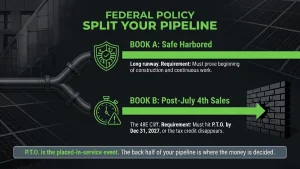
So every US installer now carries two books of business:
- Book A — safe harbored. Long runway, but you must prove beginning of construction and continuous work.
- Book B — sold after July 4. PTO by year-end 2027, or the credit disappears.
Here’s the connection most buyers miss. Permission to operate is the placed-in-service event. Not the signature. Not the install crew driving away. PTO. The back half of your pipeline is now where the money gets decided.
What does a solar CRM actually need to do now?
A solar CRM is a platform whose pipeline stages match the solar project lifecycle and end at PTO, not at contract signing. That single definition separates the tools that will survive 2026 from the ones that won’t.
Most teams still run sales in a CRM, then hand the project to a spreadsheet, a shared inbox, or a project manager living in email. That handoff always cost money. Now it’s a compliance gap.
Ask your operations lead three questions. If they can’t answer in a minute, you own a sales tool, not a system of record.
- How many backlog projects are safe harbored, and how many race a 2027 deadline?
- Which AHJ and which utility hold the most days right now?
- Could you produce the full milestone trail for one address today, without digging through Dropbox?
Where do the days actually disappear?
The numbers make this case better than any pitch.
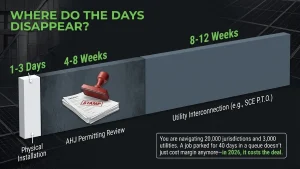
NREL points to sheer fragmentation as the root cause. Reviews spread across roughly 20,000 jurisdictions and 3,000 utilities add weeks or months — and longer waits raise cancellation risk, pushing cost onto the deals that do close. You can review the federal data on NREL’s permitting and interconnection timelines page.
A typical residential job runs 60 to 120 days from contract to a live system. The physical install takes one to three days. Permitting alone often runs four to eight weeks, and inspection plus interconnection adds two to four more.
Automation helps where it exists. NREL found SolarAPP+ cut permit review from as many as 20 business days to zero, with those projects installed 12 days faster than traditional review.
Interconnection remains the wall. In California, installer-reported SCE PTO timelines stretch to 8–12 weeks, and CPUC data cited by CALSSA shows Rule 21 compliance as low as 27–45% on some review steps.
Now read that against a 2027 cliff. A job parked 40 days in an AHJ queue used to cost margin. Next year, it can cost the credit that made the deal pencil.
How should you evaluate a solar CRM in 2026?
Skip the feature list. Judge every platform on these eight questions.
- Does the pipeline end at PTO, or at “closed won”?
- Are the stages real milestones — survey, design, PE stamp, permit submitted, permit approved, install, inspection, interconnection, PTO?
- Can you report by AHJ and utility? You can’t fix a bottleneck you can’t group by.
- Does it flag safe-harbored versus non-safe-harbored projects?
- Does it surface days-in-stage? A job sitting 30 days in “permit submitted” should be loud.
- Does it track rejections and resubmittals? Every correction cycle repeats the queue.
- Does the document trail live on the project record — plan sets, stamps, applications, the PTO letter?
- Does it connect to the engineering work, or just watch it?
That last question separates a dashboard from an operating system.
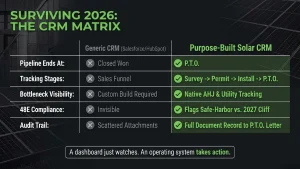
Generic CRM vs. purpose-built solar CRM
| Generic CRM (HubSpot, Salesforce) | Purpose-built solar CRM | |
|---|---|---|
| Pipeline ends at | Closed won | PTO |
| Stages | Sales stages | Survey → design → stamp → permit → install → inspection → PTO |
| AHJ / utility | Custom field, if you build it | Native record |
| Documents | Attachments | Audit-ready trail |
| Engineering status | Invisible | On the record |
Generic CRMs aren’t bad software. They simply don’t know what a site survey is. Teams that force them into solar workflows report burning months and real consulting budgets rebuilding what a solar platform ships with.
Why visibility alone won’t save the deal
Every CRM has one honest limit. It tells you a project sits in permitting. It doesn’t unstick it.
That’s the gap Sunscape closes. Sunscape isn’t a pipeline board bolted onto a sales tool. It’s the system of record for the full lifecycle — from the site survey app in the field to the PTO letter at the end.
And Energyscape Renewables runs the stages in between: plan sets, PE stamping across all 50 states, permit submissions, AHJ follow-ups, interconnection applications, and PTO — all tracked inside Sunscape. One platform shows you the days. One team takes them back.
Installers working this way have 4X’d monthly throughput without adding headcount, at a 99% AHJ and utility approval rate. That matters most when a single first-pass rejection can push a project past a deadline that never moves. For more on where those days leak, read our breakdown of solar soft costs in 2026.
See your pipeline all the way to PTO
Book a Sunscape demo and watch one project travel from lead to PTO inside a single record — survey, design, stamp, permit, inspection, interconnection, done. No spreadsheet. No guessing which utility ate your quarter.
Then talk to Energyscape Renewables about the stages costing you the most days. Plan sets, 24-hour PE stamping nationwide, permit submissions, AHJ follow-ups, interconnection, PTO — handled by the team behind that 99% approval rate.
Sunscape shows you where the time goes. Energyscape gets it back. In 2026, that’s the whole game.
Informational only — not tax or legal advice. Consult your tax advisor on 48E eligibility and placed-in-service questions.
Frequently Asked Questions: Solar CRM
Is PTO the placed-in-service date for the solar ITC?
For most distributed projects, yes. A system isn’t placed in service until the utility authorizes it to operate. That makes PTO — not the install date — the milestone your solar CRM must track. Confirm specifics with your tax advisor; see IRS Notice 2025-42.
Can I run a solar company on HubSpot or Salesforce?
You can, but you’ll build the solar pipeline yourself: permitting stages, AHJ tracking, utility milestones, document trails. Most teams spend months and significant budget recreating what a purpose-built solar CRM already includes on day one.
What should a solar CRM track after the July 4, 2026 deadline?
Track beginning-of-construction evidence, safe-harbor status per project, days-in-stage by AHJ and utility, permit rejections and resubmittals, and a complete document trail through PTO. Anything less leaves your backlog exposed.
sjayakanth@energyscaperenewables.com