
Do You Need a Separate Permit to Add a Battery to Existing Solar?

Solar Battery Permit Basics: Why Retrofits Trip Up Installers
Your customer already has solar, and now they want backup power. Naturally, you want a fast, clean install. However, many crews assume the original PV permit covers the new battery. In fact, it rarely does, so that mistake often leads to failed inspections, delayed PTO, and frustrated homeowners. In nearly every U.S. jurisdiction, you’ll need a new solar battery permit before storage goes on the wall. Fortunately, the fix is simple. First, learn what your AHJ and utility expect. Then, submit a complete package the first time. Below, we cover the codes, approvals, and steps that keep every battery retrofit moving.
Is a Solar Battery Permit Required to Add Storage to Existing Solar?
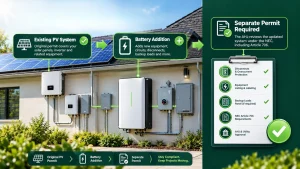
In short, yes. Industry permitting guidance treats a battery addition as a material change to the home’s electrical system under the National Electrical Code. As a result, the AHJ reviews it as new work. Moreover, a retrofit needs its own permit application, because the original approval can’t absorb the battery scope.
Why the Original PV Approval Doesn’t Cover Storage
Your first permit approved one specific design. For example, that design listed the modules, inverter, conductors, overcurrent protection, and single-line diagram. A battery, however, adds new equipment, new circuits, and often a backup loads panel. Consequently, the inspector needs to see how everything works together. Additionally, NEC Article 706 brings its own rules for disconnects, equipment listing, and labeling. Since the old package never addressed those rules, a separate solar battery permit becomes necessary.
Three Approvals Behind Every Storage Retrofit
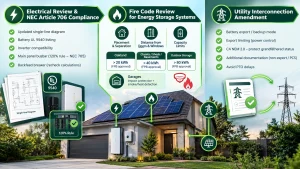
Most retrofit jobs touch three separate approval tracks. Typically, a solar battery permit package includes an electrical permit, a building or fire review, and a utility interconnection amendment. Still, the exact mix depends on the jurisdiction and system size. So, let’s break each one down.
1. Electrical Review and NEC Article 706 Compliance
The electrical side carries the most weight. Therefore, your plan set should show an updated single-line diagram, the battery’s UL 9540 listing, and inverter compatibility. In addition, reviewers check the main panel busbar against the 120% rule under NEC 705. If the battery adds a backfeed breaker, that math changes fast.
Notably, AHJs handle paperwork differently. Some issue a standalone ESS permit on top of the original electrical permit. Others, by contrast, accept the solar battery permit as one combined application. For this reason, always confirm the format before you build the package.
2. Fire Code Review for Energy Storage Systems
Fire officials, on the other hand, care about where the battery sits. Specifically, NFPA 855 and IRC Section R328 limit capacity, placement, and separation from doors and windows. For instance, Oakland requires Fire Prevention Bureau approval when a single battery exceeds 20 kWh. Likewise, approval applies when total storage tops 40 kWh in closets, sheds, or basements, or when outdoor storage reaches 80 kWh. Similarly, many garages need impact protection and smoke or heat detection. That’s why fire placement checks belong in your solar battery permit planning, not on install day.
3. Utility Interconnection Amendment
Also, don’t forget the utility. The homeowner’s current agreement covered a solar-only system. Once a battery can export, run in backup mode, or limit exports, though, the utility sees a different system. For example, California customers on legacy NEM 2.0 tariffs need careful design to protect grandfathered status. Meanwhile, non-export or power control system setups may need extra documentation. Even with an approved solar battery permit, a skipped amendment can stall PTO for weeks.
How SolarAPP+ Speeds Up Your Solar Battery Permit
Here’s some good news for 2026. SolarAPP+ now offers a Storage Only module for battery-only installs and batteries added to existing solar, including NEM 2.0 retrofits. Better yet, local governments pay nothing to turn it on. In fact, cities are already moving. For instance, El Cajon, California, made ESS additions eligible through SolarAPP+ starting January 2026.
However, coverage isn’t universal yet. Instant solar battery permit approval only works where the AHJ has enabled the storage module. So, verify your jurisdiction before you promise a customer same-day approval.
Common Mistakes That Delay Storage Retrofits
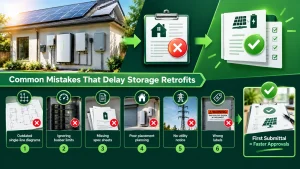
Even experienced teams get rejections. Above all, watch for these issues when you submit a solar battery permit:
- Outdated single-line diagrams. Reviewers often reject drawings that don’t match the existing install.
- Ignoring busbar limits. Unfortunately, a battery breaker can push the panel past its rating.
- Missing spec sheets. Likewise, every new component needs its listing and certification on file.
- Poor placement planning. Especially in garages and egress paths, fire code limits are strict.
- No utility notice. Consequently, installing without an interconnection update risks PTO problems.
- Wrong labels. Finally, NEC 706 and 690 labeling errors are an easy inspection fail.
Each mistake costs you a resubmittal, a truck roll, or both. In contrast, a clean first submittal protects your margin and your reputation.
Best Practices for a Faster Solar Battery Permit
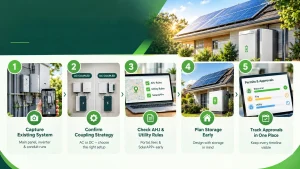
Want a smoother approval process? If so, start with these steps.
1. Capture the existing system in detail. First, photograph the main panel, inverter label, and conduit runs during the site survey. As a result, accurate field data prevents redesigns later.
2. Confirm the coupling strategy. Next, choose the right setup. AC-coupled batteries generally suit retrofits with string inverters. On the other hand, DC-coupled systems may require a hybrid inverter swap, which expands your permit scope.
3. Check AHJ and utility rules early. Then, look up portal requirements, fee schedules, and SolarAPP+ eligibility before design starts.
4. Plan storage into the first job. Similarly, when customers expect to add storage within a year, design the initial plan set with the battery in mind. Later, the amendment becomes far simpler.
5. Track every approval in one place. Finally, remember that electrical, fire, and utility timelines move separately. Without central tracking, one stalled approval can quietly hold up the whole job.
How EnergyScape Renewables Simplifies Every Solar Battery Permit
Battery retrofits are among the fastest-growing jobs in residential solar. Still, each one brings new code checks, fire reviews, and utility paperwork. That’s exactly where EnergyScape Renewables helps. Our team delivers permit-ready plan sets, PE stamping, ESS permitting, and interconnection support across all 50 states. Moreover, we build each package around NEC 706, NFPA 855, and your local AHJ’s checklist. As a result, your crews spend less time on corrections and more time on installs.
Furthermore, we pair our engineering work with smart project tracking. For example, installers and EPCs can manage permits, inspections, and PTO milestones inside Sunscape, a solar CRM built for U.S. solar teams. Together, these tools give you clear visibility from site survey to final approval.
So, ready to speed up your next battery retrofit? Contact EnergyScape Renewables today, and get your solar battery permit package right the first time.
sjayakanth@energyscaperenewables.com