
SGIP for Solar Installers: 2026 Budgets & Caps Guide

SGIP for Solar Installers: California’s #1 Battery Incentive Guide (2026)
SGIP for solar installers has become the single most important incentive program in California. The 30% federal Residential Clean Energy Credit expired on December 31, 2025. No federal backstop. No ITC to anchor your storage pitch. Right now, the Self-Generation Incentive Program (SGIP) is the most powerful financial tool available to California solar installers and EPCs running battery storage projects. However, SGIP is also the most complex program in the state. Budget steps close fast. Documentation errors kill reservations. Developer caps catch high-volume operations off guard. This guide breaks down exactly what you need to know to run SGIP projects efficiently in 2026.
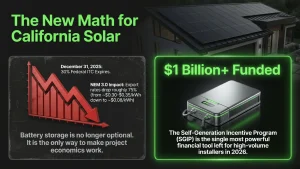
Why SGIP Is California’s Most Important Solar Incentive in 2026
The California Public Utilities Commission (CPUC) has funded SGIP with over $1 billion since the program launched in 2001. However, 2026 marks a turning point. The federal ITC is gone for residential installs. Meanwhile, NEM 3.0 cut solar export rates by roughly 75% compared to NEM 2.0 — dropping from around $0.30–$0.35/kWh down to approximately $0.08/kWh on average. That means battery storage is no longer optional for California solar projects. It is what makes the economics work.
SGIP covers that storage cost directly. Incentives range from $150 per kWh at the general market level all the way to $1,100 per kWh for qualifying households. That spread translates to the difference between covering 15% of a system cost and covering 100% of it. Same installation. Completely different project economics — all based on which budget category you place your customer in.
For solar installers and EPCs, this is where the competitive edge lives. Knowing the program is not enough. You need to operate it at scale.
Understanding SGIP for Solar Installers Budget Categories.
SGIP runs across four Program Administrators: Pacific Gas & Electric (PG&E), Southern California Edison (SCE), San Diego Gas & Electric (SDG&E, administered by the Center for Sustainable Energy), and SoCalGas. Each PA manages its own budget independently. As a result, funding availability differs by territory and by category. Here is a practical breakdown of each budget:
General Market ($150/kWh) This tier is open to most customers regardless of income or location. Incentives sit at roughly $150 per kWh. Therefore, a 13.5 kWh battery generates about $2,025 — covering around 15% of a typical install. This is also the tier where the developer cap applies most aggressively. More on that in the next section.
Equity Budget ($850/kWh) This tier targets customers at or below 80% of Area Median Income (AMI), or those in Disadvantaged Communities as defined by CalEnviroScreen. At $850 per kWh, a 10 kWh battery generates an $8,500 rebate. In many cases, that covers most or all of the installation cost. Income verification is required upfront — through CARE, FERA, DAC-SASH, ESA enrollment, or direct AMI documentation.
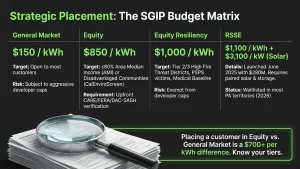
Equity Resiliency Budget ($1,000/kWh) This is the top residential tier. It targets customers in Tier 2 or 3 High Fire Threat Districts, those who have experienced multiple PSPS events, or those with Medical Baseline status. A 10 kWh system under this category generates a $10,000 rebate — often making the battery essentially free when stacked with other programs. Importantly, both the Equity and Equity Resiliency budgets are exempt from the developer cap. That is a critical distinction for high-volume installers.
Residential Solar and Storage Equity — RSSE ($1,100/kWh + $3,100/kW for solar) Launched in June 2025 with $280 million in state funding, the RSSE budget requires solar and battery to be installed together. It targets low-income customers and carries the highest incentives in SGIP history. Additionally, the RSSE Advanced Payment Program allows approved developers to receive 50% of the project incentive upfront — before installation is complete. As of early 2026, most PA territories have the RSSE budget on waitlist. Still, waitlist positions do open up through project attrition. Therefore, submitting applications now is still worth the effort.
The SGIP Developer Cap: What High-Volume Installers Must Track
This is where many established California installers get burned. Under SGIP general market budgets, any single developer is capped at 20% of available incentive funding per budget step. The cap is calculated separately across the Small Residential Energy Storage Budget, the Large Scale Energy Storage Budget, and the Generation Budget.
On the Advance Payment Program (APP) side, the limits are equally sharp. Developers without an Investment Grade Credit (IGC) rating are capped at $1 million statewide. With an IGC rating, that limit rises to $5 million statewide, with a $2 million cap per PA for CSE, SCG, and LADWP.
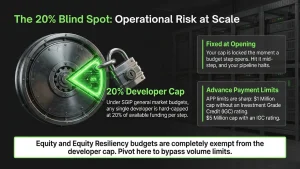
Furthermore, the developer cap is fixed the moment a budget step opens. Even if total available funds shift after opening, your cap stays locked in for that step. Any active application that has not reached ICF Pending Payment status counts toward your cap total.
If you are running high volume across California, you need real-time visibility into your reservation totals — not end-of-month reports. Hitting the cap mid-step means no new reservations until the next step opens. In a competitive environment, that is a significant operational risk.
Documentation Requirements That Make or Break Your Reservation
SGIP applications are funded in the order they are received. Incomplete packages lose their place in line. Here is what you need to have ready before you submit:
For Equity category applications, customers must provide income documentation showing household income at or below 80% AMI. Alternatively, they can provide proof of enrollment in CARE, FERA, DAC-SASH, ESA, MASH, SASH, or SOMAH programs.
For Equity Resiliency, you also need fire district verification or documented PSPS event history. Medical Baseline applicants must submit medical certification along with program enrollment confirmation.
On the technical side, your permit package must be complete and AHJ-compliant at submission. A plan set with missing details or non-compliant specifications can cause rejection at review. In a lottery scenario — which triggers whenever daily applications exceed available funds in a step — rejected applications are not carried over. They must reapply in the next funding step.
Also worth noting: in February 2026, the CPUC issued a ruling requiring all Program Administrators to collect additional cost verification documentation for RSSE projects above certain thresholds. This adds a layer of review that did not exist before. Submitting clean, complete packages from the start is more important now than ever.
For performance compliance, every installed system must complete a minimum of 52 full discharge cycles per year and maintain operational status at the installation site for 10 years. This affects how you size systems and configure monitoring from day one.
How to Close the Gap Between Site Visit and SGIP Submission
The biggest operational risk in SGIP work is the gap between your field tech finishing a site visit and your team submitting a completed application. Budget steps can close within days of opening. That means days of back-and-forth between field and office directly translates to missed reservations.
Sunscape is your solar project management tool built specifically for US solar installers and EPCs. It guides field techs through a structured data collection process — capturing roof specs, electrical details, shading notes, and photo sets — and feeds that data directly into permit package components. As a result, the time from site visit to submittable application shrinks from days to hours.
Energyscape Renewables delivers AHJ-compliant solar engineering, PE-stamped plan sets, and permit packages across all 50 states with 24-hour turnaround. When your SGIP reservation window is open and a budget step is filling up, fast and compliant engineering is not optional — it is the difference between securing a reservation and reapplying in the next step.
Together, Sunscape and Energyscape give California solar installers a complete field-to-permit pipeline that moves at the speed SGIP demands.
Let’s get started with Energyscape Renewables Now, Call us now at +1 510-387-9100 or email us at sales@energyscaperenewables.com
Get started with a demo session with Sunscape, E-mail us at hello@sunscape.solar
Ready to Run SGIP Projects Without the Bottlenecks?
Speed your field-to-permit workflow. Sunscape turns structured field data into permit-ready packages in hours — not days. If your team is losing time between site visits and SGIP submissions, Sunscape is the fix. Built specifically for US California solar installers and EPCs who need to move fast on competitive budget steps.
Get AHJ-compliant plan sets in 24 hours. Energyscape Renewables delivers PE-stamped, AHJ-compliant solar engineering and permitting across all 50 states. When a California SGIP budget step is open and reservations are filling up fast, you need engineering that keeps pace with your pipeline — not engineering that slows it down.
Frequently Asked Questions
What is the SGIP developer cap for California solar installers? The SGIP developer cap limits any single developer to 20% of available incentive funding in a general market budget step. This cap is set at step opening and remains fixed throughout that step. Equity and Equity Resiliency budgets are exempt from the developer cap.
Which SGIP budget category pays the highest incentive? The Residential Solar and Storage Equity (RSSE) budget pays the highest rates — $1,100 per kWh for storage and $3,100 per kW for solar. However, it requires both solar and battery to be installed together, and most PA territories currently have this budget on waitlist.
Does a customer need solar to qualify for SGIP battery incentives? No. Most SGIP budget categories — including General Market, Equity, and Equity Resiliency — allow standalone battery installations without paired solar. Only the RSSE budget requires both solar and battery together.
How long does an SGIP-incentivized system need to stay installed? SGIP requires a 10-year permanency period at the installation site. The system must also complete a minimum of 52 full discharge cycles annually throughout that period.
What happens if a budget step triggers a lottery? When applications submitted in a single day exceed available funds in a step, the CPUC triggers a lottery. Applications not selected in the lottery are rejected and must reapply in the next funding step — unless it is the final step, in which case they are placed on a waitlist by submission order.
sjayakanth@energyscaperenewables.com