
Scale Solar Install Volume in 2026 Without Growing Headcount
Scale Solar Install Volume in 2026 Without Growing Engineering Headcount
Want to scale solar install volume in 2026 without hiring more engineers? You can. The trick is simple. Stop treating engineering as a fixed cost. Instead, make design, PE stamping, and permitting on-demand. Then your existing team pushes more jobs through the same pipeline.
Here’s why this matters right now. On January 1, the Section 25D residential tax credit expired with no phase-down. So on a $30,000 system, roughly $9,000 in customer savings vanished overnight. Meanwhile, hardware prices stayed flat and demand softened. In short, every deal is worth less — so volume is how you protect revenue.
But you can’t just add crews and hope. Below, we’ll show where projects actually stall. Then we’ll show how to scale solar install volume without growing headcount.
Why 2026 forces you to scale solar install volume differently
The math changed this year. Because the 25D credit is gone, cash and loan deals got harder to close. As a result, more homeowners are shifting to third-party-owned systems — leases and PPAs — which still qualify under the 48E credit through 2027.
Either way, margins are thinner. So the winners in 2026 won’t sell the cheapest panels. Instead, they’ll run more installs, more efficiently, with the team they already have.
The real bottleneck to install volume isn’t your crews
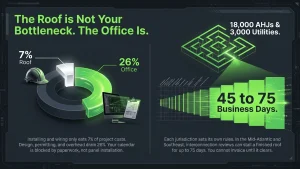
Most installers assume field labor caps their growth. Actually, it doesn’t. Installing, wiring, and inspecting a system runs only about 7% of total cost. Office work — design, permitting, and project management — eats around 26%. That’s the single biggest chunk.
Look wider and the pattern holds. On a typical residential system near $3.25 per watt, soft costs make up roughly half the total. In other words, the office, not the roof, drains your calendar.
Now add the paperwork maze. The U.S. has more than 18,000 permitting authorities (AHJs) and over 3,000 utilities, according to industry permitting data. Each one sets its own rules. Worse, some Southeast and Mid-Atlantic utilities now take 45 to 75 business days to review a residential interconnection. So your crew finishes in a day, yet the project sits for weeks. And you can’t invoice until it clears.
That delay is your ceiling. Add all the crews you want. If engineering and permitting can’t keep pace, your volume flatlines.
Why hiring more engineers is the wrong move
The obvious fix is to hire another engineer or CAD tech. In 2026, though, that’s a risky bet. Here’s why.
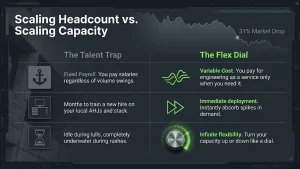
- Fixed cost, shaky year. Residential installs fell 31% in 2024, the lowest level since 2021. Payroll simply doesn’t flex when volume swings.
- Slow ramp. A new hire needs months to learn your stack and your local AHJs.
- Idle or underwater. One salaried engineer can’t scale up for a rush and back down for a lull.
So you don’t need more headcount. Instead, you need engineering capacity you can turn up and down like a dial. That single shift is how smart installers now reduce solar soft costs and grow at the same time.
How to scale solar install volume without adding payroll
Three moves let you push more jobs through the same team.
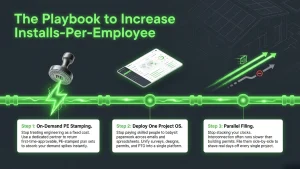
1. Make plan sets and PE stamping on-demand. First, treat engineering as a service you buy only when you need it. A dedicated partner delivers PE-stamped plan sets in all 50 states. It absorbs your spikes and returns first-time-approvable packages. So when a rush hits, you send more jobs instead of scrambling to hire.
2. Standardize on one project OS. Next, kill the coordination drag. When your team chases updates across email, texts, and spreadsheets, you pay skilled people to babysit paperwork. Instead, use one platform for surveys, designs, permits, and PTO. As a result, your staff runs more projects, not more tabs.
3. File permits and interconnection in parallel. Finally, stop stacking your clocks. Interconnection often runs slower than your building permit. So file them side by side, not one after the other. That way, you shave real days off every project — with no new hires.
Now put all three together. Your installs-per-employee climbs, and your payroll stays flat. That, in a sentence, is how you scale in 2026.
Scale your install volume without scaling payroll
It all comes down to one shift. Stop hiring engineering, and start switching it on when you need it.
That’s exactly what Energyscape Renewables delivers. We produce PE-stamped plan sets in all 50 states, with 24-hour engineering turnarounds and a 99% AHJ approval rate. So you take on more projects without adding a single engineer. In fact, installers who switched have grown monthly throughput 4X — with no new overhead. See our engineering and permitting services.
And Sunscape ties it all together. It gives you one solar OS for the whole pipeline — surveys, designs, permits, and PTO in a single place. So your team runs projects instead of chasing them. Book a Sunscape demo.
Together, they’re your elastic back office. On-demand engineering from Energyscape. Full pipeline visibility in Sunscape. That’s how you carry more volume in 2026 without carrying more payroll.
Ready to scale solar install volume without scaling headcount? Request a quote from Energyscape Renewables or book your Sunscape demo today.
Quick answers for busy installers
Can you scale solar installs without hiring engineers? Yes. First, move engineering to on-demand plan sets and PE stamping. Then cut coordination overhead with a project OS. Together, these steps raise throughput using your current team, so no new salaries are required.
What’s the biggest bottleneck to solar install volume? The back office. Design, permitting, and interconnection stall projects far more than field labor does. In fact, office work is about 26% of project cost, versus roughly 7% for installation.
Why does this matter more in 2026? Because the Section 25D residential credit expired at the end of 2025. Margins are tighter now. So higher volume, run efficiently, is how installers and EPCs protect revenue.
Does the tax credit change affect commercial and TPO projects? Partly. The 48E credit still supports third-party-owned residential and commercial projects through 2027, per IRS guidance. So leases and PPAs remain a viable lane for volume.
sjayakanth@energyscaperenewables.com