
Permit-to-Install Time: Cutting Your Average from 42 Days to 24 Days

Why Permit-to-Install Time Decides Your Solar Margins
Every solar project lives or dies by its calendar. Yet many US installers watch their permit-to-install time stretch toward 42 days. Meanwhile, cash sits frozen, crews wait, and customers grow restless. The good news is simple. That number is not fixed. With a tighter process, smarter software, and cleaner documentation, you can trim that solar permitting timeline down to 24 days. This guide shows where the delays hide. More importantly, it shows how to remove them, so you close faster and book more revenue.
What Drives a Long Permit-to-Install Time?

First, let’s name the real culprits. A long permit-to-install time rarely comes from one big mistake. Instead, it builds from many small ones that stack up across a single job.
Plan set errors top the list. When a drawing misses a label or a code reference, the AHJ kicks it back. Each rejection adds days. PE stamping delays follow close behind. If your engineer sits in a queue, your project waits too.
Interconnection delays also pile on. Utilities move at their own pace, and one missing form can stall an approval for weeks. On top of that, manual tracking spreads chaos. When status updates live in email threads and sticky notes, things slip through the cracks.
The Hidden Cost of Solar Permitting Delays
These solar permitting delays do more than annoy your team. They drain money. A 42-day cycle ties up working capital on every single job. It also lowers your install volume per crew each month. Therefore, two extra weeks can quietly cap your annual revenue. In a tight market, that gap really matters. For EPCs running dozens of jobs at once, the drag multiplies fast.
Step-by-Step: Cutting Permit-to-Install Time to 24 Days
Now for the fix. You can shorten your permit-to-install time with a few focused moves. None of them require a bigger team or a bigger budget.
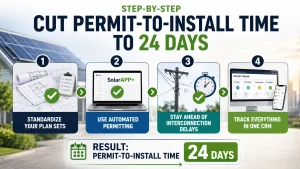
Standardize Your Plan Sets
Start with your documents. Build template plan sets for each common system type and each high-volume AHJ. As a result, your designers stop reinventing the wheel on every project. Clean, code-ready drawings sail through review. In addition, fewer mistakes mean fewer resubmittals. Fewer resubmittals mean a shorter solar permitting timeline.
Use Automated Permitting Where You Can
Next, lean on automation. Many jurisdictions now accept SolarAPP+ for instant residential permits. Where it is available, use it. Automated permitting can cut days off a single approval. Because the software checks code compliance up front, the AHJ rarely pushes back. So your team spends less time chasing corrections.
Stay Ahead of Interconnection Delays
Then, manage the utility side early. Submit interconnection applications the moment your design locks. Do not wait for the permit to clear first. Track each utility’s response window, and follow up before deadlines slip. This one habit shaves a meaningful chunk off your average permit-to-install time. EPCs especially gain here, since utility queues hit them hardest.
Track Everything in One CRM
Finally, centralize your pipeline. A purpose-built solar CRM shows every project’s stage at a glance. So nothing stalls quietly in someone’s inbox. Automated reminders nudge the right person at the right moment. As a result, your solar permitting timeline keeps dropping month over month. Visibility beats guesswork every time.
2026 Trends Shaping Solar Permit Timelines

The rules keep shifting, so stay current. Several 2026 trends now affect your solar permit timeline directly, and smart teams plan around them.
For one, more AHJs are adopting instant online permitting. Adoption grew fast through 2025, and it keeps climbing this year. Next, NEC 2026 updates change a few labeling and rapid-shutdown details. Update your templates now to avoid fresh rejections later. Also, the OBBBA construction-start deadline of July 4, 2026 has pushed many EPCs to file early. So queues at busy AHJs may swell this summer. Plan around that crunch instead of fighting it.
AI-assisted plan review is another big shift. Some jurisdictions now screen submissions with software before a human ever looks. Clean, structured plan sets score better in these automated checks. Therefore, document quality matters more than ever before. In short, the teams that win in 2026 will treat permitting as a system, not a scramble.
How EnergyScape Renewables Shortens Your Permit-to-Install Time
You do not have to fix all of this alone. EnergyScape Renewables handles the heavy lifting behind every approval. Our team delivers code-ready plan sets, fast PE stamping across all 50 states, plus full permitting and interconnection support. Because we manage the back office, your crews stay in the field where they earn. As a result, your permit-to-install time shrinks while your install volume climbs.
In addition, we pair our engineering services with smart project tools. With the Sunscape Solar CRM , you can track every milestone from sale to PTO in one place. So you always know exactly what stands between you and the next install.
In short, a 24-day cycle is realistic for most teams. Standardize your documents, automate where you can, and watch your timeline closely. Then partner with a team that lives in solar permitting every single day. Soon enough, 42 days becomes a distant memory, and 24 days becomes your new normal.
sjayakanth@energyscaperenewables.com