
PE Stamp Turnaround Time For Solar: State-By-State Guide 2026

How Long Does a PE Stamp Take for Solar? State-by-State Turnaround Times US Installers Need to Know in 2026
Let’s read about PE Stamp Turnaround Time.
Your crew is ready. Your customer is pumped. And your permit package is sitting in a queue — waiting on a PE stamp.
If that sounds familiar, you already know the cost. PE stamp turnaround time for solar is one of the most controllable variables in your workflow — and most US installers are leaving serious time on the table by not treating it that way.
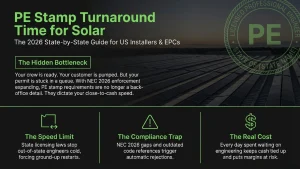
In 2026, with NEC 2026 enforcement expanding and PE stamp requirements tightening in more jurisdictions, this isn’t a back-office detail anymore. It directly controls your close-to-cash speed, your customer experience, and your margins.
Here’s the real state-by-state breakdown — plus the workflow fix that top installers are already running.
What Actually Drives PE Stamp Turnaround Time for Solar?
Not all delays come from the AHJ queue. In fact, most slow PE stamp turnarounds come down to three things.
First, state-specific PE licensing. A Professional Engineer licensed in Texas cannot legally stamp plans in Florida or California. This is a hard stop, not a technicality. If your engineering partner doesn’t hold an active license in your project state, you’re starting over from scratch.
Second, project complexity. Residential systems under standard conditions return faster than commercial jobs with interconnection requirements or non-standard roof structures.
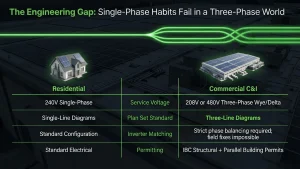
Third — and most importantly — the speed and specialization of your engineering partner. A firm that processes solar plan sets daily across all 50 states will always outperform a generalist engineer picking up solar work on the side.
Understanding NEC 2026 solar code requirements is also critical. Plan sets referencing outdated code cycles are the number one trigger for first-submission rejections — and a single rejection adds 1 to 2 weeks to your project.
Solar PE Stamp Turnaround Time — State-by-State Breakdown
There’s no single national PE stamp standard for solar. Each state sets its own rules, and local AHJs layer additional requirements on top. Depending on the jurisdiction, you could wait anywhere from 24 hours to 12 weeks. Here’s how the major markets break down.
Fast-Track States — 24 to 48-Hour Turnaround
Texas, Florida, and Arizona consistently run fast when the right engineering partner is in the picture.
Texas has no statewide PE stamp requirement for solar. However, major metros like Houston and Dallas require them on commercial projects. With an engineering partner that knows Texas AHJs cold, plan sets come back in 24 hours or less.
Florida requires PE stamps on virtually every install — residential and commercial — due to Florida Building Code wind and hurricane zone requirements. The rules are strict, but they’re consistent. Experienced firms turn Florida packages fast because the standards don’t shift city to city.
Arizona moves quickly overall. Phoenix and Tucson typically process complete, PE-stamped submissions in 1 to 3 business days.
Mid-Tier States — 2 to 5 Business Days
Georgia, Colorado, Tennessee, and Ohio sit in the middle range. These states have made real progress on streamlined permitting. However, manual AHJ review is still common — especially in smaller counties with limited staff.
Georgia and Tennessee, in particular, see delays when PE-stamped structural letters are missing from the submission. That one oversight triggers an automatic resubmission cycle, adding 1 to 2 weeks to your timeline. Therefore, always confirm AHJ documentation requirements before your first submission, not after.
Colorado’s growing solar market has put pressure on some county AHJs. Rural areas run longer. Verify the timeline with each specific jurisdiction before you lock in a project start date.
High-Friction States — 5 to 14+ Days
California, New York, New Jersey, and Massachusetts are the most complex markets.
California requires structural PE stamps for rooftop systems over 10 kW and electrical stamps above 50 kW. NEC 2026 is actively enforced here. Title 24 compliance adds documentation layers that catch most out-of-state plan sets off guard.
That said, SolarAPP+ is expanding fast in California. Cities including Los Angeles, San Francisco, Oakland, and Fresno are live on the platform. For qualifying residential systems, permits now approve in under 24 hours.
New York leads nationally at a 25-day median residential permitting timeline. However, New York City and many upstate jurisdictions require PE stamps for most commercial work. Interconnection through Con Edison and NYSEG territories regularly adds 60 or more days on top of permit approval. Build that buffer in from day one.
New Jersey and Massachusetts carry similar complexity. Utility interconnection queues with PSE&G and National Grid add time that even the fastest PE stamp can’t recover.
The Real Cost of a Slow PE Stamp
A single first-submission rejection adds 1 to 2 weeks to your project. Permit rejections cost between $2,000 and $5,000 per job once crew rescheduling and customer delays are factored in. Multiply that across a full project queue and the damage is significant — especially in a post-ITC environment where margins are already tighter.
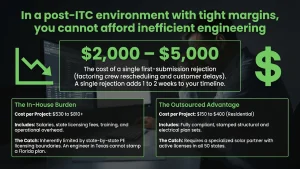
Here’s the number that surprises most installers: in-house solar engineering overhead runs $530 to $810 or more per project, including salaries, licensing fees, and overhead. Outsourced PE-stamped plan sets from a specialized firm typically cost $150 to $400 for residential work — and come back faster. For multi-state EPCs, outsourcing also removes the PE licensing problem entirely.
READ NOW: Solar Permitting Outsourcing: In-House vs. Third-Party in 2026
What Top US Installers Are Doing Differently in 2026
The installers hitting 30-day or faster close-to-PTO timelines aren’t doing anything complicated. They’re just disciplined about three things.
They submit complete, AHJ-specific packages on the first attempt. This single habit eliminates the most common delay driver in the entire process. They also build PE stamp coordination into their workflow the day the deal closes — not the day before permit submission. And they track every milestone in one dashboard, so no job stalls in an inbox and no customer finds out about a delay before the ops team does.
That workflow is exactly what EnergyScape Renewables and Sunscape are built to deliver — together.
The End-to-End Workflow Fix: EnergyScape Renewables + Sunscape
EnergyScape Renewables handles the engineering layer. Their team delivers PE-stamped structural and electrical plan sets with 15 to 24-hour turnaround for residential projects and 24 to 48 hours for commercial work — across all 50 states. Every deliverable is NEC 2026-compliant, and their 99% AHJ first-submission approval rate means fewer resubmissions and faster permit approvals. With 188,520+ projects completed and 1,508 MW of proven experience, they’ve built the infrastructure to handle your volume at any scale.
Sunscape handles the operations layer. It’s a solar CRM and project management platform built specifically for US installers and EPCs. Sunscape tracks every project from lead capture to Permission to Operate — permit status, AHJ submission dates, interconnection milestones, and PTO deadlines — all in one dashboard. When EnergyScape sends back a stamped plan set, the next workflow step fires automatically. No manual handoffs. No dropped details.
Together, they form a closed-loop system. Fast engineering on the backend. Clear project tracking on the front end. One connected workflow from contract to PTO.
Stop Losing Weeks to PE Stamp Delays
Your PE stamp timeline is your project timeline. Every day spent waiting on engineering is a day your crew sits, your customer waits, and your cash stays tied up. The fix isn’t complicated — it’s the right partner.
EnergyScape Renewables delivers PE-stamped solar plan sets in 15 to 24 hours, across all 50 states, with NEC 2026 compliance built in and a 99% AHJ first-submission approval rate.
Sunscape gives your ops team a single dashboard to track every project from permit submission to PTO — so no job stalls, no milestone gets missed, and your team always knows where every install stands.
Fast engineering. Smart tracking. One connected workflow.
👉 Get a Quote → https://energyscaperenewables.com/
👉 Book a Free Demo → https://www.sunscape.solar/
Frequently Asked Questions About Solar PE Stamp Turnaround Time
Q: How long does a PE stamp take for solar? With a specialized engineering firm, residential plan sets return in 15 to 24 hours. Commercial projects typically take 24 to 48 hours. If you’re sourcing a local engineer independently, the process can take weeks.
Q: Do I need a PE stamp for every solar installation? It depends on your state and AHJ. Florida requires PE stamps on virtually all installs. California requires them above specific kW thresholds. Texas requirements vary by city. When in doubt, stamp it — a resubmission costs far more than the stamp fee.
Q: What states require PE stamps for residential solar? Florida requires them on nearly every install due to wind zone requirements. California requires structural stamps above 10 kW and electrical stamps above 50 kW. Many Southeast and Midwest AHJs require PE-stamped structural letters regardless of system size.
Q: How much does solar PE stamping cost? Outsourced residential PE stamping typically costs $150 to $400. In-house engineering overhead runs $530 to $810 or more per project once salaries, licensing, and overhead are included.
Q: How do I speed up solar PE stamp turnaround time? Partner with a firm that holds PE licenses in all 50 states, specializes in solar, and builds NEC 2026 compliance into every plan set. EnergyScape Renewables delivers residential packages in 15 to 24 hours with a 99% AHJ first-submission approval rate.
sjayakanth@energyscaperenewables.com