
NEC 705.11 Supply-Side Conductor Length Limits: 2026 Guide
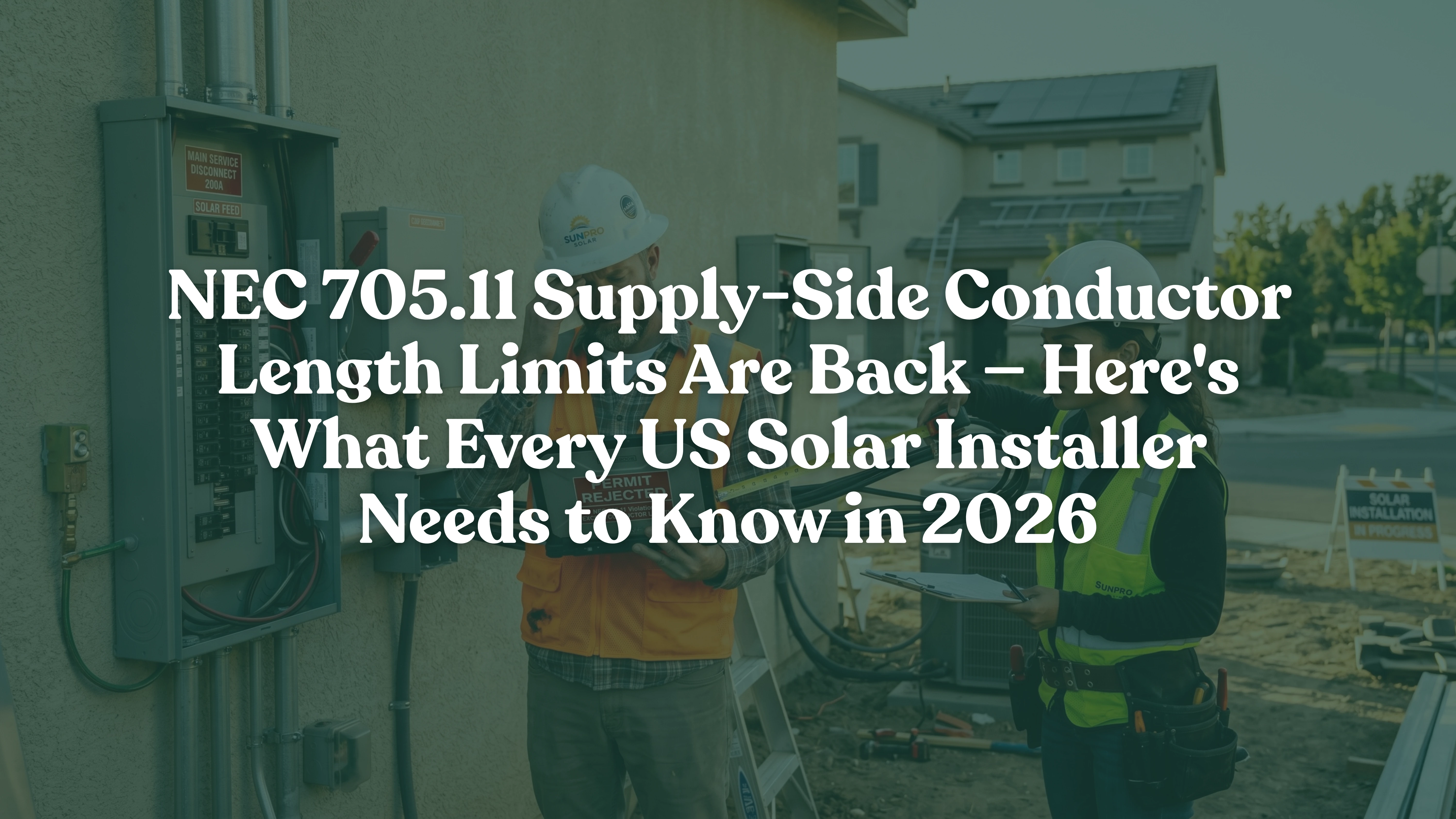
NEC 705.11 Supply-Side Conductor Length Limits Are Back — What Every US Solar Installer Must Know in 2026
Quick Summary
- The 2026 NEC reinstated supply-side conductor length limits under Section 705.11(C)(1) — removed in 2023, now back in full force
- Residential supply-side connections must keep total conductor length under 10 feet
- Plan sets built on 2023 templates may already be non-compliant in NEC 2026 jurisdictions
- California enforces NEC 2026 now; most of the Southeast runs NEC 2020 — which also has the limit
- Permit rejections from this change can cost $2,000–$5,000 per project in rework and admin time
If you updated your plan set templates after the 2023 NEC dropped the supply-side conductor length limits, you’ve got a real problem heading into permit season. The NEC 705.11 supply-side conductor length limits for 2026 are back — and AHJ reviewers in adopted jurisdictions are already flagging non-compliant packages.
This isn’t a paperwork issue. It directly affects where you position overcurrent protection devices and disconnecting means on every supply-side solar interconnection. Miss it, and you’re looking at a resubmission cycle — right when commercial ITC deadlines leave zero room for delays.
Here’s everything you need to know.

What the NEC 705.11 Supply-Side Conductor Length Rule Actually Says
Section 705.11 governs Source Connections to a Service — solar PV systems that connect on the supply side of the main service disconnect, between your utility meter and main breaker.
The 2026 NEC added 705.11(C)(1), which sets a hard cap on conductor lengths for supply-side interconnections inside residential dwellings. The limit is clear: total conductor length must be under 10 feet from the point of service connection.
However, installers often misread this rule. This limit applies to the actual conductor length — not the straight-line physical distance between components. Therefore, your disconnect and overcurrent device will sit physically closer than 10 feet, since conductors don’t run in perfectly straight lines. Plan your layout accordingly.
The reason for this rule is straightforward: shorter unprotected conductor runs inside a building reduce fire risk from faulted conductors. The Code Making Panel reinstated it for exactly that reason.
Why the Rule Disappeared in 2023 — and Why It’s Back Now
Here’s the three-cycle history that’s catching installers off guard:
| NEC Edition | 705.11 Conductor Length Status |
|---|---|
| NEC 2020 | Limits in place — under 10 ft residential |
| NEC 2023 | Limits removed — more layout flexibility |
| NEC 2026 | Limits reinstated under 705.11(C)(1) |
Installers who built plan set templates after 2023 gained real layout flexibility at the time. However, those same templates are now non-compliant in NEC 2026 jurisdictions. Any team running 2023-era electrical drawings without reviewing them is submitting packages that will come back rejected. For more on how NEC 2026 affects your solar plan sets overall, read our full NEC 2026 solar code changes guide for installers.

Why This Hits Differently in 2026
Several factors push the stakes higher than when this rule first appeared in 2020.
ITC construction deadlines are firm. Commercial EPCs must start construction by July 4, 2026 to qualify for the Investment Tax Credit’s four-year completion window. A plan set rejection caused by a 705.11(C)(1) issue adds two to three weeks minimum. That time is simply gone.
State NEC adoption is fragmented. California actively enforces NEC 2026 right now. However, most North Carolina AHJs still operate under NEC 2020 — which also includes the conductor length limits. Meanwhile, NEC 2023 states don’t enforce the restriction at all. As a result, if you run projects across multiple states, you’re facing this rule in two different code cycles simultaneously. One plan set template across three different code environments is a proven path to rejections. To understand how state-by-state NEC adoption affects your permit timelines, see our solar permit requirements by state 2026 guide.
Supply-side connections are more common. More installers now use supply-side taps specifically to avoid the load-side 120% busbar limitation. Therefore, more systems are subject to 705.11(C)(1) in applicable jurisdictions than ever before.
What a Violation Looks Like in the Field
A residential supply-side interconnection designed under 2023 rules might route conductors in a layout that made sense at the time. However, that same layout can now clock in at 13 or 14 feet of conductor length — and that package comes back rejected under NEC 2026.
The fix usually means repositioning the disconnect or OCPD closer to the service connection point. Additionally, it requires catching the issue before submittal, not after. Redesigning post-rejection means revision fees, crew rescheduling, and weeks of delay on a project where your customer is already watching the calendar. According to data from EnergyScape Renewables, permit rejections typically cost between $2,000 and $5,000 per project in rework and admin time alone — not counting client relationship damage.
Three Actions to Protect Your Projects Right Now
1. Audit every active plan set template. If your electrical drawings were last updated for NEC 2023, they don’t account for 705.11(C)(1). Verify conductor length calculations on all supply-side interconnection layouts before the next submittal.
2. Confirm the NEC edition your AHJ enforces. Multi-state EPCs get burned by this mistake every week. Before you finalize any design, confirm whether your target jurisdiction runs NEC 2020, 2023, or 2026. Our PE stamp turnaround and AHJ requirements guide breaks down which states are running which edition.
3. Work with an engineering team that tracks this for you. EnergyScape Renewables delivers NEC 2026-compliant PE-stamped plan sets with 15–24 hour residential turnaround and 24–48 hours for commercial projects, across all 50 states. Every plan set is built to the specific code edition your AHJ enforces — so the 705.11(C)(1) conductor length question gets answered before the package leaves their desk. With a 99% AHJ first-submission approval rate across 188,520+ completed projects, they carry the jurisdictional knowledge that keeps your workflow moving.
For deeper technical context on the full scope of NEC 2026 solar changes, Mayfield Renewables’ 2026 NEC Solar Update and Solar Builder Magazine’s NEC 2026 installer overview are solid references. The NFPA also publishes the official NEC 2026 standard for direct code language lookup.

The Bottom Line On NEC 705.11
The 2026 NEC didn’t overhaul solar code the way earlier cycles did. However, NEC 705.11 supply-side conductor length limits for 2026 hit quietly — and expensively — for installers still running 2023-era templates. Check your drawings, confirm your jurisdictions, and work with an engineering partner who already knows what each AHJ expects.
Stop Chasing Code Changes. Let EnergyScape Handle the Engineering.
Your 2023 plan set template just became a liability in every NEC 2026 market. Don’t let a code reversal you didn’t track cost you a full permit cycle.
EnergyScape Renewables builds every plan set to the exact NEC edition your AHJ enforces — NEC 2026, 2023, or 2020 — with PE-stamped structural and electrical drawings delivered in 15–24 hours for residential projects. A 99% first-submission approval rate means your packages move through review, not back to your desk. Whether you’re working California under NEC 2026, Florida under strict PE stamp requirements, or Texas with its city-by-city quirks, EnergyScape already knows what each jurisdiction expects.
Once your permits are in motion, Sunscape Solar keeps your entire project pipeline visible from permit submission through PTO — permit status, interconnection milestones, AHJ inspection dates — all tracked in one dashboard built specifically for US solar installers and EPCs. No manual handoffs. No missed deadlines.
Fast engineering on the back end. Clear project visibility on the front end. One connected solar workflow from contract to energization.
👉 Get NEC 2026-Compliant Plan Sets from EnergyScape → 👉 Track Your Entire Solar Pipeline with Sunscape →
Frequently Asked Questions About NEC 705.11
Q: Does NEC 705.11(C)(1) apply to load-side solar connections?
No. The conductor length limits under 705.11(C)(1) apply only to supply-side source connections — systems interconnected on the supply side of the service disconnecting means. Load-side connections follow different code provisions entirely.
Q: What is the NEC 705.11 conductor length limit for residential solar in 2026?
Under NEC 2026 Section 705.11(C)(1), total conductor length for residential supply-side interconnections must stay under 10 feet from the point of service connection. This is actual conductor length, not the physical gap between components.
Q: What if my state hasn’t adopted NEC 2026 yet?
First, check whether your state is on NEC 2020. That edition also included conductor length limits. Only NEC 2023 jurisdictions currently lack the restriction. Verify the active code edition with each AHJ before finalizing your design.
sjayakanth@energyscaperenewables.com