
NEC 2026 vs. NEC 2023, What Changes for Solar and Battery Plan Sets with a State Adoption Tracker
Why NEC 2026 Changes Matter for Your Solar Plan Sets
A rejected permit costs more than time. It stalls crews, delays installs, and frustrates homeowners who already signed. Right now, many installers face that risk because the NEC 2026 changes are reaching more states every month. Meanwhile, plenty of design templates still cite 2023 code sections that no longer exist. The good news? The new code edition doesn’t rewrite PV design. Instead, it updates calculations, moves key articles, and reshapes battery backup sizing. So if you update your templates now, approvals keep moving. This guide covers what changed, how it affects your solar plan sets, and which states already enforce the 2026 code.
NEC 2026 vs. NEC 2023: The Big Picture for Solar Plan Sets
Most Article 690 updates are clarifications, not major rule shifts. Ryan Mayfield, who served on the code-making panel for Article 706, made that point in his Solar Builder overview. However, a few NEC 2026 changes will alter real layouts and documents.
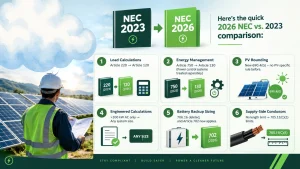
Here’s the quick 2026 NEC vs. 2023 comparison:
- Load calculations: Article 220 (2023) moves to Article 120 (2026)
- Energy management: Article 750 moves to Article 130, with power control systems treated separately
- PV rounding: no PV-specific rule becomes new 690.4(G)
- Engineered calculations: systems over 100 kW AC only becomes any system size
- Battery backup sizing: 706.16 is deleted, and Article 702 now applies
- Supply-side conductors: no length limit becomes 705.11(C)(1) limits
In short, the code didn’t change how you install systems. Rather, it changed what plan reviewers expect to see on paper.
Article 690 Updates: NEC 2026 Changes for PV Calculations
New 690.4(G) Rounding Rule
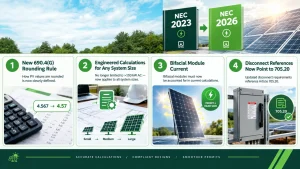
For years, designers debated how to round fractions of an amp or volt. Now the code settles it. Under 690.4(G), you drop fractions below 0.5 and round to the nearest whole number. However, timing matters. Apply all correction factors first, then round the final result once. For example, 13.4 A becomes 13 A. Therefore, make sure your spreadsheets don’t round intermediate values.
Engineered Calculations for Any System Size
Previously, only systems above 100 kW AC could use engineered voltage and current calculations. The 2026 edition removes that cap in 690.7(A)(3) and 690.8(A)(1)(a)(3). As a result, a licensed PE can now run site-specific calculations on residential jobs. This helps most in cold climates, where table-based voltage corrections often force shorter strings.
Bifacial Module Current
In addition, new 690.8(A)(1)(a)(2) lets you calculate maximum current using the listed module’s instructions. This is a big win for bifacial projects. Simply attach the manufacturer’s guidance to your permit package.
Disconnect References Now Point to 705.20
Both 690.13 and 706.15 now send users to 705.20. In practice, the disconnect rules stay largely the same. Still, update the code references on your one-line diagrams.
Supply-Side Connections: The Change That Moves Equipment
Of all the NEC 2026 changes, this one can physically shift your layout. Conductor-length limits for supply-side connections inside buildings return in 705.11(C)(1). The 2020 code had them, 2023 dropped them, and 2026 restores them.
The OCPD must sit within 10 feet of conductor length in dwelling units. In other buildings, the limit is 16.5 feet. Keep in mind that you measure the actual conductor run, including bends and terminations. Consequently, the breaker often lands closer than you’d expect. So measure your routing before you lock in OCPD placement.
Battery Storage Code Updates in NEC 2026: Sizing Backup Under Article 702
Among the NEC 2026 changes for batteries, backup sizing is the biggest shift. The 2026 code deletes 706.16. Under 2023, that section pointed designers to Article 710, which covers stand-alone, off-grid systems. That approach never fit grid-tied batteries well.
Now, most interconnected ESS used for backup follow Article 702 for optional standby systems. Section 702.4 gives you three ways to show adequate capacity:
- Full load: size the system to carry everything connected to it.
- Managed load: size for the maximum load an approved load management system allows.
- Listed PCS: new for one- and two-family homes, a listed power control system keeps reconnecting loads from overloading the inverter.
Because of this, battery plan sets must state which 702.4 option you used. Also, list backed-up and controlled loads separately. Finally, include inverter, ESS, and PCS listings.
Article 130, PCS Listings, and Article 120 Load Calculations
Two more NEC 2026 changes affect storage and service work. First, energy management systems moved from Article 750 to Article 130. The code now separates an EMS, which manages energy use, from a PCS, which limits current to prevent overloads. Expect AHJs to look for UL 3141 listings on PCS equipment.
Second, Section 120.7 lets a compliant PCS setpoint feed into branch-circuit, feeder, and service load calculations. That matters when you want to avoid a main panel upgrade. Lastly, swap every Article 220 reference on your templates for Article 120.
NEC 2026 Adoption Tracker: Which States Enforce It?
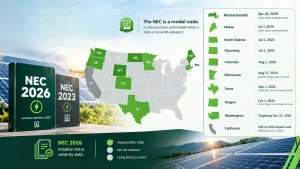
The NEC is a model code. It only becomes enforceable when a state or local AHJ adopts it. Here’s where NEC 2026 adoption stands as of mid-October 2026:
- Massachusetts: April 24, 2026 (with state amendments)
- Maine: July 1, 2026 (with state amendments)
- North Dakota: July 1, 2026
- Wyoming: July 1, 2026
- Colorado: August 1, 2026
- Minnesota: August 17, 2026 (earlier filings stay on 2023)
- Texas: September 1, 2026 (statewide, all non-exempt work)
- Oregon: October 1, 2026 (as the Oregon Electrical Specialty Code)
- Washington: targeting December 31, 2026
- California: still on its 2023-based electrical code, effective January 1, 2026
Note that local AHJs can amend state codes or move on their own timeline. Always confirm the enforced edition before you design.
Your NEC 2026 Changes Checklist for Solar and Battery Plan Sets
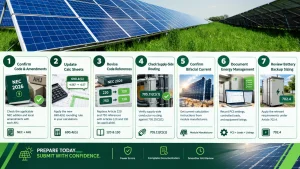
Before your next submittal, run through these steps:
- Confirm the code edition and local amendments with each AHJ.
- Update calc sheets for 690.4(G) rounding.
- Replace Article 220 and 750 references with Articles 120 and 130.
- Recheck supply-side routing against 705.11(C)(1).
- Collect bifacial current instructions from module makers.
- Document PCS settings, controlled loads, and listings.
- Size battery backup under 702.4.
How EnergyScape Renewables Keeps Your Solar Plan Sets Code-Ready
Tracking NEC 2026 changes across 50 states is a full-time job. That’s exactly where EnergyScape Renewables steps in. Our engineers build permit-ready solar plan sets and solar-plus-storage designs to the exact edition your AHJ enforces. We also provide PE stamping in all 50 states, so engineered 690.7 and 690.8 calculations get sealed fast. Beyond design, we handle permitting, interconnection applications, site surveys, and back-office support. As a result, your crews stay focused on installs, not redlines.
Plus, if you want to track every project from site survey to PTO in one place, explore Sunscape, a solar CRM and project management platform built for installers and EPCs. Ready to make your next submittal NEC 2026-ready? Contact EnergyScape Renewables today.
sjayakanth@energyscaperenewables.com