
NEC 2026 Math Simplified: Section 690.4(G) Explained in 2026

NEC 2026 Math Simplified: Section 690.4(G) Explained for Solar Installers and EPCs
NEC 2026 Math Finally Has a Clear Rounding Rule — And It’s a Game Changer
NEC 2026 math: If you’ve ever finished a solar voltage calculation and landed on something like 39.6V or 8.3A, you know the frustration. Do you round it? Leave it? What does the AHJ want to see?
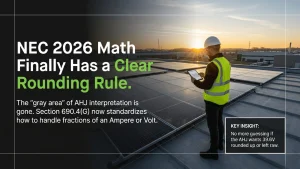
That gray area is gone now. The 2026 National Electrical Code (NEC) introduced a new section — 690.4(G): Fractions of an Ampere or Volt — and it directly answers that question for PV systems. The new NEC 2026 math rule is simple, practical, and immediately useful for any solar installer or EPC submitting permit packages.
This post breaks down exactly what 690.4(G) says, how to apply it correctly, and why getting the sequence right matters more than the rounding itself.
What Is NEC Section 690.4(G)?
Section 690.4(G) is a brand-new addition to Article 690 — Solar Photovoltaic (PV) Systems — under General Requirements in the 2026 NEC. According to the 2026 NEC and noted by industry engineers at Mayfield Renewables, the rule reads clearly:
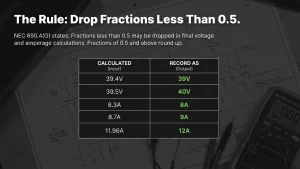
Fractions less than 0.5 may be dropped in final voltage and amperage calculations.
That means:
- 39.4V → records as 39V ✓
- 39.5V → rounds up to 40V ✓
- 8.3A → records as 8A ✓
- 8.7A → rounds up to 9A ✓
This isn’t a new concept in the NEC. Article 220 (now renumbered Article 110 in 2026) already allowed dropping fractions less than 0.5 for branch circuits, feeders, and services. But solar PV systems had no specific code provision covering this — until now.
The result? AHJs interpreted it differently. Some accepted rounding. Others didn’t. Some PE reviewers flagged it. Others moved on. That inconsistency cost installers time and money in revision cycles. NEC 2026 math change fixes that by giving everyone — designers, engineers, and plan reviewers — the same code language to work from.
The Rule Is Simple — But the Sequence Is Everything
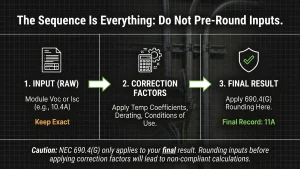
Here’s where most designers get tripped up. NEC 690.4(G) only applies to your final calculated result — after all correction factors have been applied. You cannot pre-round inputs and then run your math. The sequence must go in this order:
1: Start with the raw module datasheet value — Voc, Isc, or Vmp.
2: Apply all correction factors — temperature coefficients, conditions of use, system derating, etc.
3: Only now, apply the 690.4(G) rounding rule to the final output.
That module Isc value from the spec sheet? That’s an input. It feeds into your calculation as-is. The fraction gets dropped from the result, not from the data going in.
Real example:
- Module Isc: 10.4A
- After correction factor applied: 11.96A → rounds up to 12A ✓
- After correction factor applied: 11.3A → drops fraction, records as 11A ✓
Getting this order right is what keeps your planset compliant — and keeps the AHJ from sending it back for revisions.
Quick Reference: NEC 2026 Math Rounding at a Glance
| Corrected Calculated Value | What You Record |
|---|---|
| 39.4V | 39V |
| 39.5V | 40V |
| 8.2A | 8A |
| 8.7A | 9A |
| 415.49V | 415V |
| 415.5V | 416V |
| 11.3A | 11A |
| 11.96A | 12A |
Save this table. It’s the kind of quick reference that saves time during plan prep.
Two Other 2026 Article 690 Updates Worth Your Attention
The rounding rule doesn’t stand alone. Two closely related changes in the 2026 NEC affect how engineers calculate max voltages and currents in PV systems.
1. PE Calculations Now Allowed for Any System Size
Under NEC 690.7(A)(3) and 690.8(A)(1)(a)(3), a licensed electrical engineer could previously use advanced calculation methods only for systems exceeding 100kW. The 2026 NEC removed that size threshold entirely. PE-based calculations are now an option for any system — residential included. This opens the door to more precise design across the board and can reduce over-sizing that quietly eats into project margins.
2. New Calculation Method for Bifacial Modules
Section 690.8(A)(1)(a)(2) added a new method specifically for bifacial panels. Manufacturers can now include module-specific current instructions that account for bifacial gain. This has long been more estimation than engineering — the 2026 NEC finally gives the industry a defined path for calculating it. As bifacial modules continue to dominate residential and commercial installations, this update matters more every quarter.
🔗 Do You Really Need a PE Stamp for Solar? Learn now.
Why This Directly Affects Your Permit Approval Speed
Small fractions might seem trivial on paper. In practice, they create friction. When a plan reviewer sees 39.6V on a planset and their checklist expects a whole number, that can trigger a revision request — even when the underlying design is perfectly sound.
Every revision cycle costs you time. Multiply that across dozens of projects a month, and it adds up fast. The NEC 2026 math rounding rule — 690.4(G) — gives both your design team and the plan reviewer a shared code reference. That shared reference removes the debate and speeds up the approval.
For EPCs and high-volume installers, compliance consistency compounds into real operational efficiency. Fewer revision loops. Faster permit turnarounds. More closed projects per quarter.
How Energyscape Renewables Handles This for You
If you’re already submitting plansets through Energyscape Renewables (ESR), this isn’t something you need to track manually. ESR’s engineering team has integrated NEC 690.4(G) rounding — correctly sequenced, after correction factors — into their automated design workflow.
Every planset that leaves ESR’s team reflects the 2026 NEC. That includes 690.4(G), the PE calculation method changes, and bifacial module updates. They don’t wait for a jurisdiction to reject a package to learn what changed. They build it in from day one.
Combined with 24-hour turnaround, PE stamping in all 50 states, and AHJ-specific documentation, ESR is built around keeping your projects moving forward — not backward into revision queues.
📌 Manage your project pipeline on Sunscape — the solar CRM built for installers and EPCs. Track every job from proposal through PTO, and pair it with Energyscape’s engineering for a complete end-to-end workflow.
Ready to Run Cleaner Calculations on Every Project?
The 2026 NEC 690.4(G) rule is a small change with a big operational impact. Apply it correctly — in sequence, after correction factors — and your plansets come out cleaner, your AHJ conversations get shorter, and your revision cycles shrink.
Energyscape Renewables already has it built in. Get 24-hour, NEC 2026-compliant plansets with PE stamps in all 50 states — so your team focuses on installs, not paperwork.
Sunscape keeps your entire project pipeline organized from proposal to PTO — so nothing falls through the cracks while you’re scaling.
Start your next planset with Energyscape Renewables →
Manage your solar pipeline with Sunscape →
Frequently Asked Questions: NEC 690.4(G) Rounding
What does NEC 690.4(G) say about rounding in solar calculations?
A: Section 690.4(G) of the 2026 NEC states that fractions less than 0.5 may be dropped in final voltage and amperage calculations for PV systems. Values of 0.5 and above round up to the next whole number.
Can I round solar voltage calculations under the 2026 NEC?
A: Yes — but only after you’ve applied all correction factors and conditions of use. You cannot round input values like module Voc or Isc before running your calculations. The rounding applies only to the final result.
Does the rounding rule apply before or after correction factors?
A: Always after. Apply your temperature correction factors, derating, and all other conditions of use first. Then apply the 690.4(G) rounding to your final calculated output.
Does 690.4(G) apply to both volts and amps?
A: Yes. The rule covers both voltage and amperage calculations in Article 690 PV system design.
When does my jurisdiction adopt the 2026 NEC?
A: Adoption timelines vary by state and local authority. Check with your AHJ or visit the NFPA’s NEC adoption map for current adoption status in your area.
sjayakanth@energyscaperenewables.com