
Massachusetts SMART Program Engineering Requirements 2026
Massachusetts SMART Program Engineering Requirements 2026: What Every Solar Installer Must Get Right
If you’re installing solar in Massachusetts, the Massachusetts SMART program engineering requirements directly control whether your customer gets paid — and when. In 2026, more installers are missing enrollment windows not because of utility backlogs but because their engineering documentation fails technical review on the first submission.
The stakes are higher this year. The federal residential solar tax credit (Section 25D) expired on December 31, 2025. As a result, SMART payments now carry the bulk of the financial case for your customers. Therefore, every engineering decision upstream of SMART enrollment matters more than ever.
What Changed with Massachusetts SMART Program Engineering and Smart 3.0 — And Why Engineering Delays Cost More Now
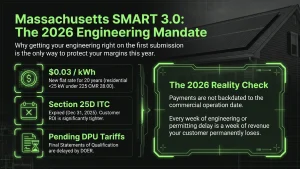
SMART 3.0 took effect on September 12, 2025, under new DOER regulations (225 CMR 28.00). For residential systems under 25 kW, the program now pays a flat $0.03 per kWh for 20 years. This replaces the old declining block structure with a more predictable return for your customers.
However, there’s a real complication right now. As of spring 2026, the DPU tariff review for SMART 3.0 is still pending. Consequently, DOER is not issuing Final Statements of Qualification yet. Moreover, payments do not get backdated to the system’s commercial operation date.
That means every week of delay in your engineering or permitting process is a week your customer doesn’t get paid. Get the engineering right the first time, and you control the timeline.
Engineering Documentation the SMART Program Requires from Your Team
Before your customer sees a SMART payment, several steps must clear in the right order. The standard SMART enrollment checklist at masssmartsolar.com requires:
- A fully installed system by a licensed Massachusetts contractor
- An executed Interconnection Service Agreement (ISA) from Eversource, National Grid, or Unitil
- A Permission to Operate (PTO) letter from the utility
- Inverter and PV module technical specifications
Most installers know this list. What they underestimate, however, is what happens before the utility issues an ISA. Interconnection applications go through technical review first. That review is based on your electrical plan set. If the single-line diagram uses the wrong NEC edition or lacks proper engineer credentials for the jurisdiction, it gets rejected. You restart from the end of the utility queue — and the 12-month reservation clock doesn’t pause.
For more on how interconnection documentation affects your project timeline, read our solar permitting timelines guide.
Massachusetts SMART Program Engineering Requirements: PE Stamps and NEC 2026 Compliance
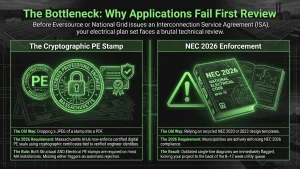
Massachusetts requires both structural and electrical PE stamps on most solar installations. Missing either one is the leading cause of first-submission permit rejections statewide. For a full breakdown of when your project needs a stamp, see our PE stamp requirements guide for solar installers.
In 2026, “current” means NEC 2026-compliant. Many Massachusetts municipalities are actively adopting the new code cycle. Consequently, plan sets still built on NEC 2020 or 2023 templates get flagged immediately at AHJ review.
Stamp format also matters. A certified digital PE seal uses a cryptographic certificate tied to the engineer’s verified identity. A stamped image dropped into a PDF doesn’t meet the standard most Massachusetts AHJs now enforce. That distinction has caught experienced multi-state EPCs off guard on otherwise clean submittals in 2026.
Massachusetts-Specific Engineering Challenges Every Installer Should Know
Massachusetts is not a standard solar market. The housing stock alone creates engineering complexity that simply doesn’t appear in Arizona or Texas projects.
The NEC 120% Rule on Older Homes
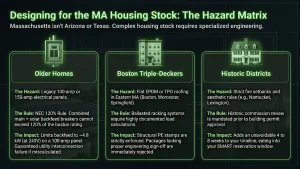
Many Massachusetts homes still run on 100-amp or 150-amp electrical panels. Under NEC guidelines, the combined amperage of the main breaker plus the solar backfeed breaker cannot exceed 120% of the busbar rating. On a 100-amp panel, that limits solar backfeed to roughly 4.8 kW at 240V without a panel upgrade. Designers who skip this calculation get flagged — either at the building department or at utility interconnection review.
Triple-Deckers and Flat Roofs
Across Boston, Worcester, and Springfield, triple-deckers with flat EPDM or TPO roofing are common installs. Ballasted racking systems on these roofs require documented load calculations. Furthermore, structural PE stamps are expected — not optional — on these submissions. AHJ reviewers in Eastern Massachusetts consistently flag ballasted packages without proper engineering sign-off.
Historic Districts and Fire Setback Requirements
In municipalities like Nantucket and Lexington, historic commission review is required before building permit approval. This process adds four to eight weeks of buffer. Additionally, Massachusetts fire departments enforce strict roof pathway rules. Arrays placed too close to ridges or valleys go back for redesign — which adds revision rounds and costs time your reservation window doesn’t have.
The 12-Month SMART Reservation Window: Why Engineering Delays Are So Expensive
When DOER issues your Preliminary Statement of Qualification (PSoQ), you have 12 months to reach Authorization to Interconnect (ATI). Miss that window, and the reservation is cancelled or you pay extension fees.
Twelve months sounds manageable. However, map out the real timeline. Building permit review in Massachusetts runs two to six weeks in most municipalities. National Grid and Eversource interconnection queues regularly run eight to twelve weeks — longer in congested grid areas. One plan set resubmission adds one to two weeks per round.
One permit rejection plus a standard utility queue: three to five months consumed before installation even starts. Add inspection scheduling, meter set, and PTO — and the 12-month clock gets tight very fast.
Installers running 15 or more active Massachusetts SMART projects with staggered PSoQ dates need a real-time tracking system. Without one, deadline misses are almost inevitable.
The Workflow That Gets Massachusetts SMART Projects to Enrollment On Time
The installers consistently hitting fast SMART enrollments follow this process:
- Confirm AHJ PE stamp requirements before design — not after submittal.
- Verify which NEC edition the local jurisdiction currently enforces.
- Submit the building permit and interconnection application simultaneously wherever the AHJ allows.
- Use an engineering partner that returns NEC 2026-compliant, PE-stamped plan sets in under 24 hours.
- Track every SMART milestone — PSoQ date, ISA submission, queue position, PTO — in a project management system that flags approaching deadlines.
This process isn’t complicated. It just requires front-end discipline on every Massachusetts project.
Two Partners Massachusetts Solar Installers Are Using in 2026
EnergyScape Renewables handles the engineering layer. Their team delivers PE-stamped structural and electrical plan sets in 15–24 hours for residential and 24–48 hours for commercial projects — across all 50 states, Massachusetts included. Every plan set is NEC 2026-compliant. With a 99% AHJ first-submission approval rate across 188,000+ completed projects, your packages go in correct the first time. In Massachusetts specifically, one rejection in a National Grid or Eversource queue can push a project past the SMART reservation window entirely.
Sunscape Solar handles the project management layer. It’s a CRM and project management platform built specifically for US solar installers and EPCs. Sunscape tracks every SMART milestone — permit submission, ISA status, interconnection queue position, PTO, and reservation window deadlines — in one real-time dashboard. When you’re managing multiple active Massachusetts SMART projects with different PSoQ dates, that visibility keeps you ahead of every deadline.
Stop Losing SMART Enrollments to Engineering Delays
Massachusetts SMART 3.0 has a hard 12-month clock. One plan set rejection, one utility queue restart — and that window closes faster than most installers expect.
EnergyScape Renewables delivers NEC 2026-compliant, PE-stamped plan sets in 15–24 hours for residential and 24–48 hours for commercial projects. With a 99% first-submission approval rate across 188,000+ completed projects, your Massachusetts submissions go in clean — and come back approved. Their engineering team knows exactly what Eversource, National Grid, and Massachusetts AHJs expect in 2026.
→ Get your plan set quote → energyscaperenewables.com
Sunscape Solar keeps your entire SMART project pipeline organized — ISA status, interconnection queue position, PTO milestones, and reservation deadlines — all tracked in one dashboard built for how your team works.
→ Explore Sunscape → sunscape.solar
Frequently Asked Questions: Massachusetts SMART Program Engineering
Does every Massachusetts residential solar installation need a PE stamp?
Yes. Most Massachusetts residential and commercial installations require both structural and electrical PE stamps. Missing either one is the leading cause of first-submission permit rejections statewide. Always verify AHJ-specific requirements before you design.
What happens if a Massachusetts SMART project misses the 12-month reservation window?
DOER cancels the Preliminary Statement of Qualification. You can apply for an extension, but it often requires additional fees and delays the payment start date further. Tracking the 12-month deadline from PSoQ issuance is the most effective way to prevent this.
Who submits the Massachusetts SMART 3.0 application — the installer or the customer?
The solar installer submits the application through PowerClerk on the customer’s behalf. DOER requires this because of the technical documentation and system data involved. According to the MA SMART program portal, the process demands technical expertise that most homeowners don’t have.
sjayakanth@energyscaperenewables.com