
Back to Blog Page
How to Pass Solar Inspection First Time: 50-State Tips

How to Pass Solar Inspection the First Time: Inspector Tips From All 50 States
Learning how to pass solar inspection on your first attempt isn’t just about saving time—it’s about protecting your profit margins and customer relationships. According to NREL’s SolarAPP+ Performance Review, roughly one in four residential solar installations fails its first Authority Having Jurisdiction (AHJ) inspection. Furthermore, each failed inspection doesn’t just mean a reinspection fee. It creates idle crews, frustrated homeowners, and—based on SEIA data—a 10% jump in project cancellation risk for every week of delay.
After engineering thousands of solar systems across all 50 states, we’ve identified the exact failure patterns that trip up installers from Florida to Alaska. The good news? Nearly every common inspection failure is completely preventable when you know what inspectors are looking for.
How To Pass Solar Inspection: The Five Biggest Solar Inspection Failures Nationwide
When we review correction reports from jurisdictions across the country, the same five issues appear repeatedly. While AHJ requirements vary—there are over 20,000 distinct permitting jurisdictions in the United States—inspectors everywhere flag these core problems.
1. Missing or Incorrect Labeling
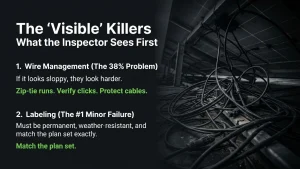
This is the single most common minor failure nationwide. Inspectors need to see permanent, weather-resistant labels for rapid shutdown, dual power source warnings, conduit identification, and PV system directories. Most jurisdictions require minimum 3/8-inch white lettering on red backgrounds, and labels must match your approved plan set exactly.
Handwritten labels, faded printouts, or labels with incorrect voltage values will fail inspection every time. To avoid this, build a labeling kit for each job. Pre-print labels using values from your final engineering package, then verify every label against the plan set before calling for inspection.
2. Poor Wire Management
Data from the Institute for Building Technology and Safety (IBTS) shows that wire management deficiencies appear on 38% of PV projects nationwide. Common issues include low-hanging conductors under arrays, improper splicing, connectors that aren’t fully seated, excessive bend radii, and cables without proper UV-rated protection.
Inspectors don’t just glance at your wiring—they follow it. Therefore, treat wire management as a quality checkpoint, not an afterthought. Zip-tie all runs, verify every connector click, and conduct a visual walk of the array before buttoning up.
3. Grounding and Bonding Errors
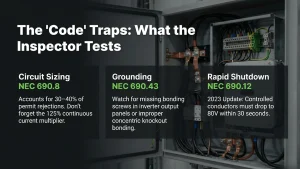
Grounding issues under NEC 690.43, 250.134, and 250.136(A) are among the most technically common failures. Equipment grounding conductors that don’t run with PV source conductors, missing bonding screws in inverter output panels, and module or racking grounding that doesn’t meet specification—these crop up constantly.
In systems over 250V, metallic raceways through concentric knockouts need specific bonding attention that installation crews frequently miss. Always double-check grounding connections with a torque wrench before inspection day.
4. Circuit Sizing Mistakes Under NEC 690.8
This violation hits projects at both the plan review stage and on the roof. Industry permitting data suggests NEC 690.8 violations account for roughly 30-40% of all solar permit rejections nationwide. Three errors dominate:
- Forgetting the 125% continuous current multiplier before applying temperature corrections
- Overlooking cumulative derating when multiple correction factors apply
- Exceeding the maximum series fuse rating listed on the module datasheet
If your engineering package gets these calculations wrong, you’ll fail before you ever pick up a drill.
5. Rapid Shutdown Non-Compliance (NEC 690.12)
Under the 2023 NEC, controlled conductors must reduce to 80 volts or less within 30 seconds. Moreover, the array boundary is now just 1 foot. Installers commonly struggle with equipment compatibility—inverters and optimizers that don’t communicate properly—and with missing or misplaced rapid shutdown labels.
If your AHJ has adopted NEC 2023, double-check that every component in your rapid shutdown pathway is listed and compatible before scheduling inspection.
Why Plan Set Deviations Will Fail You Every Time
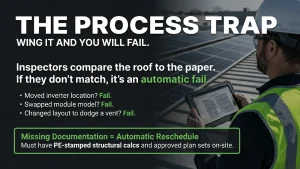
Here’s an inspector pet peeve that transcends state lines: installations that don’t match approved plans. Swap a module model without updating your permit? That’s a fail. Change the panel layout to dodge a vent pipe without resubmitting? Also a fail. Move the inverter location six feet without authorization? You guessed it—fail.
Inspectors compare what’s on the roof to what’s on paper every single time. Consequently, if your field team needs to make a change, stop work and get revised plans approved before proceeding. The one-day delay for a plan revision beats the two-week delay from a failed inspection and resubmission cycle.
Learn more about avoiding common NEC 690 permit violations that delay solar projects.
Essential Documentation for Solar Inspection Day
Having the right paperwork on-site is half the battle. Inspectors in most jurisdictions expect to see:
Approved plan set – Site layout, structural details, and electrical diagrams physically present or accessible on a tablet
Equipment datasheets – For modules, inverters, racking, and disconnects, all matching what’s actually installed
PE-stamped structural calculations – Required in most jurisdictions, especially for systems over 10 kW
Permit copies – Building and electrical permits, plus utility interconnection approval
Contractor license and insurance documentation – Current and valid for your jurisdiction
Missing documents trigger an automatic reschedule in many AHJs. Therefore, treat your documentation binder like your tool bag—if it’s not on the truck, the job doesn’t happen.
Your Pre-Inspection Field Checklist On How To Pass Solar Inspection
Before calling for inspection, walk the system yourself with fresh eyes. First, verify every label matches the plan set. Next, confirm every conductor is neatly managed and properly rated. Then, check grounding and bonding connections with a torque wrench, not just visually.
Additionally, make sure the rapid shutdown system activates correctly. Open every disconnect and panel cover so the inspector doesn’t have to ask. Keep a code-compliant ladder ready for roof access, and position that documentation binder front and center.
A 30-minute self-inspection can save you three weeks of delays and thousands in soft costs. When permitting-related expenses already average roughly $1.00 per watt—that’s $6,000 to $7,000 on a typical residential system—every avoided reinspection goes straight to your bottom line.
Get Inspection-Ready Systems From Day One
Need plan sets that pass the first time—in any state? EnergyScape Renewables provides PE-stamped solar engineering, design, and permitting services across all 50 states. Our engineers know exactly what inspectors look for in your specific AHJ because we’ve already designed systems that passed there. Get your quote today.
Managing high-volume solar projects across multiple jurisdictions? Sunscape is the solar CRM and project management platform built to track every permit, inspection, and milestone—so nothing falls through the cracks between design approval and Permission to Operate. See how Sunscape keeps projects moving.
Frequently Asked Questions About How To Pass Solar Inspection
What percentage of solar installations fail their first inspection?
According to NREL data, approximately 23-26% of solar installations fail their first AHJ inspection. Traditional permitting processes show slightly higher failure rates compared to automated systems like SolarAPP+.
What do AHJ inspectors look for during solar inspection?
Inspectors primarily check five areas: proper labeling (warnings, rapid shutdown, directories), wire management and conductor sizing, grounding and bonding compliance, rapid shutdown functionality, and whether the installation matches the approved plan set exactly.
How long does a solar inspection take?
Most residential solar inspections take 30-60 minutes. However, if the inspector finds issues, you’ll need to schedule a reinspection after making corrections, which can delay your project by 1-3 weeks depending on the jurisdiction’s scheduling.
Can I schedule a solar inspection before installation is complete?
No. Inspectors require the complete installation including all electrical connections, labeling, and grounding to be finished. Calling for inspection before completion wastes everyone’s time and may result in additional fees.

1 Comment
[…] costs roughly $1.00 per watt, or $6,000 to $7,000 on a typical residential job, as we covered in How to Pass Solar Inspection First Time. Every avoided reinspection protects that margin […]