
Florida HB 683 Solar Permits: 5-Day Installer Guide
Florida HB 683: How the 5-Day Permit Rule Changes Everything for Solar Installers in 2026
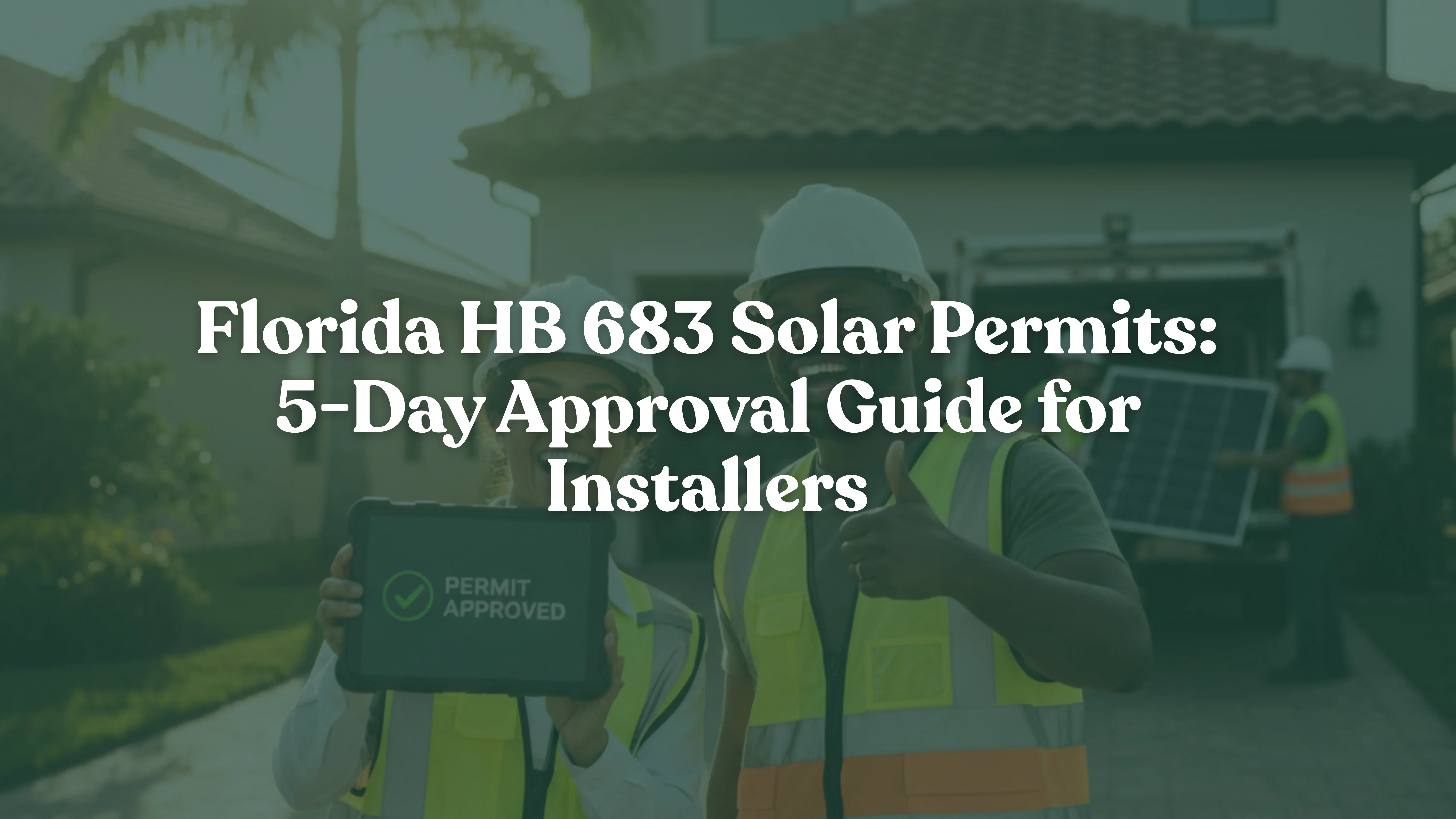
Florida HB 683 solar permits just transformed how you do business. If you’re installing solar panels across the Sunshine State, this new law mandates five-day approvals starting July 1, 2025. Furthermore, it eliminates documentation headaches that have plagued installers for years. Consequently, your project timelines can shrink by up to 80%.
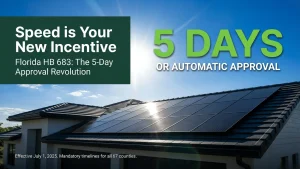
Governor Ron DeSantis signed this bipartisan legislation on June 13, 2025. As a result, local governments now face strict deadlines for processing residential solar applications. Additionally, the law authorizes private inspections and virtual site reviews. Therefore, you’re no longer waiting weeks for municipal building departments.
What Is Florida HB 683 and Why It Matters Now?
Florida HB 683 represents comprehensive construction reform legislation. Specifically, it addresses solar permitting bottlenecks across all 67 Florida counties. Moreover, the timing couldn’t be more critical for your business.
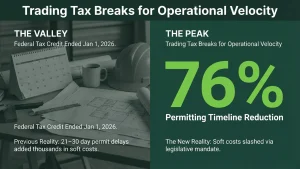
The federal solar tax credit ended January 1, 2026, after President Trump signed the “Big Beautiful Bill” on July 4, 2025. Previously, homeowners received an average $9,000 in tax savings according to EnergySage. However, that incentive no longer exists. Consequently, installers must find new value propositions.
HB 683 delivers that value through reduced soft costs. In fact, permitting delays historically added 20-30 days to Florida solar projects according to Solar Permit Solutions. Now, you’re working within a five-day maximum window.
The Three Critical Provisions Changing Solar Permitting
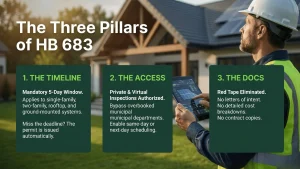
1. Mandatory Five-Day Approval Timeline
Local building officials must respond to single-trade residential permits within five business days. Otherwise, the Florida HB 683 solar permits automatically get approved. This provision applies specifically to:
- Single-family residential installations
- Two-family dwelling solar systems
- Rooftop photovoltaic arrays
- Ground-mounted residential systems
Notably, if officials miss the deadline, they must issue permits the next business day. Therefore, uncertainty disappears from your project scheduling.
2. Private Provider Authorization
Previously, only municipal building departments could perform inspections. However, Florida HB 683 solar permits now allow private inspection companies. Additionally, the law authorizes virtual inspections for single-trade work.
This flexibility delivers several advantages:
- Same-day or next-day inspection scheduling
- Reduced dependency on overbooked municipal inspectors
- Recorded virtual inspections for documentation
- Lower inspection costs in many jurisdictions
Moreover, private providers can use automated plan review systems. For instance, SolarAPP+ from the Department of Energy integrates directly with these new processes. Consequently, standardized submissions become faster and more accurate.
3. Elimination of Contract Documentation
Local governments previously required extensive paperwork before issuing permits. Specifically, they demanded:
- Complete contract copies
- Detailed cost breakdowns
- Letters of intent
- Multiple supporting documents
Florida HB 683 solar permits eliminate these requirements entirely. As a result, your submission packages shrink significantly. Furthermore, you face fewer rejections for missing documentation.
How to Calculate Your Soft Cost Savings
Soft costs include all non-hardware expenses in solar installations. Typically, these encompass permitting fees, inspection costs, and administrative overhead. According to industry research, soft costs add thousands to residential projects.
Here’s how HB 683 reduces these expenses:
Permitting Timeline Reduction
- Previous average: 21 days
- New timeline: 5 days maximum
- Time savings: 76% reduction
Administrative Labor Savings
- Fewer resubmissions due to simplified documentation
- Reduced staff time chasing permit status
- Streamlined inspection coordination
Project Carrying Costs
- Faster completion improves cash flow
- Earlier final payments from customers
- Reduced financing costs for homeowners
In fact, one Florida EPC reduced approval times from three weeks to seven days using HB 683 provisions. This represents a 66% timeline improvement according to Eden Solar Design.
Step-by-Step Implementation Strategy for Installers
Successfully leveraging Florida HB 683 solar permits requires strategic planning. Therefore, follow these actionable steps:
Immediate Actions (This Week)
- Review your current permitting workflows
- Identify bottlenecks that HB 683 eliminates
- Update customer-facing sales materials
- Train sales teams on new timelines
Short-Term Setup (This Month)
- Establish relationships with private inspection providers in Tampa, Miami, Orlando, and Jacksonville
- Evaluate SolarAPP+ integration for your design process
- Adjust project scheduling systems for five-day cycles
- Update permit submission templates
Long-Term Competitive Positioning (This Quarter)
- Develop marketing campaigns highlighting faster installation timelines
- Create case studies showing cost savings
- Build referral programs leveraging improved customer experience
- Expand into new Florida markets using standardized processes
Regional Impact Across Major Florida Markets
Florida HB 683 solar permits apply uniformly across the state. However, some markets see more dramatic improvements:
South Florida (Miami-Dade, Broward, Palm Beach) Previously faced 30-day permitting delays in some jurisdictions. Now, installers report consistent five-day approvals. Additionally, private inspection providers offer next-day scheduling.
Tampa Bay Region (Hillsborough, Pinellas, Pasco) Municipal building departments were understaffed before HB 683. Consequently, permit queues stretched weeks. Now, automated systems process applications within the five-day window.
Central Florida (Orange, Seminole, Osceola) Orlando-area jurisdictions adopted SolarAPP+ early. Therefore, many permits get instant preliminary approval. Furthermore, final authorization occurs within 48 hours.
North Florida (Duval, Alachua, Leon) Jacksonville and Gainesville markets benefit from private provider competition. As a result, inspection costs decreased while availability improved.
Comparing Florida to Other State Solar Permitting Reforms
Florida joins a growing national movement toward streamlined solar permitting. Similarly, other states enacted comparable legislation in 2024-2025:
Texas SB 1202 (June 2025) Authorizes licensed third-party professionals for residential solar permit reviews. Additionally, it allows private providers to bypass slower municipal processes.
New Jersey SB4100 (June 2025) Requires local governments to use the state’s Smart Solar Permitting Platform. Moreover, it mandates automated tools for standardization.
Minnesota HF4700 (May 2024) Allocated $2 million for local SolarAPP+ adoption. Furthermore, it created the Energy Infrastructure Permitting Act.
Colorado APPS Program (September 2024) Offered $1 million in grants for Automated Permit Processing for Solar. Consequently, multiple jurisdictions implemented streamlined systems.
These parallel reforms create opportunities for multi-state installers. Specifically, experience with Florida HB 683 solar permits translates directly to other markets.
Professional Engineering Requirements Under Florida HB 683 Solar Permits
The five-day timeline only works with complete, code-compliant submissions. Therefore, PE-stamped plans remain critical for Florida solar installations.
Professional Engineers must certify:
- Structural adequacy for hurricane wind loads per Florida Building Code
- Electrical design compliance with NEC Article 690
- Roof load calculations meeting FBC R324.4.1.1
- Wind load analysis per FBC 324.4.1.2
- Proper setbacks and pathway requirements
Moreover, plans require stamps from Florida-licensed engineers. Additionally, they must address regional requirements like:
- Coastal High Hazard Areas (Zone V)
- Wind-borne Debris Regions
- High Velocity Hurricane Zones (HVHZ)
Working with experienced engineering partners ensures submissions avoid common rejection reasons. Furthermore, permit-ready plans leverage the full benefits of HB 683’s timeline mandates.
Marketing Your Competitive Advantage
Smart installers position Florida HB 683 solar permits as a unique selling proposition. Specifically, update marketing materials to emphasize:
Speed Advantage “We guarantee installation within two weeks of contract signing, thanks to Florida’s new five-day permit law.”
Cost Savings “Reduced permitting timelines mean lower soft costs that we pass directly to you.”
Professional Expertise “Our permit packages meet the strictest Florida Building Code requirements, ensuring automatic five-day approval.”
Additionally, train sales teams to overcome federal tax credit objections. For example: “While the federal incentive ended, Florida’s permitting reforms reduce installation costs by thousands through faster timelines and eliminated red tape.”

Next Steps for Solar Professionals
The installers winning in 2026 recognize that Florida HB 683 solar permits create immediate competitive advantages. Therefore, take action now:
- Audit your current permitting processes
- Establish private inspection relationships
- Update sales and marketing materials
- Train your team on HB 683 benefits
- Partner with engineering firms offering permit-ready plans
Moreover, stay informed about implementation details as municipalities adapt to the new requirements. Additionally, share success stories to build credibility with prospects.
Florida HB 683 solar permits: Take Advantage of Florida’s 5-Day Rule with Expert Engineering Support
Need permit-ready plans that sail through Florida’s new 5-day approval process? EnergyScape Renewables provides comprehensive solar engineering services across all 50 states, with specialized expertise in Florida’s hurricane wind load requirements and code compliance. Our PE-stamped plan sets, interconnection packages, and permitting support ensure you maximize HB 683’s benefits from day one. From overnight engineering that meets tight deadlines to complete design-to-interconnection services, we handle the technical complexity so you can focus on installations. Visit EnergyScape Renewables to streamline your Florida projects with engineering that’s always permit-ready.
Managing multiple solar projects and need better visibility? The Sunscape platform combines CRM, project management, and site survey tools specifically built for solar installers and EPCs. Track permits through the five-day approval window, coordinate private inspections, and manage customer communications all in one system. With Sunscape’s mobile site survey app, you can gather accurate roof data that feeds directly into your design workflow, ensuring your HB 683 submissions are complete the first time. Explore Sunscape Solar to see how the right software accelerates your entire operation from lead to installation.
Frequently Asked Questions About Florida HB 683 Solar Permits
Does HB 683 apply to commercial solar installations? The five-day mandate specifically covers single-trade residential permits. However, commercial projects benefit from other HB 683 provisions like private inspections.
What happens if my permit gets rejected? Rejections for incomplete applications don’t trigger automatic approval. Therefore, ensure initial submissions meet all requirements. Consequently, working with experienced engineering partners prevents rejections.
Can I use virtual inspections for all installation phases? Yes, Florida HB 683 solar permits authorize virtual inspections for single-trade work. However, some jurisdictions may require in-person final inspections for utility interconnection.
Do private providers cost more than municipal inspections? Costs vary by market. However, many installers find private providers competitively priced. Additionally, faster scheduling reduces overall project costs.
sjayakanth@energyscaperenewables.com