
Commercial Solar Permitting 2026: Complexity, Timeline & Regional Variations

Navigating Commercial Solar Permitting Complexity in 2026
Your commercial solar project is ready to go. The client’s budget is approved. Your crew stands ready to mobilize. Then the AHJ rejects your permit package—two weeks after submission. This scenario unfolds across the nation daily, creating costly delays and timeline pressure. Installers underestimate permitting complexity when scaling from residential to commercial solar work. The reality? Commercial solar permitting demands precision that most installers don’t anticipate.
Rejections cost between $2,000 to $5,000 per cycle, plus crew downtime and missed deadlines. This comprehensive guide walks you through 2026’s permitting landscape. You’ll discover what AHJs actually require. Meanwhile, you’ll learn how regional variations affect your timeline. Most importantly, you’ll understand how first-submission approvals protect your margins. Commercial solar permitting isn’t harder because AHJs are difficult—instead, it’s harder because commercial systems carry genuine safety and electrical complexity that regulators rightfully scrutinize.
Understanding the Core Differences: Commercial Solar Permitting vs. Residential
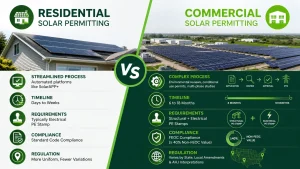
Residential solar systems operate under streamlined frameworks. However, many jurisdictions use automated platforms like SolarAPP+ for instant approvals, while commercial solar permitting follows entirely different rules. A 500 kW ground-mount commercial system commonly requires 6 to 18 months from application to Permission to Operate (PTO). That timeline stretches because commercial installations trigger environmental reviews, conditional use permits, and multi-phase utility interconnection studies.
Furthermore, your permit package needs both structural and electrical PE stamps—a dual requirement most residential applications don’t demand. Interestingly, commercial projects now require FEOC (Foreign Entity of Concern) compliance documentation. This means verifying that at least 40% of manufactured product value comes from non-FEOC suppliers. By contrast, residential projects face no such mandate.
The complexity multiplies further when you realize that regional variations mean what works in California may fail in Texas. Consequently, there’s no national standard—only state rules, local amendments, and individual AHJ interpretations.
The NEC 2026 Impact on Commercial Solar Permitting
The National Electrical Code’s 2026 edition introduced changes that directly affect your permitting success. Specifically, NEC 690.8(A)(1) now mandates using the highest short-circuit current value from module datasheets with zero exceptions. This single requirement changes conductor sizing across commercial installations, making it impossible to round down to cheaper wire sizes anymore.
Furthermore, NEC Section 690.4(G) enforces mandatory rounding in calculations. As a result, both changes increase material costs and create first-submission rejection risks. The bigger problem, however, is that state adoption varies wildly. California enforces NEC 2026 statewide, whereas North Carolina still references NEC 2020.
Submitting a plan set built against the wrong code edition is one of the fastest ways to guarantee rejection. Notably, NEC code mismatches account for roughly 30–40% of solar permit rejections nationwide. For multi-state EPCs, this means maintaining separate code templates per jurisdiction. Therefore, one mistake burns your AHJ slot for two to four weeks.
Regional Variations in Commercial Solar Permitting Requirements
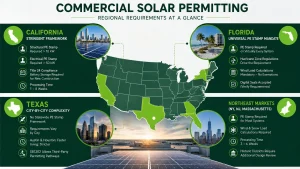
California’s Stringent Framework
California requires structural PE stamps for systems above 10 kW. Additionally, electrical stamps apply to systems over 50 kW. Meanwhile, Title 24 Building Energy Efficiency Standards demand battery energy storage integration on new construction. Processing times range from one to eight weeks depending on whether you use SolarAPP+ or traditional submission. The advantage? California mostly enforces NEC 2026 consistently across jurisdictions.
Florida’s Universal PE Stamp Mandate
Florida requires PE stamps on virtually every solar installation. Specifically, hurricane zone regulations drive this requirement nationwide. Moreover, wind load calculations are mandatory with no exemptions whatsoever. Most Florida jurisdictions accept digital seals, but you must verify requirements first.
Texas’s City-by-City Complexity
Texas has no statewide PE stamp framework. Consequently, requirements shift city by city across the state. Austin and Houston process permits quickly, whereas Irving applies stricter standards. Importantly, SB1202 lets installers bypass difficult AHJs using third-party permitting pathways. This escape route only works if you know it exists.
Northeast Markets (NY, NJ, Massachusetts)
New York requires PE stamps for most systems statewide. Additionally, coastal regions demand wind and snow load calculations. Similarly, New Jersey follows comparable patterns. Boston processes permits in three to six weeks—unless your property sits in a historic district, which triggers additional design review requirements.
Timeline Management: The 6-18 Month Reality
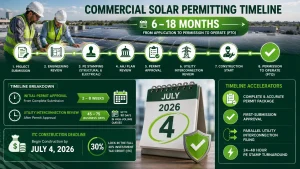
Commercial solar permitting timelines extend far beyond most installers’ expectations. Typically, initial permit approval requires two to eight weeks from a complete, correct submission. However, that’s just the first step in the overall process. Utility interconnection reviews add 45 to 75 business days in the Southeast and Mid-Atlantic. Furthermore, some utilities stretch that to 90 days in high-volume queues.
Importantly, the ITC construction deadline adds considerable time pressure. Commercial projects must begin construction by July 4, 2026, to lock in the full 30% investment tax credit. Consequently, projects starting after that date face reduced credits. Three consistent factors shorten timelines: complete, accurate applications on first submission; parallel interconnection filing (not sequential); and partnership with engineering firms offering 24-48 hour PE stamp turnaround.
The PE Stamp Strategy for Commercial Solar Permitting Success
Professional Engineer stamps verify that qualified engineers reviewed your design. Specifically, this detail alone reduces AHJ review burden and accelerates approval. Here’s what you need: structural stamps confirm the building can handle solar loads plus wind, snow, and seismic forces. Additionally, electrical stamps verify circuit sizing, NEC compliance, and equipment specifications.
California requires both stamps for larger systems, while Florida requires stamps on virtually everything. Notably, Texas requirements depend on your specific city. The game-changer? Digital PE seals. Traditional wet stamp packages take five to seven days including printing and shipping, whereas digital seals arrive in 24 to 48 hours.
For EPCs managing multiple projects simultaneously, this speed advantage compounds monthly. Moreover, multi-state engineering partnerships eliminate the search for local engineers every time you enter a new jurisdiction.
FEOC Compliance: The 2026 Requirement Installers Miss
Starting January 2026, commercial solar systems claiming ITC incentives must source at least 40% of manufactured product value from non-FEOC suppliers. Panels, inverters, and battery equipment all fall under this rule. Furthermore, AHJs in California, Texas, and Florida now require FEOC compliance documentation during permit submission. This isn’t an afterthought—instead, it’s a pre-design checklist item.
Missing FEOC documentation triggers rejections that cost time and money. Without proper sourcing documentation, you can’t claim tax credits your clients depend on.
First-Submission Approval Strategy
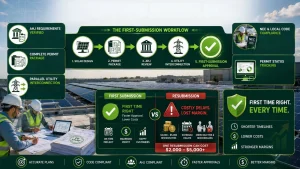
The difference between fast projects and slow projects boils down to first-submission approvals. Specifically, successful installers share these habits: they verify AHJ-specific requirements before design begins. Additionally, they submit complete packages with all required documentation. Furthermore, they parallel-file interconnection applications instead of waiting for permit approval.
Importantly, they partner with engineering firms understanding both NEC requirements and local code amendments. They maintain jurisdiction-specific checklists. Finally, they track permit status proactively. One resubmission cycle costs $2,000 to $5,000 in revision fees, administrative overhead, and crew rescheduling. Consequently, on a single job, that wipes out meaningful margin.
Solving Commercial Solar Permitting Through Partnership
Scaling commercial solar work demands operational infrastructure residential work doesn’t require. Commercial solar permitting succeeds when you eliminate variables you can’t control and leverage partners who handle the complexity.
Importantly, EnergyScape Renewables delivers PE-stamped commercial plan sets from 10 kW to 5 MW across all 50 states. Their engineering team holds active licenses nationwide. Additionally, structural and electrical stamps turn around in 24 to 48 hours. Every plan set includes NEC 2026 compliance and FEOC documentation. Notably, their 99% first-submission AHJ approval rate reflects deep understanding of what regulators actually require.
Once your plans clear, Sunscape Solar keeps your entire project pipeline organized. From permit tracking through interconnection deadlines to final PTO, one platform manages every milestone. Consequently, your team focuses on closing and installing instead of juggling spreadsheets across three states.
sjayakanth@energyscaperenewables.com