
Commercial Solar Plan Sets vs. Residential: Key Differences Every EPC Must Understand
What Every EPC Must Know About Commercial vs. Residential Differences
If you’ve been in solar long enough, you already know this truth. Pulling permits for a commercial job feels nothing like processing paperwork for a residential rooftop. Yet, many EPCs still approach both project types using a similar framework. That’s exactly where costly delays start piling up. A commercial solar plan set carries a different level of engineering complexity. It also demands greater regulatory scrutiny and deeper documentation depth. Understanding these differences isn’t just helpful — it directly impacts your bid accuracy and project timelines. Furthermore, your inspection pass rates and bottom line depend on it too.
Why the Residential vs Commercial Solar Plan Set Debate Matters for EPCs
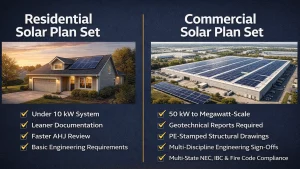
Let’s be straightforward here. When solar installers and EPCs treat a commercial project like a scaled-up residential job, things go sideways fast. Moreover, the residential vs commercial solar plan set distinction isn’t just about system size. It touches everything. That includes structural engineering requirements, load calculations, utility interconnection agreements, and fire setback compliance.
A residential solar plan set typically covers systems under 10 kW on a single-family home. The documentation stays leaner, and the AHJ review moves quicker. The engineering requirements, while still important, demand far less intensity. Commercial projects, however, regularly involve systems ranging from 50 kW to multiple megawatts. Consequently, these projects sit on flat commercial rooftops, carports, or ground-mount structures. They demand detailed geotechnical reports, stamped structural drawings, and multi-discipline engineering sign-offs.
For EPCs operating across multiple states, understanding these differences remains non-negotiable. Each jurisdiction applies its own interpretation of the NEC, IBC, and local fire marshal regulations. As a result, that complexity compounds significantly on every commercial job.
What Actually Goes Into a Commercial Solar Plan Set
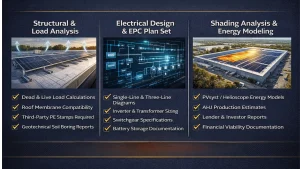
A well-prepared commercial solar plan set includes far more documentation layers than most installers anticipate. In fact, here’s what clearly separates it from a standard residential package.
Structural and Load Analysis Sets Commercial Projects Apart
Commercial rooftops are simply not uniform. For example, a flat TPO roof on a warehouse in Texas faces different wind uplift pressures than a metal roof in Minnesota. Therefore, your plan set must include detailed dead load and live load calculations. Your drafter also needs to add roof membrane compatibility assessments. In many cases, third-party structural engineering stamps become mandatory. Additionally, ground mounts require geotechnical soil boring reports and foundation design documentation. None of these elements show up in a typical residential solar permit package.
Electrical Design Complexity in an EPC Plan Set
The electrical complexity in commercial solar projects scales quickly. Specifically, your EPC plan set needs detailed single-line diagrams showing inverter configurations, transformer sizing, and utility point of interconnection. Your engineer must also include switchgear specifications and protection relay coordination. For commercial projects with battery storage, documentation requirements multiply even further. Furthermore, utilities increasingly require three-line diagrams for larger commercial interconnects. Residential jobs, by contrast, simply don’t need this level of detail.
Shading Analysis and Energy Modeling Requirements
Residential plans sometimes include basic shading reports. Commercial solar permitting, however, demands comprehensive PVsyst or Helioscope energy models. AHJs routinely require these detailed production estimates. Beyond that, lenders, investors, and off-takers also rely on them to evaluate financial viability.
Residential Solar Plan Sets: Simpler, But Still Critical
It would be wrong to dismiss residential solar plan sets as unimportant. After all, a clean, accurate residential package still determines whether your inspector approves the job on the first visit. However, the scope stays comparatively manageable. A standard residential plan set covers a site plan, roof plan with module layout, electrical diagram, equipment specs, and a labeling schedule. Experienced drafters can produce these quickly when design tools stay dialed in.
That said, net metering rules continue to evolve across US states. At the same time, interconnection queues grow tighter every season. As a result, even residential solar permitting documents are getting more detailed. Therefore, EPCs working in California, New York, and New Jersey must stay current with these evolving residential permitting standards.
Key Compliance Differences EPCs Can’t Afford to Ignore
Code Compliance and AHJ Requirements
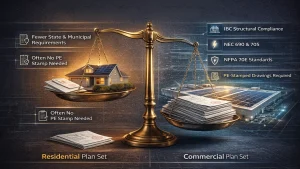
Commercial solar installations fall under stricter AHJ oversight. For instance, inspectors reviewing a commercial job expect IBC compliance for structural work. They also require NEC Article 690 and 705 adherence along with NFPA 70E standards for electrical safety. Additionally, many commercial projects trigger separate building permit requirements. This situation rarely applies to residential rooftop installs.
PE Stamps and Documentation Depth in the Residential vs Commercial Solar Plan Set
One of the clearest separators in the residential vs commercial solar plan set comparison involves PE stamp requirements. Most commercial solar permits require a licensed professional engineer to stamp both structural and electrical drawings. Residential projects in many jurisdictions, however, skip this requirement entirely. Consequently, EPCs managing volume across multiple states gain a genuine competitive advantage by partnering with reliable engineering teams. Those partners must understand both sets of requirements clearly.
How a Strong EPC Plan Set Accelerates Your Projects
Experienced EPCs understand this clearly. Permit approval speed ties directly to plan set quality. Specifically, a thorough and well-organized EPC plan set reduces back-and-forth with inspectors. It also eliminates common correction requests and builds lasting credibility with AHJs. As solar design software continues advancing in 2026, EPCs that invest in professional-grade documentation workflows consistently outperform their competitors. Their project timelines improve, and client satisfaction follows naturally.
How Energyscape Renewables Supports EPCs on Commercial and Residential Plan Sets
Whether you’re managing a 500 kW commercial rooftop in Georgia or processing residential permits across multiple crews in Arizona, the right documentation partner changes everything. Energyscape Renewables delivers professional-grade commercial solar plan sets and residential solar permit packages built specifically for US solar installers and EPCs. Their team navigates multi-state AHJ requirements, coordinates PE stamps, and handles utility interconnection documentation — so your crews stay focused on installing solar.
For EPCs looking to scale without sacrificing plan quality, Energyscape Renewables offers a streamlined documentation workflow that keeps your pipeline moving and your projects on schedule. Additionally, for solar businesses seeking broader design and sales tools, Sunscape Solar offers resources well worth exploring.
Ultimately, the difference between a smooth commercial permit approval and a costly correction cycle comes down to one thing. It’s the quality of your commercial solar plan set. So make sure yours is built right from day one.
sjayakanth@energyscaperenewables.com