
Bifacial Solar Panels Residential: ROI & Cost Guide 2026
BIFACIAL PANELS IN RESIDENTIAL: IS THE EFFICIENCY GAIN WORTH THE COST?
Bifacial Solar Panels Residential: When the Numbers Actually Make Sense
Are bifacial solar panels residential installations worth the premium price? That’s the question every US installer faces as incentives shrink and customers demand more efficiency per square foot. Moreover, with the federal tax credit potentially ending in late 2025, installers need clear guidance on when to recommend these commercial-grade modules.
This guide breaks down the real-world ROI of bifacial solar panels residential projects. Additionally, we’ll show you exactly when these dual-sided modules deliver value—and when traditional panels are the smarter choice.
What Makes Bifacial Solar Technology Different
Bifacial solar panels residential systems work differently than standard modules. First, they capture sunlight from both the front and rear surfaces. While the front operates like any traditional panel, the backside harvests reflected light from surrounding surfaces.
This reflected light is called albedo. Consequently, panels installed over white gravel or concrete can capture significantly more energy. Research from LONGi Solar shows bifacial panels generate 11% more energy in ground-mounted installations. Furthermore, when paired with tracking systems, that gain jumps to 27%.
However, the real question isn’t about lab performance. Instead, installers need to know: what happens in actual residential applications?
The Technology Behind Higher Efficiency
Modern bifacial modules use N-Type TOPCon or PERC cell technology. These advanced cells offer several advantages over traditional P-Type silicon. Specifically, they provide:
- Lower degradation rates (under 0.4% annually)
- Better temperature coefficients
- Improved low-light performance
- Higher bifacial factors (80-95%)
As a result, these panels maintain efficiency longer. Current pricing ranges from $0.40-0.50 per watt for modules alone. Meanwhile, complete installed systems cost $3.00-4.00 per watt for bifacial solar panels residential applications.
Why Most Rooftop Installs Don’t Work
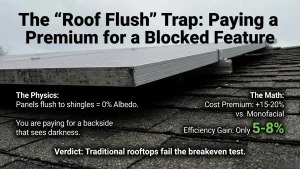
Here’s where bifacial solar panels residential projects often fail: traditional rooftop installations. When panels mount flush against pitched roofs, they can’t capture rear-side light effectively. Your customer’s home blocks the very feature they’re paying extra for.
Consider typical conditions. Most residential roofs use dark asphalt shingles with 10-15% albedo. Even under ideal circumstances, you might gain only 5-8% additional output. Therefore, that barely justifies the 15-20% cost premium over quality monofacial panels.
Additionally, installation complexity increases costs further. Bifacial modules need specialized mounting systems. These systems must maintain proper clearance and prevent rear shading. Consequently, install times increase and labor costs rise.
Three Scenarios Where Bifacial Delivers ROI
Despite rooftop limitations, bifacial solar panels residential installations excel in specific applications. Here are three scenarios that consistently deliver positive returns:
Ground-Mount Systems with Reflective Surfaces
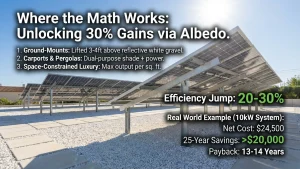
First, consider properties with available land. When you install panels 3-4 feet above white gravel or concrete, bifacial gains reach 20-30%. For example, a typical 10kW system costs approximately $35,000 before incentives. After applying the 30% federal tax credit, net cost drops to $24,500.
This investment delivers over $20,000 in savings across 25 years. Moreover, the payback period falls between 13-14 years. As reported by EnergySage, these numbers make ground-mount bifacial competitive with premium monofacial systems.
Solar Carports and Pergola Structures
Second, elevated structures provide excellent bifacial performance. These installations serve dual purposes—providing shade while generating power. The panels capture reflected light from vehicles and pavement below.
Commercial property owners particularly value this approach. In addition to energy savings, they gain functional parking structures. Therefore, the total value proposition exceeds simple electricity generation.
High-Value Properties with Space Constraints
Third, some customers prioritize maximum output per square foot. In luxury markets, aesthetics and performance outweigh upfront costs. For these bifacial solar panels residential projects, the premium pricing becomes less significant.
These installations typically feature custom designs. Furthermore, they integrate architectural elements that enhance property value beyond energy savings.
Engineering Requirements Installers Must Know
When specifying bifacial solar panels residential systems, engineering requirements change significantly. First, structural calculations need updates. Many AHJs require PE stamps regardless of system size due to different wind loading characteristics.
This requirement creates challenges for installers. You need structural engineers who understand bifacial-specific loads. Moreover, they must provide PE-stamped plans that pass inspection on the first submission. According to EnergyScape Renewables, permit rejections on high-cost bifacial systems double your losses.
Second, electrical design must account for different specifications. N-Type bifacial cells have unique temperature coefficients. Additionally, they require different string voltage calculations. Get this wrong and you’ll either undersize the inverter or waste money on oversized equipment.
Managing Customer Expectations Successfully
The hardest part of selling bifacial isn’t explaining technology. Instead, it’s managing expectations realistically. Homeowners read marketing materials claiming “30% more power” and assume that applies everywhere.
Your job involves education first. Start with honest site assessment. Walk the property and evaluate albedo conditions carefully. Ask these critical questions:
- Is there reflective surface below the proposed array?
- Can you maintain 3-4 feet of clearance?
- Does the mounting structure support bifacial requirements?
- What’s the actual albedo of ground surfaces?
Next, run transparent calculations. Show customers the cost difference between systems. Calculate realistic bifacial gain based on their specific site—not perfect lab conditions. Then provide payback periods for both options.
Most importantly, don’t oversell inappropriate applications. When the site isn’t right for bifacial, recommend quality monofacial panels instead. Your reputation as a trusted advisor outweighs any single sale.
Bifacial Solar Panels Market Growth and Future Opportunities
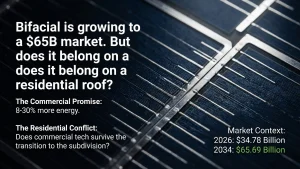
The bifacial market is expanding rapidly. According to Fortune Business Insights, the global bifacial solar market will grow from $34.78 billion in 2026 to $65.69 billion by 2034. This growth signals increasing adoption across all market segments.
Major manufacturers now target residential applications specifically. For instance, SunPower recently launched the Monolith series. These panels start at 470W and will upgrade to 500W+ bifacial designs. Importantly, they’re optimized for residential constraints rather than utility-scale installations.
As production scales increase, costs continue declining. Therefore, bifacial solar panels residential applications become increasingly competitive with traditional technology.
Permitting and Compliance Considerations
Bifacial installations add permitting complexity that installers must navigate. Many jurisdictions require additional documentation because these systems fall outside standard templates. Specifically, you’ll need:
- Comprehensive PE-stamped structural calculations
- Updated electrical diagrams showing bifacial-specific components
- Wind tunnel testing data for elevated structures
- Albedo factor documentation for rear-side gain calculations
Smart installers partner with engineering firms specializing in solar permitting. Firms offering 24-hour PE stamping turnaround become invaluable when closing deals quickly. Moreover, they understand current code requirements across all 50 states.
This expertise prevents costly delays. First-time permit approvals keep crews working and customers satisfied. Additionally, professional engineering reduces liability exposure on high-value installations.
Bifacial Solar Panels: Making the Right Recommendation
Bifacial solar panels residential applications aren’t universal solutions. Instead, they’re specialized tools delivering value in specific scenarios. As incentives decrease, customers increasingly demand maximum efficiency.
The residential solar market added approximately 19,000 megawatts of capacity in 2024. Growth continues accelerating across all market segments. Installers who master advanced technologies position themselves competitively as the market matures.
Focus on three key priorities:
- Proper site assessment – Evaluate actual conditions honestly
- Honest customer education – Set realistic expectations upfront
- Flawless execution – Get engineering right from day one
Remember this principle: the best system isn’t always the most advanced. Rather, it’s the one delivering the strongest ROI for each customer’s specific situation.
Get Professional Engineering Support for Complex Installations
Complex bifacial solar panels residential projects demand professional engineering backing. EnergyScape Renewables provides PE-stamped structural and electrical plans across all 50 states. Their 24-hour turnaround keeps projects moving forward.
Licensed engineers at EnergyScape understand bifacial-specific requirements. They work directly with AHJs ensuring first-time approval rates. From initial site assessment through final interconnection, they navigate permitting complexity professionally.
Stop risking delays with inadequate engineering support. Visit energyscaperenewables.com or call +1 855-263-0700 today. Discover how overnight engineering capability keeps your pipeline flowing smoothly.
Manage Projects Efficiently with Purpose-Built Software
From initial customer contact through final commissioning, installers need robust project management. Sunscape provides CRM and tracking tools designed specifically for solar businesses. Track site assessments, manage engineering requirements, and coordinate installation teams seamlessly.
Whether managing standard rooftop installs or complex bifacial ground-mount systems, Sunscape ensures nothing slips through the cracks. Professional project management software helps you close more deals while executing flawlessly.
Explore how leading installers work smarter. Visit sunscape.solar to see the complete platform in action.
sjayakanth@energyscaperenewables.com