
How to Survey Existing Solar Homes for Battery Retrofits

Why a Battery Retrofit Survey Matters More Than Ever
Your past solar customers are calling back. Net billing rules like California’s NEM 3.0, rising outage risk, and shifting incentives have them asking about storage. However, many installers treat these jobs like brand-new installs. That mistake leads to failed inspections, surprise panel upgrades, and change orders that eat your margins. A structured battery retrofit survey solves this problem early. It captures the existing system, the electrical service, and the code limits in one visit.
As a result, your design team quotes accurately and your crew installs without surprises. Below, we break down a field-tested process for evaluating solar homes before adding energy storage.
Step 1: Document the Existing Solar System First
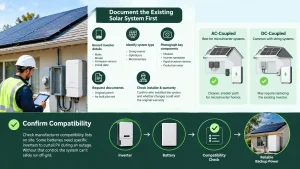
A good battery retrofit survey starts with what’s already on the roof and the wall. Begin with the inverter. Record the make, model, firmware version, and install date. Next, note whether the system uses string inverters, optimizers, or microinverters. This detail drives your coupling decision later.
Then, photograph every label. That includes modules, the inverter nameplate, rapid shutdown devices, and the production meter. Also, ask for the original permit and as-built plan set. Finally, find out who installed the system. If another company did the work, check whether your changes could void the original warranty.
AC-Coupled vs. DC-Coupled: Decide During the Battery Retrofit Survey
Your inverter findings shape the entire design. For microinverter homes, an AC-coupled battery is usually the cleanest path. Meanwhile, string systems may support a DC-coupled hybrid inverter. However, that option often means replacing a working inverter.
Therefore, confirm manufacturer compatibility lists while you’re on site. Some batteries need specific inverters to curtail PV during an outage. Without that control, the system can’t safely run off-grid.
Step 2: Evaluate the Main Service Panel for Solar Battery Retrofits
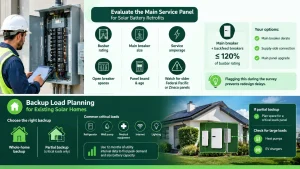
The main service panel decides more solar battery retrofits than any other component. So, record the busbar rating, main breaker size, and service amperage. Count open breaker spaces and note the panel brand and age. Older Federal Pacific or Zinsco panels usually signal a required replacement.
Next, run the numbers against NEC 705.12. Under the 120% rule, the main breaker plus all backfeed breakers can’t exceed 120% of the busbar rating. Your existing PV breaker already uses part of that allowance. Consequently, adding battery backfeed often pushes the panel over the limit. Your options then include a main breaker derate, a supply-side connection, or a main panel upgrade. Flagging this during the battery retrofit survey saves weeks of redesign.
Backup Load Planning for Existing Solar Homes
Next, help the homeowner choose between whole-home and partial backup. Ask which loads truly matter during an outage. Common picks include the refrigerator, well pump, medical equipment, internet, and select lighting.
Also, request 12 months of utility interval data. This data shows peak demand and helps you size battery capacity correctly. If the customer picks partial backup, plan wall space for a critical loads panel. Additionally, check whether large loads, like heat pumps or EV chargers, need load management.
Step 3: Assess Battery Location and Code Compliance
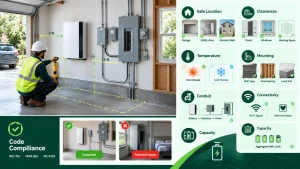
Location mistakes fail more storage inspections than wiring errors. NEC Article 706, NFPA 855, and IRC R328 set the rules for residential energy storage, depending on what your AHJ adopts. Generally, these codes allow batteries in garages, utility spaces, and on exterior walls. However, they bar installs in sleeping rooms and closets that open into them.
During the walk-through, measure wall space, working clearances, and distances from doors and windows. Many AHJs require at least 3 feet from openings into the home for exterior installs. In garages, note whether a vehicle could strike the unit, because impact protection may apply. Also, record temperature risks. A battery in an Arizona garage faces very different derating concerns than one in Minnesota. Finally, confirm aggregate kWh limits for multi-battery systems.
Structural and Site Conditions to Capture
Check the wall type and stud spacing for mounting. Floor-standing units may need a level concrete pad. Furthermore, measure conduit runs between the battery, gateway, and main panel. Long runs affect voltage drop and labor hours.
Don’t forget connectivity. Weak Wi-Fi at the battery location causes commissioning headaches. So, test signal strength or plan an Ethernet run.
Step 4: Review Utility and Interconnection Requirements
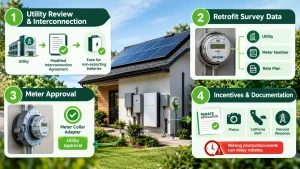
Adding storage changes your interconnection agreement. Most utilities require a modified application, even for non-exporting batteries. So, note the utility, meter number, and current rate plan during your battery retrofit survey.
Also, check the meter location. Some backup designs use a meter collar adapter, which needs utility approval. In addition, confirm local incentive programs, such as California’s SGIP or utility demand response programs. These programs have their own documentation rules, and missing photos can delay rebates.
Build a Repeatable Battery Retrofit Survey Checklist
Consistency separates profitable storage contractors from the rest. A standard battery retrofit survey checklist should cover:
- Existing system: inverter, modules, rapid shutdown, monitoring, and warranty status
- Electrical: busbar rating, main breaker, open spaces, grounding, and bonding
- Loads: interval data, critical loads, and large motor loads
- Location: clearances, code distances, impact protection, and temperature
- Utility: meter, rate plan, interconnection, and incentive eligibility
- Photos: every label, the panel interior, and the proposed equipment location
Also, switch from paper forms to digital survey tools. Structured data flows straight to your design team. As a result, designers stop chasing field techs for missing photos.
Quick FAQs for Solar Installers and EPCs
How long does a battery retrofit survey take?
With a solid checklist, most site visits take 60 to 90 minutes.
Can you add a battery to any existing solar system?
Most systems can accept AC-coupled storage. However, panel capacity and inverter compatibility drive the final cost.
Does a battery retrofit need a new permit?
Yes, in nearly every US jurisdiction. Expect an electrical permit and an updated interconnection application.
How EnergyScape Renewables Supports Your Battery Retrofit Projects
At EnergyScape Renewables, we help solar installers and EPCs turn field data into permit-ready storage projects. Our team delivers site surveys, energy storage plan sets, and PE-stamped engineering across all 50 states. We also handle permitting and interconnection modifications, so your crews stay focused on installs. Every battery retrofit survey we review gets checked against NEC 705, NEC 706, and local AHJ requirements before design begins.
To manage storage jobs from survey to PTO, pair our services with Sunscape, a solar CRM built for US installers. Together, we help you close more retrofit deals with fewer change orders and faster approvals. Ready to grow your storage pipeline? Contact EnergyScape Renewables today.
sjayakanth@energyscaperenewables.com