
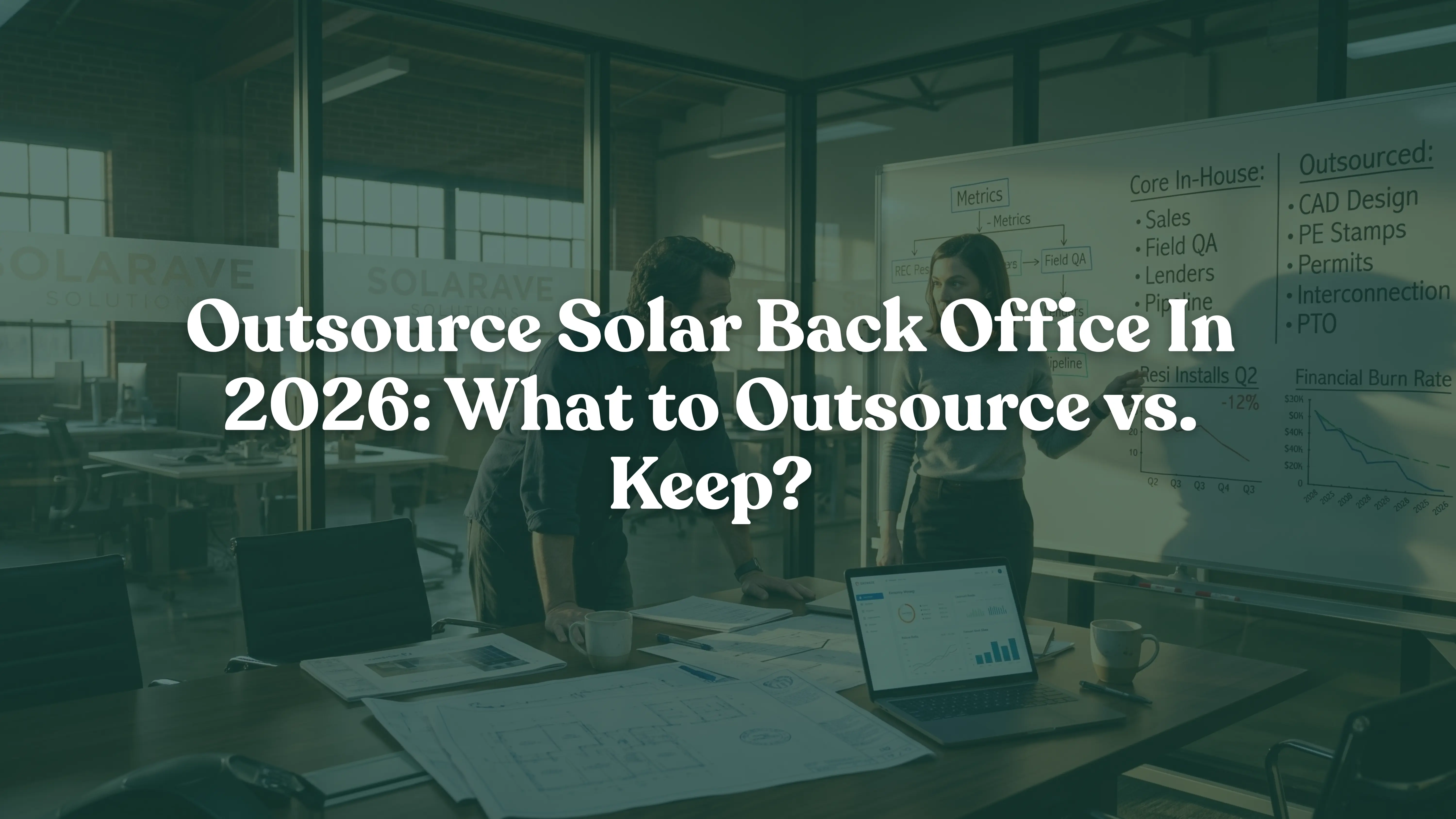
Outsource Solar Back Office In 2026: What to Outsource vs. Keep?
Solar BPO Services in 2026: What to Outsource and What to Keep In-House
Outsource solar back office in 2026: Residential solar is having a hard year, and solar BPO services have moved from a nice-to-have to a survival tool. After the Section 25D credit expired on December 31, 2025, SEIA and Wood Mackenzie projected a 19% drop in residential installs for 2026. Then their Q3 2026 Solar Market Insight report confirmed the slide. Residential capacity fell 12% year over year in Q2.
Layoffs followed. For example, Freedom Forever pulled out of 10 of its 30 state markets and cut about 20% of its workforce. Enphase also cut 160 jobs. Meanwhile, smaller shops quietly let go of designers and permit coordinators.
So most owners now ask the same question. Which back-office work stays on payroll, and which moves to a partner? This guide gives you a simple test and a clear split.
Quick answer: Outsource solar back office work that a reviewer checks against a code or checklist. That means plan sets, PE stamps, permits, interconnection and PTO. However, keep sales, financier relationships, install quality, final QA and your project pipeline in-house.
What Are Solar BPO Services?
Solar BPO (business process outsourcing) means handing repeatable back-office work to a specialized partner. Instead of paying salaries, you pay per project. For installers and EPCs, the work usually covers:
- Sales proposals and site survey processing
- Plan sets and PE stamps
- Permit submittals and AHJ follow-ups
- Interconnection applications and PTO tracking
Generic BPO firms run call centers and data entry. Solar BPO is different, because the work is engineering-heavy and code-driven. Your partner has to know NEC editions, ASCE 7-22 loads and your AHJ’s quirks.
Why Outsource Solar Back Office In 2026 Matters Now?
Three pressures are hitting installers at the same time.
First, volume you can’t forecast. The market expects a down 2026 and a recovery starting in 2027. As a result, fixed back-office payroll is the worst cost structure for that curve.
Second, more paperwork per job. Third-party ownership now leads the market. In fact, Sunrun expects TPO to make up more than 80% of its 2026 originations. Financier milestone packages and FEOC documentation add office hours, even as installs fall.
Third, soft costs still dominate. In the latest national lab benchmark, soft costs made up about half the price of a residential system. That’s roughly $1.64/W. By contrast, panels were only about 12%.
In short, your crews aren’t the bottleneck. Your office is.
The One-Question Test for Outsourcing
We call it the one-question test. For every back-office task, ask:
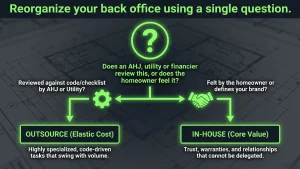
Does an AHJ, utility or financier review this, or does the homeowner feel it?
If a reviewer checks it against a code or checklist, it’s a strong candidate to outsource. On the other hand, if the homeowner feels it or it defines your brand, keep it in-house.
What to Outsource vs. Keep In-House
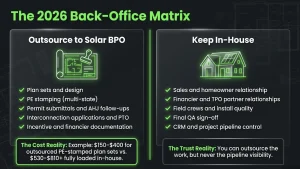
| Outsource to solar BPO services | Keep in-house |
|---|---|
| Plan sets and design | Sales and the homeowner relationship |
| PE stamping (multi-state) | Financier and TPO partner relationships |
| Permit submittals and AHJ follow-ups | Field crews and install quality |
| Interconnection applications and PTO | Final QA sign-off |
| Site survey processing and proposals | Your CRM and project pipeline |
| Incentive and financier documentation | Pricing and contracts |
Why These Tasks Belong With a Partner
These tasks are specialist, code-driven and swing with volume. Also, a missed detail here costs you a resubmittal, not a customer.
Plan sets are the clearest case. Outsourced PE-stamped residential plan sets typically run $150 to $400. Compare that with $530 to $810+ fully loaded in-house, as our solar permitting outsourcing cost breakdown shows. Likewise, holding PE licenses in many states is expensive. Our guide to PE stamp costs in 2026 walks through that math.
Permits and interconnection follow the same logic. Portal logins, redline responses and utility checklists change often. A high-volume partner tracks them every day, so your team doesn’t have to.
Why These Tasks Stay With You
Trust is your brand, so don’t outsource the kitchen table. Similarly, pricing, dealer standing and workmanship warranties belong to you. Someone on your team should also own the final yes on every plan set.
Most importantly, you can outsource the work but never the visibility. Every job’s status, documents and next step should live in a CRM you control. Otherwise, permits vanish into email threads. Then reps can’t answer a homeowner’s “where’s my permit?” call, and PTO dates slip.
When In-House Engineering Still Makes Sense
Outsourcing isn’t always cheaper. For instance, a single-state installer with high, steady volume and a trained designer can push cost per plan set below $400. If that’s you, keep core design in-house. Then send overflow, PE stamps and out-of-state jobs to a partner. This hybrid model is common and smart.
Still, most companies don’t fit that profile in 2026. Multi-state operators, shops with lumpy volume and anyone who just cut staff usually win with a per-project model.
How to Switch to Solar BPO Services Without Losing Control
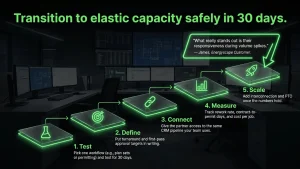
Start small and measure everything. Here’s a simple five-step rollout:
- Pick one workflow, like plan sets or permitting, and test it for 30 days.
- Put turnaround and first-pass approval targets in writing.
- Give your partner access to the same pipeline your team uses.
- Track rework rate, contract-to-permit days and cost per job.
- Add interconnection and PTO once the numbers hold.
Speed during busy months matters most. As one Energyscape customer, James, put it: “What really stands out is their responsiveness during volume spikes.” That elastic capacity is the whole point. For more on this, read how to scale solar install volume without growing headcount.
Build a Lean Back Office That’s Ready for 2027
Keep what the homeowner feels. Hand off what the AHJ reviews. Then see all of it in one place.
Energyscape Renewables takes the “outsource” column off your plate. That includes sales proposals, site surveys, plan sets, 24-hour PE stamping in all 50 states, permitting, AHJ follow-ups, interconnection and PTO. Installers working with us have grown monthly throughput 4X without adding overhead. We also hold a 99% AHJ and utility approval rate. Request a quote →
Sunscape, your Solar OS, runs the “keep” column. Every outsourced step shows up in one pipeline, from survey to design, permit, interconnection and PTO. So you never chase job status through email again. Book a Sunscape demo →
Cut fixed costs now. Keep full control. Be ready when the market comes back.
Frequently Asked Questions: Outsource Solar Back Office In 2026
What are solar BPO services?
Solar BPO services are per-project outsourcing of back-office work, such as design, PE stamps, permitting, interconnection and PTO. A solar-specialized partner handles the work, and you pay only for jobs you send.
Should small solar installers outsource permitting?
Usually, yes. Small teams rarely have enough steady volume to keep a permit coordinator busy. Pay-per-project pricing also means zero cost in a slow month.
What should a solar company never outsource?
Never outsource customer relationships, install quality, final QA or visibility into project status. Those protect your brand, your license and your cash flow.
Does outsourcing slow solar projects down?
Not with the right partner. Specialized firms can deliver plan sets overnight, because they submit to the same AHJs every day.
sjayakanth@energyscaperenewables.com