
Commercial Solar Plan Sets: Why Small C&I Projects Need Different Documentation (50kW–500kW)
Why Commercial Solar Plans Trip Up Small C&I Teams
Many installers treat a 200kW warehouse job like a big residential roof. That assumption costs them. Commercial solar plans demand deeper engineering, stricter code review, and far more documentation than any home install. As a result, drawing sets that breeze through residential permitting start failing on first submittal. The good news? The fix is straightforward. You build C&I solar documentation that matches the project, not the old habit. So this guide breaks down what actually changes between 50kW and 500kW, and how the right plan set keeps your permits moving instead of stalling.
What Makes Small Commercial Solar Plans Different
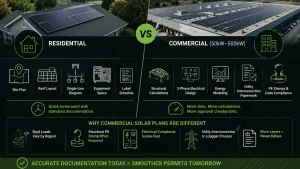
System size alone does not explain the gap. Instead, the entire documentation depth shifts. A residential package typically covers a site plan, roof layout, single-line diagram, equipment specs, and a label schedule. Experienced drafters knock those out fast.
Commercial work, however, adds layers. Specifically, your commercial solar plans now carry structural calculations, three-phase electrical design, detailed energy models, and utility interconnection paperwork. Furthermore, mid-sized C&I jobs sit in an awkward middle zone. They are too complex for residential templates, yet too small for installers to justify a full in-house engineering team.
Structural Load Documentation
Roofs behave differently across regions. For example, a flat TPO membrane on a Texas warehouse faces different wind uplift than a standing-seam metal roof in Minnesota. Therefore, your plan set must show dead load and live load calculations clearly. You also need roof membrane compatibility notes. In most jurisdictions, a structural PE stamp becomes mandatory at this scale. Ground mounts raise the bar even higher, since they require geotechnical soil borings and foundation design. None of that appears in a typical residential permit.
Electrical Complexity Scales Fast
Electrical scope grows quickly on C&I projects. Consequently, your single-line and three-line diagrams must show inverter configurations, transformer sizing, and the utility point of interconnection. Beyond that, engineers add switchgear specs and protection relay coordination. Three-phase inverters replace the simple microinverter setups common on homes. Because of this added depth, accurate commercial solar plans separate a clean first-pass approval from weeks of redline ping-pong.
PE Stamps and AHJ Scrutiny in Commercial Plan Sets
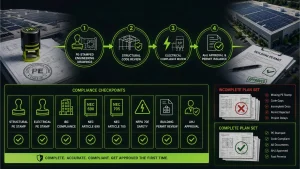
Here is what surprises installers moving up from residential work. Most commercial solar permits require a licensed professional engineer to stamp both the structural and electrical drawings. Not every job triggers this. Still, enough do that assuming otherwise is a costly gamble.
Commercial AHJ reviewers also expect specific compliance. In practice, they look for IBC adherence on structural sheets, NEC Article 690 and 705 compliance on electrical sets, and NFPA 70E documentation for electrical safety. Additionally, many commercial jobs trigger a separate building permit. That rarely happens on residential rooftops. So when your commercial plan sets miss any of these elements, the reviewer sends them straight back.
Interconnection Is a Design Input, Not an Afterthought
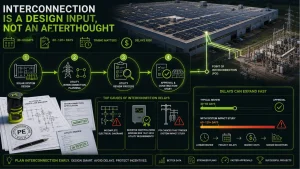
Too many teams treat interconnection as a post-installation checkbox. That mistake burns timelines. For mid-sized systems, utilities typically estimate 30 to 60 days for initial review. However, if a point of interconnection study or system impact analysis gets triggered, that window stretches to 60 to 120 days or more.
This timing matters more than ever in 2026. Under the current OBBBA framework, commercial and C&I systems still qualify for the Section 48E credit through 2027, but only if construction begins before July 4, 2026. A four-month interconnection stall eats directly into that window. Therefore, smart installers fold interconnection requirements into the commercial solar plans from day one. Three issues cause most delays: incomplete electrical diagrams at first application, inverter certifications that miss IEEE 1547-2018 utility requirements, and POI choices that force a system impact study.
NEC 2026 Changes Every Commercial Plan Set Must Reflect
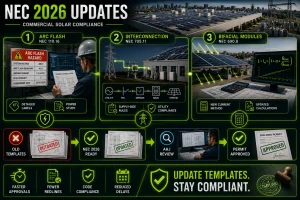
AHJs across the country now enforce the 2026 code. Meanwhile, teams running 2023 templates keep finding out the hard way. Three updates hit commercial work directly.
First, arc flash labeling under Section 110.16 changed. A generic hazard label no longer passes. Now your label must list system voltage, arc flash boundary, incident energy or PPE category, and the assessment date. In short, most commercial jobs now need a formal power study before the permit package is complete.
Second, Section 705.11 refined supply-side interconnection rules. Third, Section 690.8 added a new current-calculation method for bi-facial modules, which show up often on commercial rooftops. If you spec bi-facial panels, your electrical math must follow this method. Otherwise, the reviewer flags it. Each change touches your commercial solar plans, so update those templates before your next submittal.
A Quick Reality Check on Scope
Let us be straightforward. When installers treat a commercial project like a scaled-up residential job, things go sideways fast. Bid accuracy slips. Inspection pass rates drop. Project timelines balloon. On the other hand, accurate small commercial solar documentation protects your margins and your reputation. It also speeds warranty claims, maintenance, and future expansions. That payoff makes the upfront discipline worth it every single time.
How EnergyScape Renewables Supports Your Commercial Solar Plans
Building this depth in-house is expensive, especially for mid-sized EPCs. That is exactly where outsourced engineering earns its keep. EnergyScape Renewables delivers permit-ready commercial solar plans across all 50 states, with PE-stamped structural and electrical drawings, three-phase single-line diagrams, energy models, and full interconnection documentation. As a result, your team scales capacity without carrying full-time engineering overhead or stamp liability.
Their white-label approach lets you present every deliverable under your own brand while licensed engineers own the stamped scope. Moreover, the interconnection service handles utility coordination directly, so you are not navigating each new job blindly. Want to keep design, permitting, and project tracking connected from quote to PTO? Pair your engineering with Sunscape, a solar-specific CRM built to keep C&I projects moving on schedule. Together, they turn documentation from a bottleneck into a competitive edge.
sjayakanth@energyscaperenewables.com