
Solar Geotechnical Survey: Stop Texas Pile Refusal in 2026
Solar Geotechnical Survey & Pile Pull-Out Testing: Why Pile Refusal Is Killing Texas Schedules in 2026
Picture your crew in West Texas, watching a pile driver stall at four feet. The pile hit caliche, and the whole tracker row now sits idle. This is pile refusal, and it has become one of the biggest schedule killers in U.S. ground-mount solar. A proper solar geotechnical survey is how sharp installers and EPCs see it coming. Because in 2026, a stalled foundation isn’t only a cost problem. It can also put your federal tax credit at risk.
So let’s break down what these surveys and tests actually do, why Texas dirt is so brutal, and how to protect your timeline this year.
What Is a Solar Geotechnical Survey?
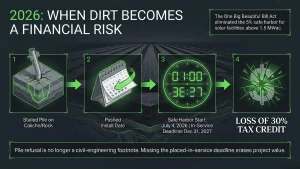
A solar geotechnical survey is a subsurface investigation that shows you what sits under your site before you drive a single pile. It combines soil borings, lab classification, and load testing to set your foundation depth and capacity. For commercial and utility-scale projects, most AHJs also require this stamped report inside the permit package.
The standard scope is fairly simple. First, crews run Standard Penetration Tests (ASTM D1586) at roughly one boring per 2–5 acres on uniform ground. Next, the lab handles soil classification (ASTM D2487), Atterberg limits, moisture, and corrosivity. Together, these results decide your pile type, embedment depth, and how often you test.
Why Texas Soil Triggers Tracker Pile Refusal
Texas has some of the hardest pile-driving ground in the country. In fact, one Texas pre-drilling contractor calls driven pile refusal the expectation rather than the exception. That single line sums up the risk for any EPC bidding work in the state.
Three regions cause the most trouble:
- West Texas caliche: a cement-hard calcium layer that stops piles cold.
- Central Texas limestone and clay: unpredictable rock shelves and mixed strata.
- East Texas blackland clay: expansive soil that swells, shrinks, and grabs piles.
Scale makes the problem worse. On a large site, refusal rarely shows up neatly row by row. For example, at the 1.6 GW CT Solar Platform in Snyder, Texas, engineers found refusal pockets appearing within a few hundred meters. As a result, they modeled refusal across the whole site instead of reacting pile by pile.
What Is a Solar Pile Pull-Out Test?
A solar pile pull-out test, also called an axial uplift test, measures how much upward force a foundation can resist before it fails. This matters because wind uplift, not downward weight, usually governs ground-mount foundations. Therefore, if your piles can’t hold against uplift, your trackers won’t survive a storm. Site-specific testing always beats generic handbook values.
Solar Pile Pull-Out Test Procedure: Step by Step
Here is the basic procedure your geotech team follows:
- Install test piles at several embedment depths that match your production design.
- Apply axial uplift load with a hydraulic jack and reaction frame, following ASTM D3689.
- Record load versus movement until you reach ultimate capacity or the target design load.
- Run lateral tests (ASTM D3966) wherever trackers will see side loading.
- Extrapolate with the Davisson method when you can’t safely reach ultimate load.
Test frequency scales with acreage and soil variability. In short, the more your soil changes across the site, the more tests you need. A ramming test on screw or helical piles plays a similar role, since it confirms torque and resistance before full production.
Why a Solar Geotechnical Survey Protects Your 2026 Tax Credit
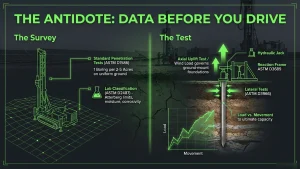
Here is what changed this year. Under the One Big Beautiful Bill Act, solar projects must begin construction by July 4, 2026 to lock in the tax credit on the favorable timeline. On top of that, the 5% safe harbor disappeared for solar facilities above 1.5 MWac. Miss that window, and your project generally must reach service by December 31, 2027 to qualify at all.
Now connect the dots. First, a crew stuck on refusal pushes your install date. Next, that delay pushes your placed-in-service date. Finally, a service date past the deadline can erase 30% or more of your project value. So in 2026, pile refusal is no longer a civil-engineering footnote. Instead, it is a financial risk that lands squarely on the EPC’s bottom line.
How to De-Risk Solar Foundations Before You Mobilize
The winning move this year is simple. You design around refusal instead of discovering it on site. Here is how the best EPCs pull it off:
- Front-load the geotech. Run borings and pull-out tests early, before crew time starts burning.
- Map refusal-prone zones and pre-plan fixes, such as auger pre-drilling, DTH hammer attachments, pile shifts within tolerance, or variable embedment.
- Lock the foundation design and PE-stamped plan set around real soil data, so you avoid re-stamping mid-build.
- Document everything for QA, because clean records protect you in warranty disputes later.
Ultimately, the contractors who hit refusal and still finish on time aren’t lucky. They saw it coming, and they tracked the recovery closely.
Keep Your Texas Schedule—and Your Tax Credit—On Track
Pile refusal will happen. Whether it derails your build depends on how early you engineer for it and how closely you track it.
EnergyScape Renewables turns your soil and pull-out test data into PE-stamped, AHJ-ready foundation plan sets and permitting support. With nationwide licensing and fast turnarounds, a refusal-driven redesign won’t cost you weeks of re-stamping. Want a second set of expert eyes on your next Texas site? Talk to our engineering team.
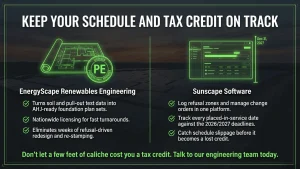
And because refusal is really a schedule problem, Sunscape gives your team one place to log refusal zones, manage change orders, and watch every placed-in-service date against the 2026 deadline. In other words, you catch slippage before it becomes a lost credit.
Don’t let a few feet of caliche cost you a tax credit. Engineer ahead of refusal, track it tightly, and keep your pipeline moving.
Solar Geotechnical Survey FAQ
What causes pile refusal on solar farms?
Pile refusal happens when a driven pile hits rock, caliche, dense sand, or hardpan and can’t reach design depth. Across Texas, caliche, limestone, and expansive clay are the usual culprits.
Is a geotechnical survey required for solar projects?
Yes, in most cases. For commercial and utility-scale work, AHJs typically require a stamped geotechnical report inside the building permit package. So it isn’t optional for permitting.
Which ASTM standard covers solar pile pull-out testing?
ASTM D3689 governs axial uplift, or pull-out, testing. Meanwhile, ASTM D3966 covers lateral loads, while ASTM D1586 and D2487 handle the soil investigation and classification.
How many soil borings does a solar site need?
A common starting point is one boring per 2–5 acres on uniform terrain. However, variable or refusal-prone sites usually need more.
sjayakanth@energyscaperenewables.com