
Outsource Solar Plan Sets: 2026 Cost vs. In-House Drafting
Outsource Solar Plan Sets vs. In-House Drafting: The 2026 Cost & Time Comparison
Should you outsource solar plan sets in 2026, or keep a drafter on staff? For most US solar installers and EPCs, outsourcing now costs less and ships faster than in-house drafting. The reason is simple. A salaried drafter is a fixed cost that runs whether or not jobs close, while outsourced plan sets flex with your pipeline. So let’s break down the real numbers, turnaround times, and the multi-state catch that changes the math.
Why the in-house vs. outsource solar drafting math flipped in 2026
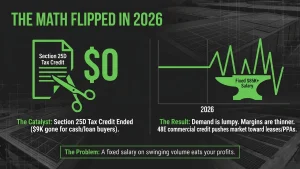
The math used to favor in-house at high volume. Then the rules changed. On December 31, 2025, the residential Section 25D tax credit ended under the One Big Beautiful Bill Act. As a result, homeowners who buy with cash or a loan now get $0 federal credit. That’s roughly $9,000 gone on a typical $30,000 system.
This single change reshaped installer economics. Demand got lumpier, and margins got thinner. Meanwhile, third-party ownership became the main route to a federal credit, because the 48E commercial credit still runs through 2027. So more teams are leaning on leases and PPAs, along with the extra documentation those deals require.
Because your volume now swings month to month, a fixed salary is the last thing you want sitting on the books. That tension sits at the heart of the 2026 build-vs-buy decision.
Should you outsource solar plan sets? Cost compared side by side
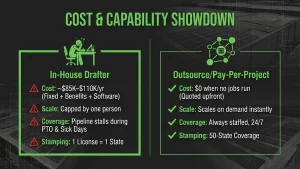
Here is the short answer first. If your volume is uneven or you work in more than one state, outsourcing usually wins on both cost and speed. The table below shows why.
| Factor | In-House Drafter | Outsourced Plan Sets |
|---|---|---|
| Cost structure | Fixed salary + benefits | Pay-per-project (variable) |
| All-in annual cost | ~$85K–$110K+ loaded | $0 when no jobs run |
| Per-set cost | Hard to isolate | Quoted up front |
| Multi-state PE stamping | One license, one state | All 50 states |
| Coverage during PTO/sick days | Pipeline stalls | Always staffed |
| CAD/design software | You buy the licenses | Included |
| Turnaround at volume spikes | Capped by one person | Scales on demand |
| AHJ approval responsibility | Yours | Partner’s |
A solar designer’s base pay runs roughly $53K–$71K on the major job boards, and experienced PV designers report well above that. So load in benefits, payroll taxes, design software, ramp-up training, and the idle weeks between deals. A realistic all-in figure then lands near $85K–$110K a year.
Outsourced, you simply pay per set. A specialized firm quotes each project, so your cost tracks your actual workload. At low or uneven volume, that difference decides the whole question.
The solar drafting service cost most teams forget: idle time and PTO
A salaried drafter still gets paid on slow weeks, sick days, and vacation. Worse, when they’re out and a deadline hits, your pipeline waits. In effect, one person becomes a single point of failure for every permit in your queue.
Outsourced engineering, on the other hand, never takes a day off. For example, when a rep closes a deal at 7 p.m., the plan set can be moving overnight instead of waiting for one person the next morning. Speed like that compounds too. Faster plan sets mean faster permits, faster installs, and a faster payout.
The solar permit drawings outsource advantage: 50-state PE stamping
Here is the part in-house simply can’t match. One in-house PE can stamp only in the states where they hold a license. So the moment you chase work across state lines, that single license turns into a wall. And more installers are expanding now, since individual markets are softening unevenly.
A nationwide engineering partner stamps in all 50 states instead. For example, EnergyScape Renewables delivers PE-stamped solar plan sets in 24–48 hours nationwide, with a 99% AHJ approval rate. That mix of speed and first-time approvals keeps projects heading toward PTO, rather than bouncing back as revisions.
When does in-house solar drafting still make sense?
To be fair, outsourcing isn’t always the answer, and honest math matters. Keeping a drafter on staff can still pencil out in three cases. First, you run very high, steady volume. Second, you work mostly in one state. Third, you can keep that drafter busy enough to beat the per-set cost of outsourcing. Still, for most teams facing variable demand in 2026, those conditions rarely line up at once.
How Outsourcing kills the “I’ll lose control” fear
The biggest objection to outsourcing is visibility. Hand work to an outside firm, the thinking goes, and you lose track of it. But that’s a workflow problem, not a reason to staff up.
When your plan sets run through a purpose-built solar CRM, an outsourced stamped set doesn’t stall in an inbox. Instead, it drops into your pipeline and triggers the next step automatically. As a result, you see every project’s status from lead to PTO in one place. So outsourcing the drafting and keeping tight control of it aren’t in conflict. Together, they form the closed-loop workflow modern installers actually run on.
Move faster in 2026 without adding payroll
Is your pipeline uneven and your margin tight? Then the smart play this year is to make engineering a cost that flexes with your jobs. EnergyScape Renewables delivers PE-stamped plan sets, permitting, interconnection, and PTO support in 24–48 hours across all 50 states. So you grow throughput without growing overhead.
Then keep every outsourced set tracked from lead to PTO inside Sunscape, the CRM and project management platform built for US solar installers and EPCs. Design it, hand it off, and watch the status move on its own.
One connected workflow. Fast engineering, full visibility, zero back-office chaos. Start your next project today.
Frequently asked questions
How much does it cost to outsource solar plan sets?
Outsourced plan sets are quoted per project, so cost scales with your workload instead of a fixed salary. Against an in-house drafter’s roughly $85K–$110K all-in annual cost, pay-per-project pricing wins at low or uneven volume.
How long does an outsourced solar plan set take?
With a nationwide engineering partner, PE-stamped plan sets can ship in 24–48 hours across all 50 states. That’s often faster than a single in-house drafter can clear a backlog.
Is outsourcing solar drafting worth it for small installers?
Usually yes. Smaller teams rarely have the steady, single-state volume needed to justify a full-time drafter. So pay-per-project keeps engineering a variable cost that rises and falls with revenue.
Can in-house drafters handle multi-state projects?
Only where they hold a PE license. Multi-state work generally requires an engineering partner licensed across all 50 states.
Kaushik Prakash