
PE Stamp Costs for Solar Projects: In-House Engineering vs. Outsourcing in 2026

The Real Cost of PE Stamping Is Draining Your Solar Margins
If you run solar projects across multiple states, PE stamp costs are quietly eating your margins. Many companies assume keeping engineering in-house saves money. That thinking has a gap. When you factor in salaries, licensing fees, and idle overhead, in-house PE stamping runs $530 to $810 per project. Outsourcing that same work typically drops it to $150 to $400 for residential jobs. That’s a wide gap. In 2026, with NEC 2026 enforcement tightening and project volumes rising, it compounds fast. This blog breaks down where in-house PE stamp costs go wrong. It also covers when outsourcing makes more sense and how top installers protect their margins.
What PE Stamp Costs Actually Include in 2026
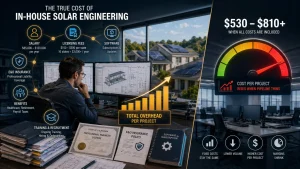
Breaking Down In-House Solar Engineering Overhead
Most installers only count the engineer’s base salary when calculating in-house solar engineering costs. That’s a costly mistake. The true cost-per-project picture looks very different once you include everything.
A mid-level licensed solar engineer earns between $85,000 and $120,000 annually. On top of that, add state PE licensing fees. Each state license runs $150 to $500 to obtain, plus annual renewals. Spanning 10 states already costs $3,000 or more per year in licensing alone. Then add software subscriptions, E&O insurance, benefits, training, and recruitment. During slow months, that engineer stays on payroll regardless of volume. The true cost per project climbs sharply when the pipeline thins.
In-house solar engineering overhead runs $530 to $810 or more per project once salaries, licensing, and overhead are included. That’s the number most installers don’t calculate until margins are already gone.
What Outsourced PE Stamp Pricing Actually Looks Like
Outsourcing flips the model entirely. Instead of fixed overhead, you pay per deliverable. Individual stamps typically cost $200 to $650. Combined electrical and structural certification packages run $400 to $850. For residential work through a specialized solar engineering partner, a full PE-stamped plan set lands between $150 and $400.
Outsourced providers also hold PE licenses in every state you operate. You don’t pay for their licensing or downtime. Payment only triggers when a project needs stamping. That variable cost structure is why outsourcing works well for seasonal businesses and growing EPCs.
In-House Solar Engineering: Where It Still Makes Sense
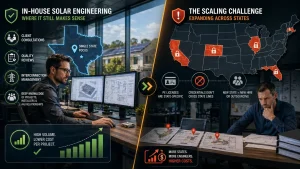
To be fair, in-house engineering isn’t always the wrong call. Large EPCs with consistent commercial volume in a single state can justify building internal PE capacity. High monthly volume in one jurisdiction spreads fixed overhead far enough to stay competitive.
Internal engineers also offer advantages beyond stamping. Client consultations, quality reviews, and direct interconnection management all add real value. Their knowledge of your project types, installers, and AHJ relationships is something outside firms take time to build.
However, even strong in-house teams hit a hard ceiling. PE licenses are state-specific. A Professional Engineer licensed in Texas cannot legally stamp plans in Florida or California. The moment you expand into a new state, that credential doesn’t apply. Every new market means hiring another licensed engineer or outsourcing. Either way, you’re carrying new costs.
Why Outsourcing PE Stamps Wins for Multi-State Operations

The Multi-State Licensing Problem
This is where outsourcing shifts from preference to necessity. There are over 20,000 permitting jurisdictions across the United States, and no single in-house team maintains AHJ-specific knowledge at that scale. Each new state adds PE licensing costs, AHJ knowledge, and compliance requirements. Building all of that internally takes months.
Outsourced solar engineering partners already carry that infrastructure. You scale into new markets without adding headcount, acquiring new licenses, or a multi-month ramp-up.
The First-Submission Rejection Cost Is Bigger Than You Think
Here’s a cost that rarely shows up in in-house calculations: first-submission rejections. Many installers report rejection costs ranging from $2,000 to $5,000 per project — and that’s before crew rescheduling and client delay penalties enter the picture. A single rejection also adds one to two weeks to the project timeline. In a volume business, that delay stacks across the whole pipeline.
In-house teams not current on NEC 2026 are statistically more likely to generate those rejections. Outsourcing partners build code compliance into every deliverable by default. Solar permitting is their core business — not a side function.
Scalability Without the Hiring Lag
Volume spikes are real in solar. A strong referral month can triple your permit queue overnight. In-house teams have a fixed throughput ceiling. Outsourced partners scale with your pipeline instantly, without a hiring lag. That scalability matters most heading into Q3 and Q4 when installer pipelines peak.
The Hybrid Model: Best of Both Worlds
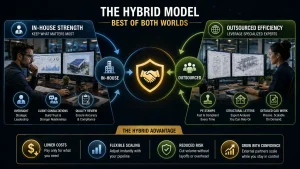
Not every installer needs to choose one side. A growing number of EPCs run a hybrid model. One senior engineer handles oversight, client consultations, and quality review in-house. PE stamps, structural letters, and detailed CAD work go to an outsourced partner. It keeps technical leadership internal while capturing the cost benefits of outsourcing.
This structure also reduces risk. During slowdowns, outsourced volume can be cut immediately — no layoffs, no difficult decisions. When volume climbs again, external partners absorb it while you evaluate whether to add permanent staff.
How EnergyScape Renewables Solves the PE Stamp Cost Problem
EnergyScape Renewables is built for US solar installers and EPCs needing fast, reliable PE-stamped plan sets at scale. Licensed PEs cover all 50 states with 24 to 48-hour residential turnaround. The team delivers a 99% AHJ first-submission approval rate — directly eliminating the rejection cost problem described above. Every plan set meets NEC 2026 standards by default, with no chasing code updates and no technicality-driven rejections.
The pay-per-project model keeps idle overhead off your books. Scaling into new states requires no new PE licenses on your end. EnergyScape also pairs directly with Sunscape Solar — a CRM built for US solar operations. A stamped plan set triggers the next workflow step automatically, with no dropped handoffs and no lost weeks between engineering and permitting.
Whether you’re running 10 projects monthly or 200, EnergyScape scales with your pipeline.
Frequently Asked Questions About PE Stamp Costs for Solar Projects
What are typical PE stamp costs for solar projects in 2026?
Outsourced residential PE stamping runs $150 to $400 per project. In-house solar engineering costs $530 to $810 or more once you include salaries, licensing fees, and overhead. That gap widens during slow seasons when your in-house engineer stays on payroll regardless of volume.
Do I need a PE stamp on every solar project?
Not always — but requirements are tightening in 2026. Residential systems generally require PE stamps above 10 kW to 15 kW. Commercial installs almost always need both a structural and electrical stamp. Always verify with your specific AHJ before submission.
Can one engineer stamp solar plans across multiple states?
No. PE licenses are state-specific. A Professional Engineer licensed in Texas cannot legally stamp plans in Florida or California. For multi-state operations, outsourcing to a firm with licenses across all 50 states is far more practical than building in-house capacity market by market.
What does a first-submission rejection actually cost my business?
Direct costs range from $2,000 to $5,000 per project — covering revisions, admin time, and resubmission fees. A single rejection also adds one to two weeks to your timeline. Across a busy pipeline, those delays hit your cash flow hard
sjayakanth@energyscaperenewables.com