
Grid-Forming Inverters: Daytime Backup Without Batteries

Grid-Forming Inverters: Daytime Backup Power Without the Battery Expense
What is Grid-Forming Inverters? Your customer’s power just went out. It’s 2 PM on a bright Tuesday. The sun’s blazing overhead, and their brand-new solar array sits there—completely shut down and useless.
Does this scenario sound familiar to you?
For years, this frustrating situation has pushed installers toward recommending battery storage systems. However, those batteries add $10,000 to $15,000 to every residential project. Not every homeowner needs overnight backup power, though. Many customers simply want electricity when the sun’s shining and the utility grid isn’t working.
That’s exactly where grid-forming inverters revolutionize the solar backup conversation.

What Are Grid-Forming Inverters and How Do They Work?
Traditional grid-tied inverters function as followers, not leaders. Essentially, they wait for the utility company’s grid to signal the correct voltage and frequency. When that grid signal disappears during a power outage, your customer’s solar installation immediately shuts down—even when it’s producing 8 kilowatts of clean energy.
In contrast, grid-forming inverters completely flip this operational model. They independently create their own stable voltage and frequency reference. Think of them as the quarterback calling plays rather than the wide receiver waiting for signals.
According to the U.S. Department of Energy’s Solar Energy Technologies Office, this technology allows solar systems to restart the grid independently during blackouts. Furthermore, real-world installations in Hawaii have successfully proven this concept works at utility scale.
The Technical Difference That Matters
Grid-following inverters require an external AC reference signal. Without it, they cannot operate safely. Meanwhile, grid-forming technology synthesizes its own AC waveform. This critical difference enables autonomous operation during grid failures.
Research from the National Renewable Energy Laboratory demonstrates that grid-forming controls significantly enhance grid stability. Specifically, systems can recover from frequency disturbances within 300 milliseconds while maintaining voltage stability.
Cost-Effective Solar Backup Solutions for Price-Sensitive Markets
Let’s discuss the numbers that actually close deals.
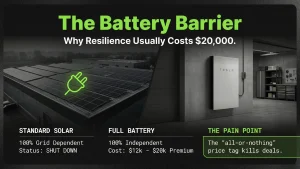
A typical residential battery backup system costs between $12,000 and $20,000 when fully installed. For commercial solar projects, you should multiply that figure by 5 to 10 times depending on load requirements and backup duration needs.
By comparison, grid-forming inverters with daytime backup capability add approximately $3,000 to $5,000 to your inverter investment. That’s substantially less than complete battery storage systems. Therefore, for customers who primarily need power during business hours, this becomes an incredibly compelling value proposition.
Commercial Applications That Maximize ROI
Consider a manufacturing facility operating first shift from 7 AM to 3 PM daily. Their peak electricity demand aligns perfectly with solar production hours. Consequently, when the grid fails during operating hours, a grid-forming inverter keeps critical production equipment running smoothly.

This approach eliminates the need for battery banks sized for 24-hour backup capacity. Moreover, the facility avoids expensive downtime while spending significantly less on backup infrastructure.
This pricing advantage proves especially relevant in cost-sensitive solar markets. Customers understand grid instability concerns but can’t always justify premium battery storage expenses.
Grid-Forming Technology Implementation Best Practices
Successful installations require proper load management planning and realistic customer expectations from the start.
The Enphase IQ8 microinverter series pioneered residential-scale grid-forming technology. Their “Sunlight Backup” feature delivers up to 1,280 watts per inverter during daytime grid outages. Similarly, string inverters like SMA’s Secure Power Supply provide around 2,000 watts through dedicated backup outlets.

For larger commercial solar applications, hybrid inverters combine grid-forming capabilities with optional battery integration. This gives your customers a scalable upgrade path from daytime-only backup to complete 24-hour energy independence.
Matching Inverter Capacity to Critical Loads
The essential principle is straightforward: match your inverter capacity to genuinely critical electrical loads. You cannot run an entire home on sunlight-only backup power. However, you absolutely can keep refrigeration systems, communication equipment, and essential lighting operational during daytime grid failures.
Additionally, proper circuit design segregates backup loads from non-essential systems. This ensures customers receive reliable power for equipment that truly matters during outages.
Where Grid-Forming Inverters Deliver Maximum Value
Grid-forming inverters aren’t the perfect solution for every solar installation. Instead, they excel in specific scenarios that experienced installers quickly recognize:
Hurricane-prone coastal regions frequently experience daytime outages during storm preparation periods. Customers can operate essential systems while securing their homes before nightfall arrives.
Areas with aging utility infrastructure suffer frequent brief outages during peak summer demand. When the grid drops for 30 minutes on a sunny afternoon, grid-forming technology keeps business operations running smoothly.
Commercial facilities with daytime-heavy operations include warehouses, light manufacturing plants, and retail locations that close at night anyway. These businesses benefit tremendously from daytime-only backup solutions.
Markets where utility interconnection approval is slow can use grid-forming as a bridge solution. This provides backup capability while customers wait for complete grid approval processes.
Learn more about solar permitting timelines and how to accelerate your approval process.
Professional Engineering Requirements for Grid-Forming Systems
This represents where many solar installers encounter significant roadblocks. Authority Having Jurisdiction requirements for grid-forming technology vary dramatically by geographic location.
California’s Title 24 compliance and Rule 21 interconnection standards now recognize advanced inverter functions explicitly. However, your documentation must be absolutely precise. Florida’s strict hurricane building codes require PE-stamped structural and electrical engineering designs for virtually all solar installations—adding grid-forming capability doesn’t fundamentally change those requirements.
Texas presents particularly interesting market opportunities. With ERCOT’s independent merchant market structure and growing solar capacity, grid-forming technology aligns perfectly with the state’s energy independence priorities. Nevertheless, PE stamp requirements vary significantly between cities and counties.
First-Time Permit Approval Strategies
The critical success factor remains submitting complete, accurate permit applications on your first submission. According to NREL research data, permit rejections add an average of 2 to 3 weeks to project completion timelines. When you’re actively competing for solar deals in competitive markets, those delays directly cost sales revenue.
Moreover, incomplete engineering documentation triggers immediate permit rejections. Missing PE stamps, structural load calculations, or equipment specifications add unnecessary weeks to your installation schedule.
Discover proven strategies for avoiding solar permit rejections in our comprehensive installer guide.
Installation Guidelines From Thousands of Field Deployments
After analyzing thousands of grid-forming installations nationwide, certain success patterns emerge consistently:
Start every project with detailed energy audits. You need accurate daytime load consumption profiles, not simply average daily energy usage statistics. Which specific equipment absolutely must stay online during grid outages? Then size your backup circuits accordingly.
Set realistic customer expectations during initial sales conversations. Customers who understand they’re receiving daytime backup capability only rarely file complaints later. Conversely, customers sold on generic “backup power” who discover limitations after installation? That’s precisely where service callbacks and negative online reviews originate.
Design electrical systems for future battery expansion. Many modern grid-forming inverters support battery integration during later upgrades. Wire your installation so customers can easily add energy storage if their requirements change—it creates a powerful upgrade revenue path that protects your initial equipment sale.
Document everything thoroughly for building inspectors. Include complete manufacturer specification sheets showing grid-forming certification. Provide clearly labeled one-line electrical diagrams with backup circuits highlighted. Add comprehensive anti-islanding protection documentation.
The Competitive Marketing Advantage Nobody’s Leveraging Yet
Here’s your immediate competitive edge in solar sales: most installers either completely ignore daytime backup options or immediately jump to expensive battery storage solutions.
Therefore, you can strategically own the valuable middle ground.
When potential customers express legitimate concerns about grid reliability but hesitate at battery system costs, you’re not simply telling them “no.” Instead, you’re offering a practical, cost-effective solution addressing their actual use case rather than selling excess capacity they’ll never actually need.
This consultative positioning establishes you as the trusted advisor who truly understands their business operations, not just another aggressive salesperson pushing maximum system size for higher commissions.
In B2B solar sales, especially commercial installations, this consultative approach consistently closes profitable deals that pure price competition completely misses.
Making Grid-Forming Technology Your Standard Offering
The U.S. solar market added approximately 19,000 megawatts of new photovoltaic capacity during 2024. Meanwhile, regulatory scrutiny continues intensifying nationwide across all jurisdictions. Grid-forming technology represents one of the few genuine value-add features that doesn’t dramatically increase total project costs.
Forward-thinking solar installers are already incorporating grid-forming capabilities into their standard commercial proposal templates. It’s rapidly becoming a standard checkbox item—just like rapid shutdown NEC compliance or remote monitoring system capabilities.
Consequently, the real question isn’t whether to offer this advanced inverter technology. Rather, it’s whether you want to lead innovation or follow competitors in your local solar market.
Your Next Steps: Engineering Support and Project Management Tools
Success with grid-forming inverter installations requires two absolutely critical operational capabilities: accurate engineering documentation and seamless project management workflows.
On the engineering side, you need professionally PE-stamped designs satisfying AHJ requirements across all your service territories. Load calculations must properly account for grid-forming operational modes. Electrical diagrams need to clearly show backup circuit segregation from standard loads. These aren’t optional extras—they’re fundamental requirements for permit approval success.
On the project management side, tracking grid-forming installations requires CRM systems understanding solar-specific workflows intuitively. From initial site survey activities through final Permission to Operate approval, every project stage needs complete visibility and team coordination.
Partner With Engineering Experts
Ready to confidently add grid-forming inverter capabilities to your installation services? Energyscape Renewables delivers industry-leading 24-hour PE stamping services across all 50 states. Our permit-ready plan sets are professionally engineered for first-time AHJ approval success.
Our revolutionary overnight engineering service means your sales team can present complete, PE-stamped system designs the very morning after conducting site surveys. We expertly handle structural load calculations, detailed electrical diagrams, and jurisdiction-specific compliance documentation keeping your solar projects moving forward efficiently.
Call +1 855-263-0700 or email info@energyscaperenewables.com to discuss your specific permitting requirements today.

Streamline Your Solar Operations
Need better software tools to manage your rapidly growing project pipeline? Sunscape Solar provides purpose-built CRM and project management platforms specifically designed for solar installers and EPCs.
Track grid-forming inverter installations alongside traditional grid-tied systems seamlessly. Manage comprehensive site survey data, coordinate installation teams efficiently, and maintain complete visibility from initial lead capture through final inspection approval.
Stop fighting with generic business software that fundamentally doesn’t understand solar industry workflows. Schedule a personalized demo to discover how Sunscape streamlines operations from quote generation to cash collection.
sjayakanth@energyscaperenewables.com