
The 10 Best Commercial Solar Markets for 2026: Where to Focus Your Expansion

Navigating Commercial Solar Expansion in a Changing Market
Finding the right markets for commercial solar expansion has become increasingly challenging for installers and EPCs across the United States. With shifting federal incentives, rising electricity rates, and evolving state policies, solar professionals need clear direction on where to focus their resources in 2026. Fortunately, several states are emerging as powerhouse markets with strong growth potential, favorable policies, and expanding commercial opportunities. Understanding these commercial solar markets 2026 will help your business thrive in an increasingly competitive landscape.
Why Market Selection Matters More Than Ever

The commercial solar industry is experiencing a pivotal transformation in 2026. While some traditional markets face policy transitions, emerging states are creating unprecedented opportunities for solar installers. Moreover, the commercial segment continues to show resilience, with over 2.3 GWdc of new installations projected nationally in 2025, setting a record for the segment. Consequently, strategic market selection has become the difference between steady growth and stagnation.
Top 10 Commercial Solar Markets for 2026
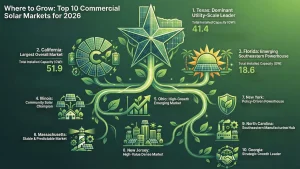
1. Texas: The Undisputed Leader
Texas dominates commercial solar markets 2026 with an impressive 41.4 GW of installed capacity. Additionally, the state leads in utility-scale installations, with over 3 GWdc coming online in Q3 2025 alone. Furthermore, Texas offers independent grid operations, abundant land, low development costs, and rising retail electricity rates. Major corporate buyers like Meta, Amazon, and Verizon are securing significant Power Purchase Agreements in the Lone Star State, creating substantial opportunities for commercial solar installers.
Why Texas Works: The state’s business-friendly environment, coupled with strong energy demand from data centers and manufacturing facilities, makes it ideal for commercial solar expansion. Solar jobs in Texas grew by 3% in 2024, demonstrating sustained market momentum.
2. California: Prime Commercial Solar Expansion Territory
Despite policy changes, California maintains its position as a leading commercial solar market with 51.9 GW of total capacity. However, the NEM 2.0 transition is creating both challenges and opportunities. California NEM 2.0 projects continue coming online, with strong commercial installations in 2025. Nevertheless, installers must adapt strategies for the Net Billing Tariff regime taking full effect in 2026.
Strategic Advantage: California’s high electricity rates and established commercial solar infrastructure provide a solid foundation. Meanwhile, the state leads in battery storage integration, opening new revenue streams for commercial projects.
3. Florida: The Rising Star
Florida is rapidly emerging as one of the best commercial solar markets 2026, with 18.6 GW of installed capacity. Significantly, the Sunshine State overtook California in new utility-scale solar capacity additions in 2024. The state’s growing population, tourism industry, and increased focus on energy resilience after extreme weather events drive commercial solar adoption.
Market Opportunity: Florida’s commercial sector benefits from strong solar incentives, high insolation values, and increasing corporate sustainability commitments. Additionally, the state has 461 solar companies supporting robust industry infrastructure.
4. Illinois: The Midwest Powerhouse
Illinois stands out among commercial solar markets 2026, particularly for community solar and commercial installations. The state installed 213 MWdc of community solar in 2024, representing an 82% increase. Furthermore, Illinois drove significant Q3 2025 commercial installations alongside California.
Competitive Edge: Adjustable Block Program incentives, combined with direct pay provisions for nonprofits and government entities, make Illinois attractive for commercial solar projects. The state’s diversified project pipeline ensures steady opportunities through 2026.
5. Ohio: Emerging Best Commercial Solar Markets
Ohio represents one of the fastest-growing commercial solar markets for installers seeking expansion opportunities. The state achieved record solar installations in 2024, with solar employment growing 5%. Moreover, Ohio ranked among the top five states for utility-scale installations in Q1 2025.
Why Enter Ohio: Low development costs, increasing electricity demand, and minimal market saturation create favorable conditions for commercial solar EPCs. The Midwest location also provides geographic diversification for installers.
6. Massachusetts: Established Solar Installer Markets
Massachusetts remains a traditional commercial solar powerhouse with sophisticated policy frameworks. Although residential installations faced challenges, commercial projects continue demonstrating strength. Subsequently, the state’s SMART program and robust net metering policies support commercial solar growth.
Long-term Stability: Massachusetts offers predictable incentive structures and high electricity costs, ensuring strong project economics. Additionally, established interconnection procedures streamline commercial solar development.
7. New York: Commercial and Community Solar Leader
New York excels in both commercial and community solar markets 2026. The state installed 861 MWdc of community solar in 2024, accounting for significant national volumes. Similarly, commercial installations remain robust across the Empire State.
Market Dynamics: New York’s Climate Leadership and Community Protection Act drives aggressive renewable energy targets. Furthermore, direct pay provisions benefit government and nonprofit commercial solar projects significantly.
8. New Jersey: The Garden State’s Growth
New Jersey maintains its position among top commercial solar markets with strong policy support and high electricity rates. The state’s commercial solar segment benefits from established solar renewable energy certificate markets and progressive clean energy standards.
Business Case: New Jersey’s dense population and commercial activity create consistent demand. Moreover, the state’s grid modernization efforts support increased distributed solar capacity.
9. North Carolina: Southeastern Leadership
North Carolina has emerged as a southeastern commercial solar leader with 9.6 GW of installed capacity. The state’s renewable portfolio standard and favorable interconnection policies attract commercial solar development. Additionally, North Carolina’s manufacturing sector presents substantial commercial opportunities.
Regional Advantage: Lower construction costs compared to northeastern states improve project margins. Furthermore, North Carolina’s solar workforce infrastructure supports efficient project execution.
10. Georgia: The Fast Grower
Georgia rounds out the top commercial solar markets 2026 with impressive growth momentum. Solar jobs increased 4.5% in 2024, while utility-scale installations reached record levels. The state’s business-friendly environment and growing corporate sustainability initiatives drive commercial solar demand.
Strategic Position: Georgia offers geographic proximity to major southeastern markets while maintaining competitive development costs. Additionally, the state’s solar manufacturing investments strengthen the local supply chain.
Key Market Trends Shaping 2026
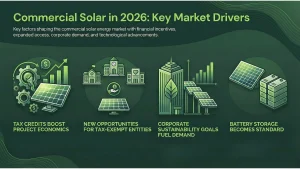
Several critical trends are influencing commercial solar markets across all states. First, the Section 48E Investment Tax Credit with transferability provisions continues supporting commercial project economics. Second, direct pay options for tax-exempt entities expand opportunities with schools, municipalities, and nonprofits. Third, corporate sustainability commitments drive demand for on-site and off-site commercial solar installations. Finally, battery storage integration is becoming standard in commercial solar projects, enhancing value propositions.
Making Your Expansion Decision
Selecting the right commercial solar markets requires analyzing multiple factors beyond installation volumes. Therefore, evaluate state incentives, interconnection timeframes, labor availability, and competitive landscapes. Furthermore, consider your company’s existing geographic presence and operational capabilities.
Successful market expansion demands thorough due diligence, strong partnerships, and adaptable business models. Meanwhile, installers who position themselves in high-growth markets today will capture the greatest opportunities as commercial solar continues expanding through 2026 and beyond.
Partner with EnergyScape Renewables for Market Success
Navigating these commercial solar markets 2026 requires experienced engineering partners who understand regional complexities. EnergyScape Renewables provides comprehensive solar engineering services, including system design, permitting support, and technical consulting tailored to your target markets. Our team understands the unique requirements of commercial projects across all fifty states.
Additionally, managing your commercial solar pipeline efficiently is essential for scaling operations. Sunscape Solar offers industry-leading CRM and project management solutions designed specifically for solar installers and EPCs. Our platform helps you track opportunities, manage customer relationships, and streamline operations across multiple markets simultaneously.
The commercial solar industry’s future looks bright, and these ten markets represent your best opportunities for growth in 2026. By focusing your expansion strategy on states with strong fundamentals and supportive policies, you’ll position your business for sustained success in America’s evolving solar landscape.
sjayakanth@energyscaperenewables.com