
Solar Financing 2026: Why TPO Is Taking Over Now
Solar Financing 2026: Why Dealer Fees and High Rates Are Killing Traditional Loans
Solar financing 2026 looks dramatically different from just two years ago. Traditional solar loans—once the industry’s preferred option—are struggling under the weight of dealer fees reaching 30% of project costs and interest rates that have tripled since 2022. Meanwhile, third-party ownership (TPO) options like solar leases and power purchase agreements are experiencing unprecedented growth.
For solar installers and EPCs across the United States, this shift represents both a challenge and an opportunity. Understanding these changes is critical to staying competitive and closing deals in today’s market.
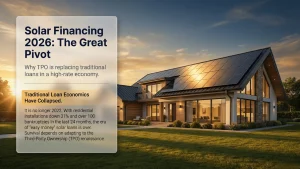
The Hidden Cost Crisis: Dealer Fees Explained
Dealer fees are destroying solar loan economics. These fees—sometimes called origination fees or finance charges—are what lenders charge solar companies to offer financing to homeowners. However, these costs get rolled into the loan principal without most customers realizing it.
According to the Consumer Financial Protection Bureau, dealer fees now range from 15% to 30% of the cash price. Some lenders are pushing past 50%. For a typical $30,000 system, that translates to $4,500 to $9,000 in hidden costs added before installation begins.

How Dealer Fees Impact Your Bottom Line
Consider this scenario: A homeowner sees an advertised 4.5% APR and assumes they’re getting a good deal. But they’re actually financing $39,000 instead of the $30,000 cash price. Over 20 years, this creates thousands in additional interest charges.
Research from EnergySage shows that most homeowners completely overlook dealer fees when comparing financing options. They focus on monthly payments and APR. Consequently, solar companies face credibility issues when customers eventually compare financed prices to cash prices.
Interest Rates Compound the Problem
While dealer fees inflate the principal, rising interest rates multiply the damage. Solar loan rates jumped from under 2% in late 2022 to 7-9% APR by mid-2024. Although the Federal Reserve implemented rate cuts in late 2024, financing costs remain significantly elevated.
Every percentage point increase in interest rates adds approximately $0.15 per watt to the effective system cost, according to Solar.com analysis. Therefore, on a 10 kW system, shifting from 3% to 8% APR means roughly $7,500 in additional interest over a 20-year term.
Market Impact Data
The numbers tell a stark story:
- Residential solar installations dropped 31% in 2024
- More than 100 solar companies declared bankruptcy
- Installation volumes fell as financing costs climbed
This data comes from SolarReviews market research, highlighting how solar financing 2026 challenges are reshaping the entire industry.
Third-Party Ownership: The Solar Financing 2026 Solution
Third-party ownership (TPO) is experiencing a renaissance as traditional solar financing struggles. TPO includes solar leases and power purchase agreements (PPAs), where a solar company owns the system and the homeowner pays for the energy produced or a fixed monthly lease payment.
Why TPO Works in 2026
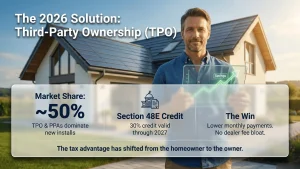
TPO providers still qualify for the 30% federal tax credit under Section 48E through December 31, 2027. Since the solar company owns the system, they claim the credit and pass savings to homeowners through lower payments. This matters because homeowners lost access to the residential tax credit (Section 25D) when it expired on December 31, 2025.
According to Ohm Analytics forecasts, TPO market share reached nearly 50% of new installations by summer 2025. Furthermore, investment bank Jefferies predicts a 25% jump in TPO installations throughout 2026.
Prepaid Lease Innovation
A new hybrid model is accelerating TPO adoption: prepaid leases. These allow homeowners to pay upfront for 20-25 years of solar energy at a 20-30% discount compared to cash purchases. After six years, ownership transfers to the homeowner at minimal or no cost.
This innovation addresses the ownership desire while leveraging tax credits homeowners can no longer claim directly.
Solar Financing 2026: Adapting Your Solar Business Model
Smart solar installers are diversifying their financing offerings rather than relying solely on traditional loans. This approach matches products to customer needs:
Customer Segmentation Strategy
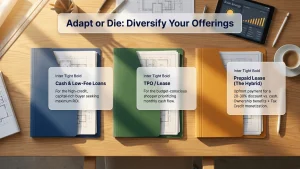
Cash buyers and low-fee loans: Customers with strong credit and capital seeking maximum ROI benefit from cash purchases or secured loans with minimal dealer fees.
TPO products: Cost-conscious homeowners prioritizing low monthly payments find leases and PPAs attractive, especially with dealer fees eliminated.
Prepaid leases: Customers wanting ownership benefits but lacking full upfront capital appreciate the hybrid model combining discounts with eventual ownership.
This segmentation requires updated sales processes and training. Your team must understand lease escalators (typically 0-2.99% in most 2026 markets), transferability for home sales, and transparent lifetime cost comparisons.
Proposal Tools That Win Deals
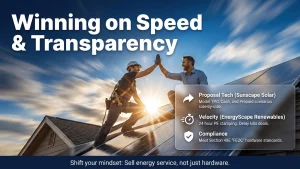
Generic calculators won’t work in today’s complex solar financing 2026 landscape. You need software that models multiple scenarios side-by-side with transparent breakdowns.
Modern solar CRM platforms like Sunscape Solar enable installers to present all financing options clearly. These tools streamline workflows from lead capture through installation tracking while managing the complexity of different financing structures.
Engineering and Permitting Considerations
As financing models evolve, engineering requirements become more critical. TPO providers need rapid PE-stamped plan turnaround to maintain competitive pricing and close deals quickly.
Systems claiming Section 48E credits must meet Foreign Entity of Concern (FEOC) requirements:
- 40% of project costs from non-FEOC sources
- 50% ratio for solar panels and inverters
- 60% ratio for battery storage
These requirements tighten equipment availability and make first-time permit approval essential. According to Solar Energy Industries Association data, permit delays kill TPO economics because every week of delay risks losing deals to faster competitors.
Partnering with engineering firms like EnergyScape Renewables that deliver 24-hour PE stamping across all 50 states provides competitive advantages in speed-sensitive markets.
Key Takeaways for Solar Professionals
Solar financing 2026 requires adaptability. Traditional loans remain viable for specific customer segments, but they’ve lost their market monopoly. Successful installers are those who:
- Offer multiple financing options transparently
- Educate customers about true costs including dealer fees
- Invest in proposal software showing clear comparisons
- Partner with engineering firms ensuring rapid approvals
- Train sales teams on TPO product structures
The shift from selling “ownership” to selling “energy service” represents a fundamental business model change for many installers.
Take Action About Solar Financing 2026: Future-Proof Your Solar Business
Solar financing 2026 challenges require immediate strategic responses. Installers who adapt quickly by diversifying offerings, investing in proper tools, and educating customers will thrive while others struggle.
Transform Your Sales with Sunscape Solar
Stop losing deals to financing confusion. Sunscape’s solar CRM and project management software streamlines your entire workflow. Present multiple financing scenarios professionally, manage TPO agreements alongside traditional sales, and track projects efficiently.
Our platform handles everything from lead capture and automated site surveys to equipment tracking and proposal generation. Give customers the transparent comparisons they demand to make confident decisions.
Visit Sunscape Solar to discover how our CRM helps installers navigate today’s complex financing landscape.
Accelerate Projects with EnergyScape Renewables
Permitting delays kill deals in speed-sensitive TPO markets. EnergyScape Renewables delivers PE-stamped engineering plans in 24 hours across all 50 states. Our overnight engineering service lets you quote confidently knowing designs will pass AHJ review on first submission.
Whether handling customer-owned systems or TPO projects with FEOC compliance requirements, our licensed engineers understand exactly what each jurisdiction expects. Stop losing weeks to permit rejections and rework.
Visit EnergyScape Renewables to streamline your engineering and keep installation pipelines flowing.
Frequently Asked Questions About Solar Financing 2026
What are solar dealer fees?
Solar dealer fees are charges lenders add to loan principals, ranging from 15-30% of cash prices. These hidden costs inflate total financing amounts without obvious disclosure to homeowners.
Is TPO better than solar loans in 2026?
TPO works better for cost-conscious customers prioritizing low monthly payments and zero maintenance. Loans suit buyers wanting maximum ROI and willing to pay higher upfront costs.
What is the Section 48E tax credit?
Section 48E provides 30% federal tax credits for TPO solar systems through December 31, 2027. Only solar companies owning systems can claim it, not homeowners.
How do prepaid solar leases work?
Prepaid leases let customers pay upfront for 20-25 years of solar energy at discounted rates. After six years, ownership transfers to the homeowner at minimal cost.
sjayakanth@energyscaperenewables.com