
What Changed on January 1, 2026: Complete Solar Industry Update

Navigating Solar Changes 2026: What Every Installer Must Know
The clock struck midnight on January 1, 2026, and everything changed for the solar industry. If you’re a solar installer or EPC wondering why your pipeline looks different or why clients are asking tougher questions, you’re not alone. The solar changes 2026 brought aren’t just minor policy tweaks—they’re fundamental shifts that are reshaping how we do business. From the end of residential tax credits to complex Foreign Entity of Concern requirements, installers and EPCs face a new landscape. However, understanding these changes opens doors to new opportunities in commercial projects, third-party financing, and compliance-ready installations that set you apart from competitors.
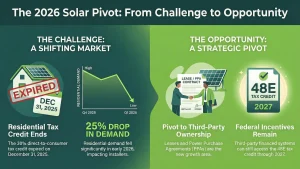
The elimination of the 30% residential Investment Tax Credit marks the most visible impact among solar changes 2026. Following the passage of the One Big Beautiful Bill, homeowners who installed systems before December 31, 2025, were the last to claim the direct consumer tax credit. Consequently, residential demand dropped by an estimated 25% in early 2026, creating immediate challenges for installers focused on the residential market.
Nevertheless, the picture isn’t entirely bleak. Third-party ownership arrangements—leases and Power Purchase Agreements—remain eligible for the 48E tax credit through 2027. This means installers who pivot toward offering prepaid leases and PPAs can still provide customers with federal incentive value. Moreover, these financing structures are becoming increasingly attractive as they absorb the complexity of FEOC compliance on behalf of homeowners.
Understanding FEOC Requirements for Solar Installers
Starting January 1, 2026, Foreign Entity of Concern regulations fundamentally altered the commercial solar landscape. These requirements restrict projects from receiving federal tax credits if they use excessive components from prohibited foreign entities—primarily China, Russia, Iran, and North Korea. For solar projects beginning construction in 2026, at least 40% of manufactured products must come from non-PFE sources.
Furthermore, this threshold increases by 5 percentage points annually, reaching 60% for projects starting after 2029. Solar installers and EPCs must now verify their supply chains, obtain manufacturer certifications, and calculate material assistance cost ratios. While this adds complexity, it also creates competitive advantages for companies that establish FEOC-compliant supply chains early.
Supply Chain Shifts Affecting Solar Projects
The solar changes 2026 are forcing dramatic supply chain reorganization. Module imports from Cambodia dropped to zero in early 2025, while imports from traditional Southeast Asian sources decreased significantly. Meanwhile, Indonesia and Laos captured 34.6% of the U.S. module import market by Q1 2025. Additionally, manufacturers are rapidly developing “reliance letters” certifying their FEOC compliance status.
Smart installers are proactively auditing their supplier networks and establishing relationships with FEOC-compliant manufacturers. This preparation not only ensures project eligibility but also protects against future supply disruptions. In addition, projects that achieved safe harbor status before December 31, 2025, remain protected from these requirements for up to four years.
Commercial Solar Opportunities in 2026
While residential installations face headwinds, commercial and industrial solar projects present significant growth opportunities. The 48E tax credit remains available for commercial projects, though they must meet FEOC requirements. EPCs positioning themselves as FEOC compliance experts will capture market share from competitors still figuring out the new rules.
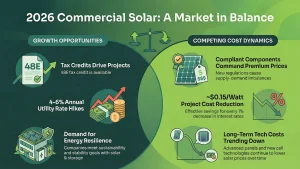
Commercial clients are increasingly motivated by energy cost stability as utility rates continue rising 4-6% annually in many markets. Solar installations with energy storage provide resilience against grid instability while meeting corporate sustainability goals. Therefore, installers expanding their commercial offerings and developing expertise in complex project structures will thrive despite residential market challenges.
Pricing and Cost Considerations
Solar pricing in 2026 faces competing pressures. On one hand, FEOC-compliant components command premium prices due to supply-demand imbalances. Projects requiring domestically manufactured or certified non-PFE equipment see costs rising monthly through the first half of 2026. On the other hand, Federal Reserve interest rate reductions are making solar loans more affordable—each 1% rate decrease effectively reduces project costs by approximately $0.15 per watt.
Additionally, long-term solar technology costs continue their downward trajectory. Industry leaders target $2 per watt within 5-10 years, and advanced technologies like TOPCon panels and tandem perovskite cells are entering the market. Installers balancing immediate cost pressures with long-term efficiency gains position themselves advantageously.
Technical Advances Driving Solar Forward
Despite policy challenges, solar technology leaps forward in 2026. TOPCon technology is capturing 70% of the market, offering 24% efficiency and superior hot-weather performance. These advanced panels maintain output better over time, providing better long-term value for clients. Furthermore, back-contact designs eliminate front-facing wiring, improving both aesthetics and performance.
Smart inverters and advanced monitoring systems are making installations more grid-friendly while providing clients with unprecedented control and visibility. For installers and EPCs, offering cutting-edge technology demonstrates value beyond just cost considerations. Consequently, technical expertise becomes a key differentiator in competitive markets.
Storage Integration and Grid Services
Energy storage integration has transitioned from optional to essential for many installations. Battery capacity grew 45% in 2025, and this trajectory continues through 2026. Commercial clients increasingly request solar-plus-storage systems for backup power, demand charge management, and grid services participation. Installers developing storage expertise and installation capabilities open multiple revenue streams.
Moreover, utility-scale projects focusing on grid integration and bulk generation remain strong despite temporary global market slowdowns. The U.S. solar capacity is projected to reach 182 gigawatts by year-end 2026, with utilities providing most new electricity generation capacity. EPCs with utility-scale experience find robust project pipelines despite broader market uncertainties.
Adapting Your Business Strategy for 2026
Successful solar businesses are reimagining their strategies for the post-tax-credit environment. First, diversifying beyond residential installations reduces exposure to that market’s volatility. Commercial, community solar, and utility projects offer stability and growth potential. Second, becoming FEOC compliance experts positions you as a trusted advisor rather than just an installer.

Third, emphasizing quality and long-term value over lowest upfront cost resonates with clients making significant investments without tax credits. Solar systems remain excellent investments based on energy savings, home value appreciation, and protection against utility rate increases. Fourth, developing expertise in third-party financing structures allows you to serve residential clients effectively despite tax credit elimination.
Marketing and Client Education
The solar changes 2026 demand updated marketing and education approaches. Clients need clear explanations of how FEOC requirements affect their projects, why certain equipment costs more, and what value they receive. Transparency builds trust, and educated clients make better partners throughout the installation process.
Additionally, highlighting your company’s expertise in navigating regulatory complexity differentiates you from competitors. Case studies demonstrating successful FEOC-compliant installations, testimonials from satisfied commercial clients, and thought leadership content establish authority in the new landscape. Remember that solar fundamentals remain strong—technology improves continuously, energy costs keep rising, and sustainability drives increasing corporate and residential demand.
Conclusion: Partner with EnergyScape Renewables for FEOC-Compliant Success
Navigating the solar changes 2026 requires expert partners who understand both technical requirements and regulatory complexity. EnergyScape Renewables provides PE-stamped engineering services, permitting support, and design expertise ensuring your projects meet all FEOC requirements while optimizing performance and cost. Our team helps solar installers and EPCs confidently navigate supply chain verification, compliance documentation, and technical specifications for projects of any scale.
Whether you’re adapting your residential business model, expanding into commercial installations, or tackling utility-scale projects, having the right engineering and compliance partner makes all the difference. Visit Sunscape Solar to learn more about comprehensive solar project management solutions that streamline your workflow from initial design through final interconnection. The solar industry’s future remains bright—those who adapt quickly and partner strategically will lead the way forward.
sjayakanth@energyscaperenewables.com