
Remote Solar Site Surveys vs. On-Site Visits: Which Method Saves You More Money?

Are Your Solar Site Surveys Costing You More Than They Should?
The solar industry is booming across America. In fact, installations are hitting record numbers every quarter. However, solar installers and EPCs face a critical challenge. How do you conduct site surveys efficiently without sacrificing accuracy? Traditional on-site solar surveys consume valuable time and resources. Meanwhile, remote solar site surveys promise speed and cost savings. Therefore, this decision isn’t just about convenience. Instead, it’s about profitability and staying competitive.
Understanding the Two Approaches to Solar Site Surveys
First, traditional on-site solar surveys involve physical property visits. Specifically, technicians climb roofs and take measurements. Additionally, they assess shading patterns. Consequently, this provides direct observation about roof conditions and structural integrity.
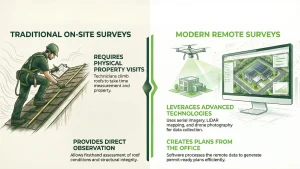
In contrast, remote solar site surveys leverage advanced technologies. These include aerial imagery and LIDAR mapping. Furthermore, drone photography plays a crucial role. Subsequently, modern software processes this data efficiently. As a result, you generate permit-ready plans from your office.
Breaking Down the Real Costs: Remote vs. On-Site
Understanding cost differences is crucial. Therefore, let’s examine the numbers.
On-site solar surveys involve multiple expenses. For instance, there’s labor costs for 2-4 hours. Additionally, transportation adds up quickly. Furthermore, scheduling delays create hidden costs. Meanwhile, safety equipment represents ongoing expenses.
In contrast, remote costs center on software subscriptions. Services like EagleView charge monthly fees. Moreover, these cost significantly less than physical visits. Most importantly, remote surveys eliminate travel time. Consequently, teams process multiple projects simultaneously. As a result, productivity multiplies dramatically.
Industry data reveals impressive results. Specifically, remote solar site surveys reduce costs by 40-60%. For example, companies processing 50 projects monthly save thousands. Furthermore, that’s not counting faster turnaround benefits.
Time Efficiency: The Hidden Value Proposition
Beyond cost savings, time represents your most valuable resource. Therefore, speed determines winners in competitive markets.

Notably, remote solar site surveys dramatically compress timelines. Traditional surveys require scheduling and traveling. In contrast, remote surveys provide instant data access. Subsequently, layouts get created within hours. As a result, you close deals before competitors schedule visits.
Furthermore, remote methods eliminate bottlenecks. Technicians visit only 3-5 locations daily. However, remote technology allows parallel processing. Consequently, multiple projects advance simultaneously. Thus, this maximizes revenue potential.
Accuracy and Quality: Dispelling Common Misconceptions
Initially, many installers resist remote solar site surveys. However, technological advances eliminated concerns. In fact, remote methods often provide superior precision.
For example, modern imagery offers 2-3 inches per pixel resolution. Moreover, LIDAR captures millions of data points. Additionally, drone surveys combine data with current conditions.
Studies show impressive results. Specifically, remote accuracy exceeds 95% for residential applications. In comparison, traditional surveys face frequent errors. Consequently, these create costly redesign requirements.
Safety Considerations and Risk Management
The solar industry faces ongoing safety challenges. Specifically, roof access represents significant liability. Therefore, remote solar site surveys become increasingly attractive.
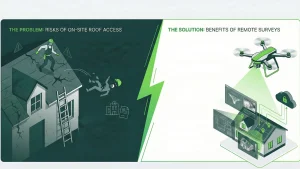
Every roof climb exposes companies to risks. For instance, workers’ compensation claims happen. Additionally, accidents occur regularly. Furthermore, falls represent leading injury causes.
In contrast, remote methods eliminate this exposure. Nevertheless, installers eventually access roofs for installation. However, eliminating unnecessary visits reduces overall risk. Consequently, insurance premiums may lower.
Additionally, remote solar site surveys provide comprehensive documentation. For example, drone footage creates permanent records. Therefore, this protects against false damage claims.
When On-Site Visits Still Make Sense
Despite advantages, some scenarios need traditional assessment. For instance, complex commercial installations require physical inspection. Additionally, facilities with electrical complexity benefit from on-site surveys.
Moreover, historic buildings present unique challenges. Nevertheless, these represent exceptions. Thus, smart contractors use remote solar site surveys for screening. Then, they reserve visits only when necessary.
Implementing a Hybrid Approach for Maximum Value
Successful installers strategically combine both approaches. As a result, this optimizes efficiency.
First, start projects with remote solar site surveys. Then, use information to qualify leads. Subsequently, create preliminary designs. Therefore, this captures maximum efficiency.
However, reserve on-site visits for specific circumstances. For example, use them when data reveals complications. Consequently, technicians spend time only when valuable.
Leading companies report impressive results. Specifically, hybrid approaches reduce costs by 50-70%. Moreover, outcomes improve through better screening.
The ROI Calculation: Making the Business Case
The investment math proves compelling. For example, consider installers processing 40 projects monthly. Traditional surveys cost roughly $6,000 monthly. Now, implement remote solar site surveys. Services cost $2,500 monthly covering 80% of projects. Meanwhile, remaining 20% add $1,200. As a result, expenses drop to $3,700. That’s $2,300 monthly savings or $27,600 annually.

Furthermore, faster turnaround enables higher closing rates. Imagine converting five additional customers monthly at $25,000 each. Therefore, that’s $300,000 additional annual revenue. Combined with savings, the impact becomes transformative for growing solar businesses.
Overcoming Implementation Challenges
Successful implementation requires addressing challenges. Team training represents the primary hurdle. Therefore, invest in comprehensive programs. Additionally, establish clear protocols. Consequently, this empowers teams to make judgment calls.
Moreover, start gradually. Instead of switching overnight, pilot on straightforward projects. Build success stories. As a result, demonstrate effectiveness. Meanwhile, monitor accuracy rates continuously.
Conclusion: Partner with Experts Who Understand Both Methods
The choice isn’t binary. Instead, it’s about strategically leveraging both approaches. Consequently, you maximize efficiency and profitability. Evidence demonstrates substantial benefits. Remote methods deliver 40-60% cost savings. Moreover, they maintain traditional accuracy. Additionally, safety benefits create compounding value.
At EnergyScape Renewables, we help solar installers and EPCs optimize workflows. Furthermore, our team understands when remote solar site surveys provide sufficient data. We also recognize when on-site verification adds value. Whether you need engineering support or PE-stamped design packages, we deliver. Therefore, our expertise helps businesses grow profitably.
Moreover, our Sunscape Solar platform offers cutting-edge tools. These manage projects from survey through installation. As a result, operations get streamlined and costs reduced.
The solar market continues expanding. However, competition intensifies alongside opportunity. Solar EPCs and installers who embrace remote solar site surveys gain advantages. Consequently, they’ll capture market share from slower competitors. The technology exists today. Therefore, will you implement it before your competition does?
sjayakanth@energyscaperenewables.com