
Net Metering Policies 2025: State-by-State Guide for Growing and Declining Solar Markets

Why Net Metering Policy Changes Matter for Your Solar Business in 2025
Net metering policies are experiencing unprecedented upheaval across the United States. Solar installers and EPCs must completely rethink their business strategies. If you’re wondering which states still offer profitable opportunities, you’re not alone. Approximately one-third of US states are transitioning away from traditional net metering. Others are implementing major policy revisions. The question isn’t whether change is coming. It’s how to position your solar business for survival and growth. This state-by-state net metering guide reveals where markets are expanding with favorable compensation structures. It also shows where markets are contracting under hostile utility regulations. You’ll gain the strategic intelligence needed to allocate resources effectively in 2025.
Understanding Net Metering Changes in 2025
Traditional net metering is rapidly becoming extinct. Solar customers previously received full retail rate credits for excess energy. The NC Clean Energy Technology Center’s Q3 2025 report documents this shift. They recorded 217 distributed solar policy actions during the quarter. Specifically, 57 addressed net metering policies. This represents the highest concentration of policy activity in recent history.

The shift toward wholesale-rate net billing is fundamentally changing project economics. California demonstrates what happens when compensation rates plummet. The California Solar and Storage Association reported a 77% to 85% drop in sales. This followed NEM 3.0 implementation. For installers and EPCs, understanding these dynamics is mission-critical.
States Where Net Metering Markets Are Growing
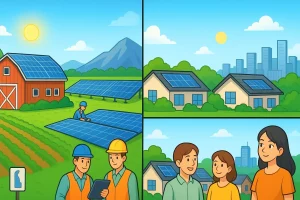
Delaware: Expanding System Size Limits
Delaware presents excellent opportunities for commercial and agricultural solar projects. The Delaware Public Service Commission recently approved key changes. They increased the system size limit for farm customer-generators from 100 kW to 150 kW. This signals strong state support for agricultural solar deployment. The expansion creates new market segments for EPCs specializing in mid-sized commercial installations.
Idaho: Massive Non-Residential Potential
Rocky Mountain Power proposed a dramatic expansion. They want to increase maximum system size for non-residential customers from 100 kW to 2 GW. This represents one of the most significant policy expansions in 2025. The proposal is still under regulatory review. Idaho installers should prepare for potential commercial solar boom conditions if approved.
Maryland: Comprehensive Incentive Ecosystem
Maryland continues strengthening its position as a top solar market. The state approved rules for a permanent community solar program in 2025. This complements its existing net metering framework. Maryland’s SREC market provides additional revenue streams for installers. These factors make it one of the most financially attractive states for solar deployment.
Massachusetts: High Electricity Rates Drive Demand
Massachusetts has some of the highest residential electricity rates in the country. This creates compelling value propositions for solar customers. The state’s SMART program provides performance-based payments. Combined with net metering and state tax credits up to $1,000, Massachusetts remains strong. It’s an excellent market for installers focusing on high-value residential projects.
States Where Net Metering Is Dying or Dead
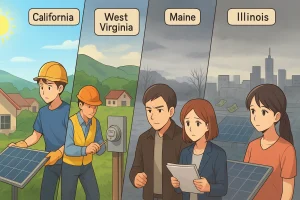
California: The Cautionary Tale
California’s NEM 3.0 implementation effectively killed the traditional residential solar market. Export compensation rates dropped dramatically. Battery attachment rates skyrocketed from 10% to 60%. California remains viable for solar+storage projects only. Pure solar installations have become financially uncompetitive for most customers. Installers must completely retool their sales processes to survive in this market.
West Virginia: Wholesale Rate Transition
The West Virginia Public Service Commission approved net billing for major utilities. Compensation was slashed from 13 cents per kWh to approximately 6.6 cents per kWh. This 50% cut in export value has decimated residential solar economics. EPCs should consider exiting West Virginia unless focusing on self-consumption projects with storage.
Maine: Retroactive Charges Destroy Investor Confidence
Maine’s LD 1777 legislation represents hostile policy action against solar. Governor Janet Mills signed provisions making community solar ineligible for net metering. The law also imposes retroactive monthly fees on existing projects starting January 2026. The Coalition for Community Solar Access estimates this impacts over $1 billion in solar investments. Installers should avoid new Maine projects until policy stabilizes.
Illinois: 2025 Transition Deadline
Illinois began phasing out traditional net metering on January 1, 2025. The state transitioned to the “Smart Solar Billing Tariff” with time-of-use export values. Customers who registered before this deadline were grandfathered into full retail rates. This created a rush of installations in late 2024. Going forward, installers must recalibrate savings calculations and emphasize storage solutions.
States Proposing Net Metering Changes

Virginia: Dominion’s NEM 2.0 Proposal
Dominion Energy Virginia filed a proposed net metering successor program. It uses 30-minute interval net billing. Compensation is based on distributed solar PPA bid prices. This represents a potential 70% reduction in export compensation. Virginia installers face significant uncertainty as proceedings determine final structures.
Arizona: Ongoing Rate Pressures
The Arizona Corporation Commission continues reviewing annual limits on credit rate changes. Additional reductions beyond the current 10% cap are possible. Arizona has already transitioned to net billing at reduced rates. Further cuts would compress margins for installers even more.
Strategic Implications for Solar Installers and EPCs
Prioritize Storage Integration
Battery attachment rates show market adaptation to hostile net metering policies. California’s 60% attachment rate proves this trend. Hawaii’s 90% rate demonstrates storage is essential in net billing states. Installers must develop storage expertise immediately. Financing partnerships are equally critical.
Target Commercial and Industrial Segments
Residential markets are under pressure. Commercial solar represents the growth frontier. Q3 2024 saw US commercial rooftop installations exceed 500 MW. This marked a 40% increase year-over-year. Commercial projects benefit from different economics. Demand charge reduction and higher self-consumption rates reduce dependence on export compensation.
Geographic Diversification
Single-state installers face existential risk from adverse policy changes. Successful EPCs in 2025 operate across multiple states. They balance exposure between growing markets like Delaware and Maryland. They maintain presence in mature but large markets like Texas and Florida. Meanwhile, they exit hostile jurisdictions like Maine and West Virginia.
Leverage Community Solar Where Available
Maryland’s permanent community solar program proves subscription-based models can thrive. EPCs should evaluate community solar opportunities in supportive states. This segment often enjoys different regulatory treatment than individual net metering.
Financial Modeling in the New Net Metering Landscape

Traditional financial models are obsolete. They assumed full retail rate compensation for 25 years. Modern solar proposals must account for different factors. These include time-of-use export rates and storage dispatch optimization. Policy sunset provisions matter. Expect changes every 3-5 years. Demand charge reductions are critical for commercial projects. Multiple revenue streams like SREC markets add value.
Installers using spreadsheet-based proposals face competitive disadvantage. EPCs with sophisticated modeling tools accurately represent complex rate structures. They properly calculate storage economics.
Partner with EnergyScape Renewables for Success
Navigating the rapidly changing net metering landscape requires expert partners. We provides comprehensive engineering services to solar installers and EPCs. We operate across all 50 states. Our services include overnight engineering, PE stamping, and sales proposals. We also handle site surveys, permitting, and interconnection applications.
Our team monitors policy changes in real-time. This ensures your proposals reflect current compensation structures and regulatory requirements. Whether you’re expanding into new states or adapting your business model, EnergyScape delivers results. We provide the technical expertise and market intelligence you need to succeed.
Additionally, leverage advanced solar design tools at Sunscape Solar to streamline your project pipeline. The right partners make the difference between thriving and merely surviving.
Visit EnergyScape Renewables to learn how we help solar installers navigate policy complexity. We optimize project economics and scale operations efficiently across multiple state markets. The net metering landscape may be changing. However, opportunities for strategic, well-informed solar businesses remain abundant.
sjayakanth@energyscaperenewables.com