
NEC 690 Permit Violations: Electrical Code Mistakes That Delay Solar Projects
Why Your Solar Projects Keep Getting Rejected And How to Fix It
Picture this scenario. You’ve designed what seems like a perfect solar installation, submitted your permit application, and waited weeks for approval. Then comes the dreaded email—rejection due to NEC 690 permit violations.
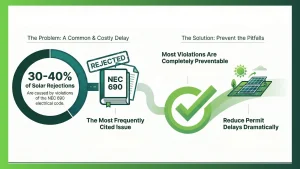
For US solar installers and EPCs, this happens far too often. Fortunately, most electrical code violations are completely preventable. In fact, NEC 690 permit violations account for approximately 30-40% of all solar permitting rejections nationwide. Consequently, this makes it the most frequently cited issue during electrical inspections. By mastering these common pitfalls, your team can dramatically reduce permit delays and keep projects moving forward.
Understanding the Real Cost of Electrical Code Violations
Every permit rejection triggers a cascade of problems. First, your installation crews sit idle. Next, your customers grow frustrated. Meanwhile, your profit margins shrink as projects drag on. Moreover, repeated solar permit rejection issues damage your reputation with local Authorities Having Jurisdiction (AHJs).
The electrical inspection process exists to ensure system safety and compliance. However, when your team doesn’t grasp NEC 690 compliance requirements, even minor oversights can derail projects. Therefore, understanding these regulations isn’t just about passing inspections. Rather, it’s about building a sustainable business that delivers quality installations efficiently.
The Most Common NEC 690 Permit Violations Killing Your Approvals
Circuit Sizing and Conductor Ampacity Errors
Circuit-related violations represent the single biggest category of NEC 690 permit violations. Specifically, inspectors consistently flag improper conductor ampacity calculations that fail to account for temperature correction factors.
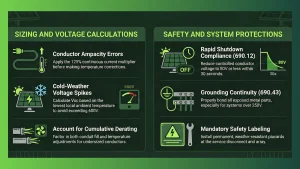
Here’s what typically goes wrong. First, installers forget to apply the 125% continuous current multiplier before making temperature corrections. Additionally, they overlook cumulative derating when multiple correction factors apply simultaneously. Furthermore, they may exceed the maximum series fuse rating listed on module datasheets.
For instance, consider a module with an 11.5A short-circuit current (Isc). Initially, you must multiply by 125% to get 14.375A. Then, apply temperature derating factors based on local conditions. Finally, factor in conduit fill adjustments if applicable. As a result, missing any step can cause undersized conductors that fail inspection.
Rapid Shutdown System Mistakes
Rapid shutdown requirements under NEC 690.12 have evolved significantly. Nevertheless, they remain a frequent source of solar electrical inspections failures. Specifically, the 2023 NEC mandates that controlled conductors must reduce voltage to 80 volts or less within 30 seconds. Additionally, all equipment must be clearly labeled with permanent, weather-resistant placards.
Equipment compatibility issues rank high on common mistakes. For example, installers often pair inverters and optimizers that fail to communicate properly for rapid shutdown commands. Similarly, inadequate labeling or ambiguous single-line diagrams often lead to rejection. Therefore, your documentation must clearly show shutdown perimeters and include proper signage at both the service disconnect and array boundaries.
Grounding and Bonding Deficiencies
Equipment grounding errors create serious safety hazards and trigger immediate permit denial. Specifically, NEC 690.43 requires proper bonding of all exposed non-current-carrying metal parts. This applies especially for systems operating at voltages over 250V.
Unfortunately, inspectors routinely find installations where grounding continuity is compromised. As a result, improper grounding can lead to shock hazards and equipment damage. Consequently, AHJs scrutinize grounding details extensively during plan reviews. Therefore, your electrical diagrams must explicitly show how every component connects to the grounding system.
Voltage Calculation Failures
Maximum voltage calculations under NEC 690.7 trip up even experienced installers. Essentially, the code requires calculating worst-case voltage scenarios using the module’s open-circuit voltage (Voc) adjusted for the lowest expected ambient temperature. Unfortunately, installers often use incorrect temperature coefficients or fail to account for local climate data properly.
For example, in colder regions, voltage can spike significantly above nameplate ratings during winter mornings. If your calculations don’t account for this, you might inadvertently exceed critical limits. Specifically, the 1000V limit applies to building-mounted arrays while the 600V restriction applies to residential dwellings. Ultimately, this type of PV system code violations not only fails inspection but could also create dangerous operating conditions.
Advanced Compliance Strategies That Actually Work
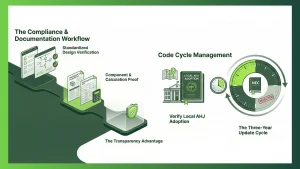
Successfully avoiding NEC 690 permit violations requires systematic implementation. First, develop standardized design checklists that walk through every code requirement before submission. Next, cross-reference your single-line diagrams against NEC Article 690 requirements. Then, verify that conductor sizing, overcurrent protection devices, and voltage calculations all comply.
Furthermore, invest in proper documentation. Include complete manufacturer cut sheets for all major components. Additionally, include detailed electrical calculations showing your work. As a result, when AHJs can easily verify your compliance, approvals happen faster.
Moreover, stay current with code cycles. The NEC updates every three years. Therefore, before submitting any permit, confirm which NEC version your AHJ has adopted. Otherwise, designing to outdated standards guarantees rejection.
Proactive Prevention Beats Reactive Corrections
The most successful solar installers prevent permit rejections entirely. To accomplish this, implement quality control processes that catch errors before submission. Specifically, have a senior designer review all calculations, particularly for complex installations.

Additionally, consider creating location-specific templates for your most common AHJs. Although this upfront work takes time, it dramatically accelerates subsequent projects.
Furthermore, regular team education on electrical code violations and NEC updates keeps everyone aligned. Ultimately, passing inspection requires coordination between engineering, installation crews, and project management.
Why Professional Engineering Support Makes the Difference
Navigating NEC 690 compliance becomes significantly easier with the right partners. Specifically, work with experienced engineering professionals who specialize in solar permitting. At EnergyScape Renewables, we’ve processed thousands of solar permits across all 50 states. As a result, this gives us deep insight into how different AHJs interpret and enforce electrical codes.
Our comprehensive permitting services eliminate guesswork from code compliance. First, we provide PE-stamped electrical drawings that clearly demonstrate NEC 690 compliance. Additionally, we handle all conductor sizing calculations with documented methodology. Our team delivers permit-ready packages that pass inspection on the first submission.
Moreover, when you leverage tools like Sunscape Solar’s project management platform, you gain additional efficiency. Easily track permit status, manage documentation, and coordinate with engineering teams. Consequently, this integrated approach transforms permitting from a bottleneck into a streamlined process.
Every day spent waiting for permit approval represents lost revenue. Therefore, by understanding common NEC 690 permit violations and implementing systematic compliance processes, you can dramatically reduce approval times. Don’t let preventable electrical code violations hold your business back. Instead, take control of your permitting success today.
sjayakanth@energyscaperenewables.com