
California Solar Permitting in 2026: Navigating the Strictest Requirements in the Nation

Turning California Solar Permitting Challenges Into Competitive Advantages
California solar permitting continues to evolve as the state leads the nation in renewable energy adoption. However, navigating California’s complex permitting landscape presents significant challenges for solar installers and EPCs. The good news? Understanding the streamlined processes, automated platforms, and compliance requirements can transform what seems like an obstacle into a competitive advantage for your solar business.
Understanding California’s Unique Solar Permitting Framework
The Golden State’s commitment to carbon neutrality by 2045 has resulted in some of the most comprehensive solar regulations in the country. For solar installers and EPCs, California solar permitting requirements represent both an opportunity and a challenge. Unlike other states where requirements vary wildly, California has implemented standardized processes designed to accelerate adoption while maintaining rigorous safety standards.
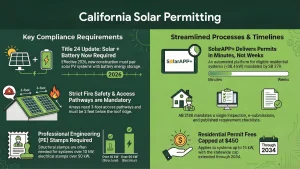
California’s permitting system stands out due to several key factors. First, Title 24 Building Energy Efficiency Standards mandate solar installations on most new residential and commercial construction. Additionally, the state requires specialized engineering stamps, fire safety compliance, and strict adherence to the National Electrical Code (NEC). These requirements ensure system safety but add complexity to the permitting process.
Mandatory Automated Permitting: SolarAPP+ and SB 379 Compliance
One of the most significant changes affecting California solar permitting involves Senate Bill 379, passed in 2022. This legislation requires most cities and counties to implement automated, online permitting platforms for residential solar and battery storage systems. By September 2024, jurisdictions under 50,000 residents had to comply, following larger jurisdictions that met the deadline in 2023.
The preferred compliance method is SolarAPP+, a free platform developed by the National Renewable Energy Laboratory (NREL) and the U.S. Department of Energy. This automated system verifies code compliance and issues permits in real time, often within minutes. For solar installers, this represents a dramatic improvement over traditional permitting that could take weeks or months.
However, not all projects qualify for automated permitting. SolarAPP+ eligibility requires specific conditions: roof-mounted systems on existing residential structures, systems under 38.4 kW, and designs meeting prescribed technical specifications. Furthermore, ground-mounted systems, new construction projects, and installations with unusual configurations still require traditional review processes.
Title 24 Compliance: Energy Code Requirements for 2026
California’s Title 24 Energy Code, particularly Part 6, establishes mandatory requirements that directly impact California solar permitting. The 2025 Building Energy Efficiency Standards, effective January 1, 2026, introduce significant updates that solar professionals must understand.
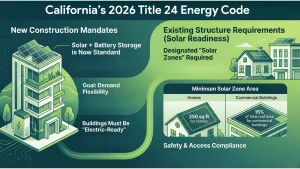
For new construction, the code requires solar photovoltaic systems paired with battery energy storage systems (BESS). This integration supports demand flexibility and allows buildings to shift energy consumption away from peak periods. Additionally, commercial kitchens and certain multifamily buildings must meet electric-ready requirements, facilitating future conversion from gas to electric systems.
The code also maintains solar readiness requirements for existing structures. Solar zones must meet minimum area requirements, typically 250 square feet for single-family residences and 15% of total roof area for commercial buildings. Moreover, these zones must comply with access, pathway, smoke ventilation, and spacing requirements specified in Title 24, Part 9.
Fire Safety and Access Requirements
California’s wildfire concerns have resulted in some of the nation’s strictest fire safety requirements for solar installations. These regulations, established by the Office of the State Fire Marshal, address equipment positioning, conductor location, and emergency access pathways.
Specifically, photovoltaic arrays cannot exceed 150 feet in any dimension. Residential buildings with hip or ridge roof features must provide a 3-foot access pathway from the eave to these features. Furthermore, PV arrays cannot be located higher than 3 feet below the ridge to provide adequate smoke ventilation. These requirements apply statewide, though jurisdictions in Wildland-Urban Interface Fire Areas face additional restrictions.
For solar installers, understanding these fire code requirements is critical. Plan submissions must demonstrate compliance with access pathways, smoke ventilation provisions, and proper DC conductor routing. Consequently, working with engineering firms experienced in California fire codes can prevent costly plan rejections and delays.
Professional Engineering (PE) Stamp Requirements
California solar permitting typically requires professional engineering stamps for larger installations. Structural PE stamps are generally necessary for rooftop systems exceeding 10 kW, verifying that buildings can support solar array loads considering roof framing and seismic conditions. Meanwhile, electrical PE stamps usually kick in for systems over 50 kW, confirming designs meet NEC requirements.

The cost of PE stamps typically ranges from $200 to $650 per project, varying based on system complexity. However, the value extends beyond mere compliance. Professional engineering review identifies potential issues before installation, reducing liability and ensuring long-term system performance. Additionally, having PE-stamped plans expedites the permitting process, as authorities having jurisdiction (AHJs) can approve technical aspects more quickly.
Streamlined Permitting Under AB 2188
Assembly Bill 2188, passed in 2014, established California’s expedited permitting framework for small residential rooftop solar systems. This legislation requires every city and county to adopt ordinances creating streamlined processes for systems up to 10 kW photovoltaic or 30 kW thermal.
Under AB 2188, jurisdictions must publish checklists of requirements and allow electronic submission of permit applications. Moreover, the law mandates that only one inspection is required for qualifying installations, eliminating pre-inspections or rough inspections that previously slowed the process. For solar installers, this means faster project completion and improved cash flow.
The law also addresses permit fees. Cities and counties cannot base fees on the system value or property value. Instead, fees must reflect the reasonable cost of providing permitting services. AB 1132, passed in 2023, extended fee caps until 2034, limiting residential permits to $450 for systems up to 15 kW, with additional charges per kilowatt for larger systems.
Permit Fees and Processing Times in 2026
Understanding the financial and temporal aspects of California solar permitting helps installers provide accurate project timelines to customers. Permit costs typically range from $200 to $600 for residential installations, depending on jurisdiction and system size. Commercial permits generally cost more, with fees reaching $900 to $1,000 for larger systems.
Processing times vary significantly based on several factors. Jurisdictions using SolarAPP+ can issue permits within hours or days. Traditional permitting processes typically take one to two weeks for straightforward residential installations, though complex projects may require four to eight weeks. Commercial installations and projects requiring electrical service upgrades face longer timelines.
Beyond permit processing, solar installers must account for utility interconnection approval, which adds 15 to 90 business days to project timelines. Permission to Operate (PTO) from utilities represents the final step before systems can begin generating revenue, making efficient permitting crucial for project economics.
Common Challenges and Solutions
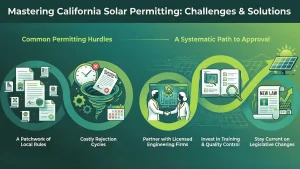
Despite California’s efforts to streamline solar permitting, installers still face several challenges. Jurisdiction-to-jurisdiction variations create confusion, even with standardized state requirements. Some building departments maintain additional local requirements that complicate compliance. Additionally, incomplete applications or design errors trigger rejection cycles that add weeks to project timelines.
The solution lies in building systematic approaches to California solar permitting. First, develop relationships with engineering firms licensed across California’s diverse jurisdictions. Second, invest in training staff on Title 24 compliance, fire code requirements, and automated permitting platforms. Third, implement quality control processes that catch errors before submission. Finally, maintain updated knowledge of legislative changes affecting permitting requirements.
Partner with the Right Experts
Success requires working with partners who understand California’s unique regulatory landscape. EnergyScape Renewables specializes in helping solar installers navigate complex California solar permitting requirements. Our team provides PE stamping services, engineering reviews, and permitting support across California’s diverse jurisdictions, ensuring your projects move smoothly through approval processes. Visit https://energyscaperenewables.com/ to streamline your permitting workflow.
Managing the entire project lifecycle demands robust tools designed for solar professionals. Sunscape Solar offers comprehensive project management and CRM solutions that integrate permitting workflows with site surveys, customer communications, and installation scheduling. From initial assessment to final PTO, Sunscape helps you manage every aspect efficiently. Discover how at https://www.sunscape.solar/.
California solar permitting in 2026 demands expertise, attention to detail, and strategic partnerships. By leveraging automated platforms and working with experienced professionals, solar installers and EPCs can thrive in the nation’s most demanding—and most rewarding—solar market.
sjayakanth@energyscaperenewables.com