
TPO Solar Proposal: Reframe Savings After the 25D Cliff in 2026

TPO Solar Proposal Playbook: Reframe Monthly Savings After the 25D Cliff
Quick answer: A TPO solar proposal has to show a Year 1 cost below the utility bill, then every year of payments after that, along with the assumptions behind each savings figure. Section 25D is gone, so three parties now judge that document: the homeowner, the financier and, in more states each year, a regulator.
January 1, 2026 took away the easy close. A homeowner paying cash or taking a loan now gets no federal credit. But the company that owns a leased system can still claim Section 48E, and some of that money comes back as a lower payment.
Sales teams followed the money. Aurora Solar found that 55% of installers now call TPO their most popular financing option, yet plenty of decks still pitch like it’s 2025.
It’s showing up in the numbers. Wood Mackenzie counted just 995 MWdc of residential installs in Q2 2026, the lowest quarter in five years, and says installers are still working through the switch from cash and loans to third-party ownership.
Why the Old Solar Pitch Stopped Working
Buy now, get 30% back, own the system. A lease or PPA breaks that script because the homeowner claims no credit and doesn’t own the equipment.
So every kitchen-table conversation lands on one question: “Will I pay less, and for how long?”
Losing that conversation costs more this year. Wood Mackenzie expects customer acquisition costs to climb 40% to $0.84 per watt in 2026, which works out to about $2,880 extra on a 12 kW job. If you’ve ever watched a homeowner go quiet at page six, you know how fast that money disappears. Our proposal conversion benchmarks show where those deals tend to slip.

Who Reads Your TPO Solar Proposal Now?
Your TPO solar proposal goes to three readers, and they’re hunting for different things.
| Reader | Their question | What your proposal needs |
|---|---|---|
| Homeowner | Am I better off every year? | Year 1 savings and a full payment schedule |
| Financier | Does this fit our program? | Accurate production, approved equipment, compliant pricing |
| Regulator | Where did this number come from? | Stated assumptions and a clear method |
The regulator is the new one. Colorado now requires a disclosure of four pages or fewer on leases and PPAs, and it has to spell out where any savings estimate came from. Oregon wants production estimates, the method behind them and good-faith first-year savings. Then there’s Texas, where the attorney general has started asking major solar companies how they track bill changes.
Three Ways to Reframe Savings in a TPO Solar Proposal
Start with last month’s electric bill. Every homeowner has one, and they all hate it.
1. Lead With the Homeowner’s Rate
Put today’s rate and the solar rate side by side before anything else. EnergySage puts the average PPA near 14 cents per kWh, about 22% below an 18-cent national residential average.
That national figure won’t sign anyone in Phoenix or Hartford, though. Pull the customer’s bill, tariff and export rules, because time-of-use rates, fixed charges and net billing can eat into solar-only savings.
2. Show All 25 Years
Escalators usually run 1% to 3% a year, and a lot of proposals stop at Year 1. Here’s what a 2.9% escalator does to a 14-cent PPA, in an illustration we ran ourselves:
| Price per kWh | Year 1 | Year 10 | Year 25 |
|---|---|---|---|
| PPA with 2.9% escalator | 14.0¢ | 18.1¢ | 27.8¢ |
| Utility, flat | 18.0¢ | 18.0¢ | 18.0¢ |
| Utility, up 2% a year | 18.0¢ | 21.5¢ | 28.9¢ |
Flat utility rates put the PPA above the utility by Year 10, and if rates climb 2% a year, the PPA stays ahead while the discount falls from about 22% to about 4%.
Print that utility growth assumption right on the page, then add a conservative case and quote a low-escalator option next to the standard one. EnergySage already tells homeowners to ask for a year-by-year schedule, so hand it over first.
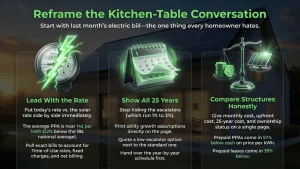
3. Compare Structures Honestly
Some households come out ahead paying cash, and they can smell it when a rep pretends otherwise. EnergySage’s H1 2026 data had cash beating a standard PPA by 33% on price per kWh, while a prepaid PPA came in 57% below cash and a prepaid lease 39% below.
Give all of it one page: monthly cost, upfront cost, 25-year cost and who owns the system. Before it goes out, check that your proposal and system design tell the same story.
Check Your TPO Solar Proposal Before You Send It
A design change after signature can wreck all of that. Run five checks first.
Production. Use real site data. A lease payment stays fixed, so an inflated estimate lands on the homeowner.
Equipment. Financiers keep approved vendor lists and the owner’s credit faces FEOC screening, so lock the bill of materials early.
Savings cap. SEIA notes that providers with savings policies limit what you can charge in each market. If a redesign comes late, the difference comes out of your margin.
Calendar. Anything that began construction after July 4, 2026 has to reach service by December 31, 2027.
Your promises. Half of sales pros name follow-up and closing as their biggest struggle, and that’s before anyone has to dig up version three of a proposal. So tie every version to the customer record.
Once it’s signed, your TPO milestone funding checklist takes over. December’s tariffs also make quote validity windows worth a second look.
Send a Savings Number You Can Stand Behind
If your team can’t defend the number, the deal is shaky before it starts. Energyscape Renewables builds engineering-accurate sales proposals in 15 minutes, using SiteScape survey data from the real site. When funding paperwork piles up, our back-office team takes it on, and our consultants can help rework your sales motion for TPO. Request your next proposal.
After signature, Sunscape tracks every lead, follow-up and milestone through PTO, so your customer never has to call and ask where things stand. Book a Sunscape demo and bring one live deal to walk through.
TPO Solar Proposal FAQs
What should a TPO solar proposal include?
Current utility cost, Year 1 solar cost, a yearly payment schedule, the escalator, production assumptions and ownership terms. Also state the utility rate growth behind your savings estimate.
Can homeowners still get a federal solar tax credit in 2026?
No, if they buy with cash or a loan. Section 25D expired on December 31, 2025, but a company that owns a leased or PPA system may claim Section 48E and pass some value to the homeowner.
How does an escalator affect solar lease savings?
It raises the payment every year, usually by 1% to 3%. The starting price drops, but savings shrink when utility rates grow slowly, so model the full contract term.
sjayakanth@energyscaperenewables.com