
Solar Domestic Content Bonus 2027: How to Claim the 10% Adder

The Solar Domestic Content Bonus in 2027: How Installers Claim the 10% Adder After the Section 232 Tariffs
Two dates belong on every 2027 project calendar. On December 4, 2026, Section 232 tariffs start hitting imported polysilicon, wafers, cells and modules. Four weeks later, on January 1, the solar domestic content bonus gets harder to earn. If you’re carrying commercial, community or third-party-owned residential jobs into next year, the 10% adder is still worth going after, but the rules got tighter and the pricing math moved.
Quick answer: To claim the solar domestic content bonus in 2027, a Section 48E project needs 100% US-made structural steel and iron, plus at least 55% domestic content on manufactured products. It also has to pass the FEOC material assistance cost ratio. And if construction started after July 4, 2026, the system must be placed in service by December 31, 2027.
What Is the Solar Domestic Content Bonus?
It’s a 10-point adder on the Section 48E investment tax credit. A qualifying project moves from the 30% base credit to 40%, so a $500,000 commercial system picks up another $50,000 in credit.
To qualify, a project has to clear two tests. First, all structural steel and iron has to be made in the US. Second, a set share of manufactured-product cost (modules, inverters, trackers) has to be domestic.
The credit goes to whoever owns the system. On a commercial job, that’s your customer. On a residential lease or PPA, it’s the financier. Homeowners who buy outright can’t claim it, and the residential 25D credit ended December 31, 2025. Installers still control the outcome, though, because they choose the equipment, draw the design and keep the paperwork.
What Changes for the Solar Domestic Content Bonus in 2027
Three rules tighten at once.
| Construction start | Domestic content threshold | FEOC minimum (MACR) |
|---|---|---|
| 2025 (after June 15) | 45% | Not required |
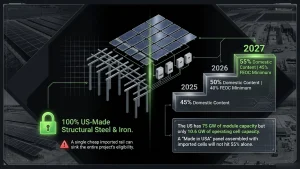
| 2026 | 50% | 40% |
| 2027 | 55% | 45% |
The domestic content threshold rises to 55%. The FEOC material assistance cost ratio, a separate test that caps equipment from prohibited foreign entities, also climbs 5 points a year from its 40% starting point in 2026. Then there’s the calendar. Any solar project that begins construction after July 4, 2026 has to reach placed-in-service status by December 31, 2027, or it can’t claim 48E at all.
Twelve months is tight. A 2027 project has to qualify for the adder, pass FEOC and get energized inside the same calendar year, which means one late module swap or one permit stuck at the AHJ can take the whole credit down with it.
How Section 232 Tariffs Change the Math
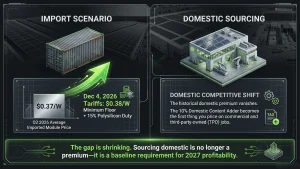
The proclamation sets minimum import prices of $0.38 per watt for modules and $0.22 per watt for cells. On top of that floor comes a 15% duty on most polysilicon products, with lower rates for some countries.
Compare that with what installers paid this year. SEIA puts the average distributed-segment module at $0.37 per watt in Q2 2026. So the floor for imported modules already sits above today’s average, before anyone adds the duty.
For years, the knock on domestic content was the premium. US-made equipment cost enough extra to eat most of the 10% bonus. That gap shrinks in 2027. On a lot of commercial and TPO jobs, the domestic content adder becomes the first thing you price.
Does a US-Made Panel Qualify for the Domestic Content Adder?
Sometimes. The US has roughly 75 GW of module capacity but only about 10.6 GW of operating cell capacity, with 19.1 GW more under construction. Most US-assembled panels still run on imported cells, and the cell is one of the priciest parts of a module.
So a “Made in USA” sticker won’t get a project to 55% by itself. Ask the manufacturer for its domestic content documentation before the adder goes into a proposal. Check the racking too. Steel racking and piles fall under the 100% steel and iron test, so a cheap imported rail can sink a project whose modules pass easily.
A 2027 Playbook for Installers and EPCs
- Review borderline projects now. A project that truly begins construction in 2026 keeps the 50% threshold. Ask your tax advisor what counts before December 31.
- Pick the calculation method early. Owners can document actual manufacturer costs or use the IRS safe harbor tables. The safe harbor covers the whole project or nothing, so lock in that choice before procurement.
- Design around the bill of materials. List exact module, inverter and racking models on the planset. When equipment changes, recheck the numbers and order a planset revision so the stamped set matches what goes on the roof.
- Keep one compliance file. IRS Notice 2026-15 lets taxpayers use the domestic content safe harbor tables for the FEOC calculation as well, so one clean package can back up both tests.
- Schedule backward from December 31, 2027. Map design, permitting, interconnection and PTO with real slack built in.
Where the Solar Domestic Content Bonus Is Won or Lost
Plenty of projects that miss the adder had qualifying equipment. They lost the credit to a missing supplier letter or a module swap nobody flagged. Sometimes a permit delay shoves the in-service date into 2028.
Win the 10% Adder Without the Back-Office Headache
The 2027 solar domestic content bonus pays installers who move fast and keep clean records. Energyscape Renewables covers both. Our Professional Consulting team reviews each project’s start date, thresholds and FEOC exposure, so you know whether the adder pencils out before you order a single pallet. Our plansets list exact equipment models and get revised quickly after a swap, backed by overnight engineering and 24-hour PE stamping in all 50 states. And our BPO team chases down supplier letters and compliance documents while your crews stay on roofs.
Every milestone lands in Sunscape, our solar CRM and project management platform. Construction-start dates, equipment lists, documents and PTO status sit in one place, so you can see which 2027 jobs are on pace for December 31 and which ones need a push this week.
Ready to protect your 2027 tax credits? Request a quote from Energyscape Renewables or book a Sunscape demo. For more on permitting and incentives, browse our solar permitting and tax credit guides.
Frequently Asked Questions
What is the solar domestic content bonus threshold for 2027?
For solar projects that begin construction in 2027, 55% of manufactured-product cost has to be domestic. All structural steel and iron must be US-made as well.
Can residential solar projects get the domestic content bonus?
Yes, through third-party ownership. The lease or PPA provider claims the credit and decides whether any of it reaches the installer.
Is domestic content required for the base 30% ITC?
No. The adder is optional. FEOC material assistance rules do apply to every project that begins construction after 2025, though.
Do Section 232 tariffs affect US-assembled panels?
They can. The tariffs cover imported cells, so a US-assembled module built on imported cells may cost more after December 4, 2026.
sjayakanth@energyscaperenewables.com