
Section 232 Solar Tariffs in 2026: Protect Margin Before Dec 4
Section 232 Solar Tariffs Hit December 4: How Installers Protect Margin Without Losing Deals in 2026
Section 232 solar tariffs take effect on December 4, 2026. Most coverage targets importers and customs paperwork. For installers and EPCs, though, the real risk sits in your own pipeline. It’s the deals you priced at today’s module costs that install after the new price floor kicks in.
This guide covers what changes, what it costs per job, and how to protect margin without scaring off homeowners.
Quick answer: Starting December 4, 2026, imported solar modules face a $0.38/W minimum import price, plus a 15% tariff for most countries. Analysts expect module prices to rise about $0.10/W. Your biggest exposure is signed backlog that installs after the deadline. So audit it, re-quote fast, and lock equipment early.
What Do the Section 232 Solar Tariffs Change?
President Trump signed the proclamation on August 6, 2026. It replaces the Section 201 safeguard that expired in February. However, it reaches further up the supply chain, according to White & Case. Here’s the short version:
- Price floors: Imported products must enter at or above a minimum import price (MIP).
- 15% tariff: It applies to ingots, wafers, cells, and modules. Raw polysilicon faces only the floor.
- Partner caps: Products from the EU, Japan, South Korea, Taiwan, Switzerland, and Liechtenstein pay 15% combined duty at most. UK products pay 10%.
- Paperwork: Importers must show CBP that goods entered, and will resell, at or above the floor. If they can’t, CBP charges the full floor as a tariff (Sheppard Mullin).
- Stockpiling limits: Commerce can restrict imports from companies that stockpile before the deadline.
| Product | Minimum import price | Extra 15% tariff |
|---|---|---|
| Polysilicon | $21/kg | No |
| Ingots and wafers | $100/kg | Yes |
| Solar cells | $0.22/W | Yes |
| Solar modules | $0.38/W | Yes |
Commerce can also adjust these floors over time. So don’t treat $0.38/W as permanent.
How Much Will Section 232 Solar Tariffs Add Per Job?
Roth Capital Partners expects module prices to rise about $0.10/W on average. Meanwhile, Anza’s modeling shows roughly a 40% jump for imported modules. Fully domestic modules rise too, by 19% to 32%.
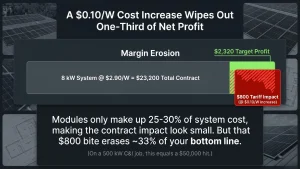
Still, modules make up only 25% to 30% of a residential system’s cost. So the contract impact looks small. Your margin, however, tells a different story:
- 8 kW system at $2.90/W = $23,200 contract
- Tariff impact at $0.10/W = $800
- At a 10% net margin ($2,320), that $800 eats about one-third of your profit
This is an example, so run your own numbers. On a 500 kW commercial job, the same $0.10/W adds up to $50,000.
Why Signed Backlog Is the Real Risk
Most installers will update price sheets for new leads. The bigger problem sits between signature and install.
For example, say you signed a homeowner in October at old module pricing. Then permitting and scheduling push the install into December. Your distributor’s price may change before you buy. Without a price-validity window or a substitution clause, you absorb the difference.
Timing makes it worse. On November 2, Commerce issues antidumping and countervailing duty (AD/CVD) orders on cells and modules from India, Indonesia, and Laos. Combined rates top 200%, according to pv magazine. As a result, switching to those origins won’t save you.
Meanwhile, SEIA and Wood Mackenzie forecast a residential market contraction in 2026. In a shrinking market, you can’t just pass every cost on.
5 Ways to Protect Margin From Section 232 Solar Tariffs
1. Audit Your Pipeline This Week
First, pull every open deal. Sort it by signed date, expected install date, and module brand and origin. Then flag any job that installs after December 4 without bought or allocated equipment. That’s your exposure list. If your project data lives in spreadsheets and email, this step alone can take days.
2. Re-Quote Fast and Clearly
Next, send revised proposals for flagged deals that haven’t reached permitting. A homeowner who waits two weeks for a new number starts shopping. Also, add a price-validity window and plain-language substitution terms to every new proposal. Show the change as a line item, not a mystery bump.
3. Swap Equipment Without Stalling Projects
A domestic module, or one from a capped country, can protect margin. But a swap isn’t free. A new module means a revised plan set, possibly a new PE stamp, an updated single-line diagram, and sometimes an interconnection amendment. If that redesign takes three weeks, you’ve traded a tariff problem for a cycle-time problem. Our permit-to-install time guide shows where those days go.
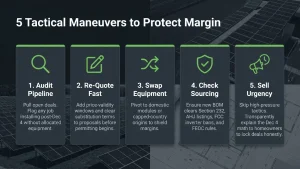
4. Check Sourcing Against Every Rule
In addition, one bill of materials now has to clear Section 232, the new AD/CVD orders, AHJ listings, and FEOC rules. A module that dodges the tariff but breaks FEOC eligibility costs you more than the tariff did. Our MACR calculation guide and equipment selection checklist walk through those checks. Also confirm inverters against the FCC inverter ban.
5. Sell Honest Urgency
Finally, consumer sites like SolarReviews already warn homeowners about “sign today” pressure. So skip that game. Instead, explain the December 4 date, show the numbers, and offer a real reason to decide: locked equipment pricing. Transparency wins more deals than pressure.
Section 232 Solar Tariffs for EPCs and Commercial Projects
EPCs face the same backlog risk at bigger dollar amounts. First, check supply contracts for fixed-price terms signed before August 6, 2026. Those can qualify for relief from the resale requirement. Also, get your distributor’s floor-price paperwork commitment in writing. Then price tariff change orders into new C&I bids before award, not after. For TPO projects, review our milestone funding checklist too.
Protect Your Margin Before December 4
Section 232 solar tariffs are fixed. How much of them hits your margin isn’t.
See every exposed deal in one place with Sunscape. Sunscape, your Solar OS, tracks every project from proposal through permitting, interconnection, and PTO. So you can spot jobs installing after December 4 and push re-quotes without chasing spreadsheets. Book a Sunscape demo →
Re-quote and re-engineer overnight with Energyscape Renewables. Swapping modules? We turn around revised plan sets with 24-hour PE stamping nationwide. We also handle interconnection updates and build sales proposals your homeowners trust. Plus, our consulting team reviews your sourcing against Section 232, AD/CVD, and FEOC rules before you commit. Request a quote →
Frequently Asked Questions
When do Section 232 solar tariffs take effect?
December 4, 2026, at 12:01 a.m. ET. They apply to covered goods entered on or after that date.
Do the tariffs raise prices on US-made solar panels?
Yes, indirectly. Domestic modules built with imported cells or wafers carry tariff costs. Anza models a 19% to 32% increase for fully domestic product.
How much will a home solar system cost after December 4?
SolarReviews estimates $600 to $1,100 more on a typical 7.2 kW California system. Your number depends on your supply chain and contract terms.
Should installers rush deals before December 4?
Rush equipment allocation, not homeowners. Your purchase date drives your cost, not the signature date.
sjayakanth@energyscaperenewables.com