
Battery Storage Retrofit Playbook: Beat the 2027 Solar Cliff
After the 2027 Solar Cliff: The Battery Storage Retrofit Playbook for Installers (Credits, Codes, Interconnection)
A battery storage retrofit is the strongest residential product left after the 2027 solar cliff. Under the One Big Beautiful Bill Act, solar that began construction after July 4, 2026, must be placed in service by December 31, 2027, to claim the 48E credit (SEIA). However, the storage credit keeps full value for projects that start construction through 2033.
So your best leads already sit in your CRM. Every solar-only home you’ve built can take a battery. You skip roof work and module orders. Plus, the federal credit outlives solar’s by six years.
This guide walks through the three gates every retrofit must clear: credits, codes and interconnection.
What Is a Battery Storage Retrofit?
A battery storage retrofit adds an energy storage system (ESS) to an existing grid-tied solar system without new PV. Most installers use AC-coupled batteries, so the original inverter and array stay untouched. The AHJ then reviews the ESS under NEC Article 706 and NFPA 855. Finally, the utility handles it as an interconnection amendment or a non-export application.
Why Battery Storage Retrofits Matter in 2026
Storage keeps growing while new solar slows down. U.S. installers deployed a record 18.9 GWh of batteries in Q2 2026. The residential solar-plus-storage attachment rate also hit 46%, up from 41% a year earlier.
Meanwhile, Wood Mackenzie expects the residential segment to shrink about 5% in 2026. Tight tax equity and new permitting rules drive that drop.
The retrofit pool is huge. For example, California alone has more than 1 million solar homes without a battery. Those owners already know your crew and trust your work.
Gate 1: Tax Credits for a Battery Storage Retrofit
| Credit | Who Claims It | Status |
|---|---|---|
| 25D residential | Homeowner (cash or loan) | Ended December 31, 2025, for solar and standalone storage |
| 48E solar | Third-party owner (lease/PPA) | Placed in service by December 31, 2027, unless construction began by July 4, 2026 |
| 48E storage | Third-party owner or commercial | Full credit through 2033 starts, then 75% in 2034, 50% in 2035, 0% in 2036 |
Here’s what that means in the field:
- Cash and loan deals get no federal credit. As a result, your proposal must win on state rebates, utility programs and bill savings.
- TPO battery deals can still carry 48E value after solar’s deadline. So talk to your finance partners now.
- FEOC rules decide eligibility. In 2026, at least 55% of storage material cost must come from non-prohibited foreign entities, and that bar rises to 75% by 2030. Ask suppliers for FEOC certifications before you pick a battery brand.
Tax rules shift often, so confirm every deal structure with a qualified tax professional.
Gate 2: NEC 2026, NFPA 855 and UL 9540 Codes
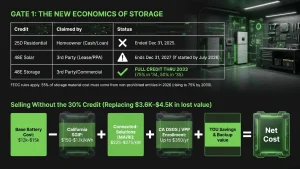
The 2026 NEC didn’t rewrite Article 706. Still, designers will notice four changes:
- Articles 480 and 706 now split stationary batteries and ESS more clearly.
- Backup load sizing moves toward Article 702.
- The code recognizes two types of power control systems (PCS). A listed PCS can help you skip a main panel upgrade.
- Every ESS install now needs commissioning, including one- and two-family homes.
NFPA 855 caps each residential unit at 20 kWh. It also sets aggregate limits by location: 40 kWh in utility closets and basements, and 80 kWh in garages, on exterior walls and outdoors. In addition, the UL 9540 listing must match the exact battery and inverter combo you install.
Watch for adoption lag, though. Many AHJs still enforce older NFPA 855 editions. Florida’s next code cycle, for instance, references the 2023 edition. Always design to the edition your AHJ enforces.
Retrofit site survey checklist:
- Main panel and busbar rating, plus main breaker size
- Existing inverter make, model and firmware
- ESS location options, clearances and vehicle impact risk
- Critical loads the homeowner wants backed up
- Meter location and service conductor size
Gate 3: Interconnection That Protects Net Metering
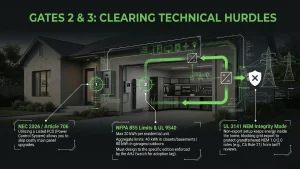
A sloppy interconnection filing can cost a legacy customer more than the battery saves. In California, NEM 1.0 and 2.0 customers can add storage and keep grandfathered rates. The battery just needs to run non-exporting or pair properly with the existing system. Some batteries offer a non-export mode certified to UL 3141 NEM Integrity Mode for this exact case.
Non-export can also speed up approvals where grid capacity runs tight. Under California Rule 21, non-export systems stay off the Net Billing Tariff. Other utilities, including Minnesota municipal utilities, run dedicated non-export processes for UL 1741-PCS or UL 3141 equipment.
Before you file, pull the original interconnection approval, system size and PTO date. Adding PV can trigger a tariff review. Adding storage alone usually doesn’t.
Selling a Battery Storage Retrofit Without the 30% Credit
On a $12,000 to $15,000 battery, the expired 25D credit was worth $3,600 to $4,500. Instead of discounting, replace that value with a stack:
- California SGIP: $150 to $1,100 per kWh
- ConnectedSolutions (MA/RI): $225 to $275 per kW
- California DSGS: up to $350 per battery per year through VPP enrollment
- VPP programs: open in about half the states
- TOU savings and backup: shift solar into evening peaks and keep lights on during outages
Then show net cost, each incentive and its timing on one page. Clear math closes deals.
Your 5-Step Battery Storage Retrofit Workflow
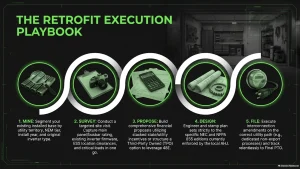
- Mine your installed base by utility, NEM tier, install year and inverter type.
- Survey the site and capture panel, location and equipment data in one visit.
- Build the proposal with stacked incentives, or offer a TPO option.
- Design and stamp to the NEC and NFPA 855 editions your AHJ enforces.
- File interconnection on the right path and track it to PTO.
Build Your Retrofit Pipeline with Energyscape Renewables and Sunscape
The 2027 cliff won’t wait for your back office. That’s where Energyscape Renewables comes in. Our team handles:
- Site surveys
- NEC 706 and NFPA 855 compliant plan sets
- 24-hour PE stamping in all 50 states
- Permitting and interconnection
- Sales proposals
With more than 347,000 projects completed and a 99% AHJ and utility approval rate, your retrofits move from survey to PTO without rework. Explore our full solar engineering services.
Next, run it all inside Sunscape, your Solar OS. Segment solar-only customers, launch retrofit campaigns and capture site data with the Sunscape Site Survey App. Then track every permit and interconnection to PTO in one dashboard.
Send us your first 10 battery retrofits. Request a quote and turn your installed base into 2028-proof revenue. Want more code and policy updates? Browse the Energyscape blog.
FAQs
Can homeowners get a federal tax credit for a battery in 2026?
Not with cash or a loan, because the 25D credit ended December 31, 2025. Third-party-owned batteries may still qualify for 48E.
Does adding a battery affect NEM 2.0 in California?
Usually not. Add storage only, and configure it as non-exporting or paired under existing NEM rules.
What is the maximum home battery size under NFPA 855?
Each unit tops out at 20 kWh. Aggregate limits run 40 kWh or 80 kWh, depending on location.
sjayakanth@energyscaperenewables.com