
Proposal-to-Contract Conversion: Benchmarks for US Installers in 2026
Why Solar Proposal Conversion Now Decides Your 2026 Margin
Every US solar installer feels the same squeeze this year. Leads cost more, buyers hesitate longer, and quotes pile up without signatures. Meanwhile, solar proposal conversion has quietly become the metric that separates profitable EPCs from the ones shutting their doors. Residential installations are forecast to fall 18% to 21% in 2026 after the Section 25D federal tax credit expired, while customer acquisition cost is projected to climb 40% to $0.84 per watt, up from $0.60. Therefore, every unsigned quote now burns real cash. Fortunately, the fix is not more leads. Instead, it is tighter proposal-to-contract discipline: faster turnaround, cleaner engineering, and follow-up you can measure. Below, you get the 2026 benchmarks, the leak points, and the moves that lift your close rate.
What Counts as a Healthy Solar Proposal Conversion Rate in 2026?

Benchmarks only help when you compare apples to apples. So start by segmenting your pipeline before you judge the number.
Residential Benchmarks
A healthy proposal-to-close rate for residential solar in 2026 sits between 20% and 30%. Anything under 15% signals a qualification problem, not a sales-skill problem. Anything above 35% usually means you are turning away volume you could serve.
Lead source swings this number hard. Close rates range from roughly 5% on aggregator leads to 33% on Solarize program leads. As a result, a blended company-wide average tells you almost nothing. Break it out by channel instead.
Commercial and C&I Benchmarks
Commercial deals run longer and close lower. Most EPCs land between 8% and 15% on C&I proposals, with sales cycles stretching three to nine months. However, average contract value offsets the drop. One signed 500 kW project can outweigh twenty residential wins.
Track two commercial numbers separately: bid-to-shortlist and shortlist-to-award. Teams that only track the final award rate miss where they actually lose.
Where Solar Proposal Conversion Breaks Down
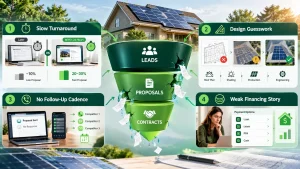
Most installers assume the loss happens at price. Usually, it happens earlier. Here are the four leaks we see most often in US sales pipelines.
Slow turnaround. Proposals delivered within 24 hours close at roughly two to three times the rate of slower ones. Homeowners rarely call one installer. The first credible quote sets the comparison baseline, and everyone after that plays defense.
Design guesswork. Sales reps eyeball roof planes, skip shading detail, and promise production the engineering team cannot deliver. Later, redesigns and change orders kill trust. Consequently, solar proposal conversion drops even on deals you technically won.
No follow-up cadence. Reps send the PDF, then wait. Meanwhile, competitors call twice.
Weak financing story. With the residential credit gone, buyers scrutinize monthly payments harder than ever. A single loan option no longer closes.
Five Levers That Lift Proposal-to-Contract Conversion
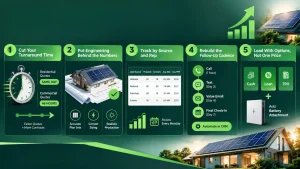
1. Cut Your Turnaround Time
Set a same-day standard for residential quotes and a 48-hour standard for commercial. Next, measure “time to proposal” for every rep, every week. Publish it. Speed responds to visibility faster than to coaching.
2. Put Engineering Behind the Numbers
Accurate plan sets, correct string sizing, and realistic production estimates protect your close rate twice. First, they win skeptical buyers. Second, they prevent post-signature cancellations. Because a stamped, permit-ready design signals competence, sophisticated commercial buyers notice immediately.
3. Track Solar Proposal Conversion by Source and Rep
Build one simple table: lead source, proposals sent, contracts signed, average system size, average PPW. Review it every Monday. Within a month, you will spot the channel quietly draining your budget.
4. Rebuild the Follow-Up Cadence
Structure beats hustle. For example, a proven sequence looks like this: call within one hour of sending, text on day two, value email on day four, and a final check-in on day seven. Automate the reminders inside your CRM so nothing depends on memory.
5. Lead With Options, Not One Price
Show cash, loan, and TPO side by side. In addition, quote a battery attachment on every proposal. Storage remains one of the few growth lines in the 2026 market, and it lifts contract value without new acquisition spend.
The Weekly Scorecard Every EPC Should Run
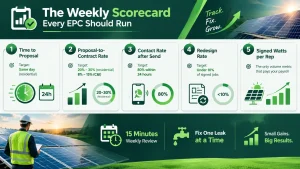
Strong solar proposal conversion comes from routine, not heroics. Consequently, keep your dashboard short and honest:
- Time to proposal — target: same day (residential)
- Proposal-to-contract rate — target: 20%–30% residential, 8%–15% C&I
- Contact rate after send — target: 80% within 24 hours
- Redesign rate — target: under 10% of signed jobs
- Signed watts per rep — the only volume metric that pays your payroll
Review these five numbers for fifteen minutes each week. Then fix one leak at a time. Small, compounding gains beat a full sales overhaul every quarter.
How EnergyScape Renewables Helps You Close More Contracts
Better solar proposal conversion starts with proposals your buyers can trust, and trust comes from engineering. That is exactly what we deliver at EnergyScape Renewables.
Our team provides PE-stamped plan sets, permit-ready designs, interconnection support, site surveys, and complete back-office services across all 50 states. So your reps stop guessing and start quoting real, buildable systems. Moreover, our fast turnaround protects the 24-hour window where most deals are actually won. When AHJ requirements shift or NEC 2026 compliance questions arise, our engineers handle it before it reaches your customer.
Sales speed also depends on the system running your pipeline. Therefore, many of our partners pair our engineering support with Sunscape, a purpose-built solar CRM that tracks proposals, automates follow-up, and reports close rates by rep and source in real time.
Ready to raise your close rate this quarter? Reach out to EnergyScape Renewables, and let us handle the engineering while your team handles the signature.
sjayakanth@energyscaperenewables.com