
MACR Calculation Solar Guide For Installers in 2026
MACR Calculation Solar Guide: Non-PFE Content on Residential + Storage Jobs
Two Calculations, Not One
MACR calculation solar:
Here’s what catches crews off guard. A residential solar-plus-storage job needs two separate MACR calculations, not one.
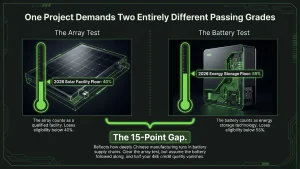
The array counts as a qualified facility. The battery counts as energy storage technology. Each gets its own test, and each has a different pass mark. Clear the array and assume the battery followed along, and half your 48E credit quietly vanishes — usually after the panels are already up.
For shops that sold under Section 25D for a decade, none of this used to be your problem. Section 25D terminated for any system placed in service after December 31, 2025, which pushed residential work onto the commercial credit. In 2025, 44% of solar salespeople said more than half their projects used third-party ownership. For 2026 that figure was expected to reach 65%, while the share selling no TPO fell from 9% to just 1%.
Translation: your tax equity partner now depends on your paperwork.
What MACR Actually Measures
Start with the definitions, because three acronyms drive everything here.
MACR (material assistance cost ratio) is the share of a project’s direct costs that did not come from a prohibited foreign entity. PFE (prohibited foreign entity) covers companies owned or controlled by China, Russia, Iran, or North Korea. Section 48E is the clean electricity investment credit that TPO providers claim on residential systems.
Now the counterintuitive part. MACR measures non-PFE content, not PFE content. That 40% is not a cap on Chinese equipment. It’s a floor of non-Chinese equipment you have to reach. Baker Tilly
Fall short and the credit doesn’t shrink. It disappears entirely.
The 2026 Thresholds
| Technology | 2026 | 2027 | 2028 | 2029 | 2030+ |
|---|---|---|---|---|---|
| Solar facility | 40% | 45% | 50% | 55% | 60% |
| Energy storage | 55% | 60% | 65% | 70% | 75% |
Qualified facilities lose eligibility below 40% in 2026. Storage loses eligibility below 55%. Both climb five points annually through 2030. The year construction began decides which column applies — not the year you install.
That 15-point gap reflects how deep Chinese manufacturing runs in battery supply chains.
MACR Calculation Solar Example: The Array
Treasury and the IRS released Notice 2026-15 on February 12, 2026, which finally gave installers a method instead of just a number. It permits reliance on existing domestic content safe harbor tables to identify components and assign cost percentages.
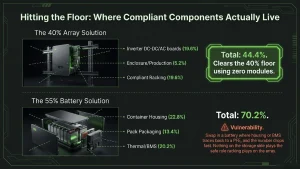
SolarEdge published its own figures using the Rooftop MLPE column. Their compliant DC optimized inverter system carries 24.8% — 7.8% DC-DC boards, 11.8% DC-AC boards, 4.3% enclosure, 0.9% production. Add compliant racking at 19.6% and the total reaches 44.4%.
That clears 40% using nothing from the modules.
Read that twice if you handle procurement. A project can pass the solar test on inverter and racking alone, which changes how you source panels on residential work.
MACR Calculation Solar Example: The Battery
Same exercise, higher bar — 55%.
Using the distributed BESS table, SolarEdge’s compliant battery systems total 70.2%. Container housing contributes 22.8%, pack packaging 13.4%, the battery management system 10.1%, thermal management another 10.1%, plus converter boards, enclosure, and production.
That passes comfortably. But look at what carried it: housing, BMS, thermal. Swap in a battery where those trace back to a PFE and the number drops fast. Nothing on the storage side plays the role racking plays on the array.
One warning. That same SolarEdge FAQ states in one spot that 2026 storage needs 50%. The statutory figure is 55%. Manufacturer collateral contains mistakes, and “my rep said it was compliant” won’t hold up in year five of an audit.
What Counts and What People Confuse
Steel and iron components meeting domestic content definitions stay out of the calculation entirely, unless other guidance names them as a manufactured product or component. Anything absent from the 2023–2025 safe harbor tables gets disregarded.
Bigger source of confusion: PFE status versus domestic content. These are separate tests. PFE status follows the manufacturer, not the factory address — a product built in Texas by a prohibited foreign entity still fails. And a PFE-compliant product doesn’t automatically earn the domestic content adder.
Also worth flagging: interconnection property requires its own separate MACR calculation.
Small doesn’t mean exempt either. Between the sub-1 MW prevailing wage carve-out and the 5% safe harbor for small solar, plenty of people assume FEOC skips small facilities. It doesn’t.
Choose Your Method Project by Project
Notice 2026-15 offers an actual cost method plus three safe harbors: identification, cost percentage, and certification.
Here’s the tactical piece most write-ups skip. These methods can produce materially different ratios on identical facts. In the IRS’s own examples, one approach passed while another failed on the same project. Make that choice at the project level, not as blanket company policy.
Paperwork Outlasts the Install
This is where residential shops get hurt, because exposure runs for years after the truck pulls away.
Section 6501(o) gives the IRS six years to assess a deficiency tied to a MACR error. Section 6662(m) drops the substantial understatement threshold from 10% to 1% when a credit gets disallowed for overstating MACR. Suppliers who sign false certifications face penalties of the greater of 10% of the underpayment or $5,000.
Certification rules leave no wiggle room. Each one needs the supplier’s EIN — not just a company name — signed under penalties of perjury, retained six years, and attached to the return for the first credit year. Miss any element and the certification is invalid. Collecting them after the filing deadline creates real risk. You also can’t rely on a certification you know or should know is wrong.
Where Jobs Actually Fail
Not in the spreadsheet. In the field.
A battery goes on backorder. The crew swaps a different SKU. Nobody redlines the plan set, nobody flags the TPO fund, and the MACR on file now describes a system that doesn’t exist. Six years later, someone requests documentation for equipment that never left the warehouse.
We caught exactly this pattern last quarter — a mid-Atlantic installer running 40-plus jobs had two battery substitutions nobody had logged. Both would have dropped below 55%. Fixing it took an afternoon of as-built revisions. Finding it three years into an audit would have cost far more.
That’s the real failure mode. Stale records, not bad math.
Make Your Compliance Trail Audit-Proof: MACR Calculation Solar
MACR calculation solar work doesn’t start with your accountant. It starts with an accurate, SKU-level record of what actually got installed — and stays accurate through every change order.
Energyscape Renewables builds that engineering layer. Plan sets, structural and PE-stamped packages, and interconnection submittals that name exact equipment, plus as-built revisions when the field changes the spec. We handle every part of the solar workflow except swinging the hammer.
Sunscape keeps it findable six years later. Track begin-construction dates, equipment SKUs, and supplier certifications per project, so a substitution raises a flag today instead of an audit letter later.
Book a walkthrough with our expert and see what your compliance trail looks like right now.
Quick Answers: MACR Calculation Solar
Does MACR apply if my customer pays cash?
Probably not to you directly, since you aren’t claiming the credit. But you still specify equipment and pass documentation to partners who are, so accuracy matters just as much.
Which year’s threshold applies to my job?
The calendar year construction began, determined under pre-OBBBA beginning-of-construction guidance. Installation year doesn’t change the answer.
What happens if MACR falls short?
The full credit gets disallowed. There’s no partial credit and no reduced rate — the project simply becomes ineligible under Section 48E.
Are these rules final?
No. Notice 2026-15 is interim and leaves open questions on ownership and control. Treasury must publish new safe harbor tables by December 31, 2026.
sjayakanth@energyscaperenewables.com