
Shading Analysis for Solar: What Installers Must Measure in 2026
Why Solar Shading Analysis Decides Your Project’s Real Output
Solar shading analysis separates a proposal that pencils out from one that quietly drains your margin. Yet many US installers still eyeball a roof, drop an array, and hope for the best. Then, twelve months later, production lands 12% under model. As a result, homeowners call, lenders ask questions, and EPCs eat the shortfall on a performance guarantee. Fortunately, the fix is straightforward. First, measure shade early. Next, document it clearly. Finally, carry that one dataset through every stage of the job. Moreover, today’s survey tools make the work faster than ever. Below, therefore, we break down what to measure in 2026 and how to turn shade data into stronger projects.
What Solar Shading Analysis Actually Measures
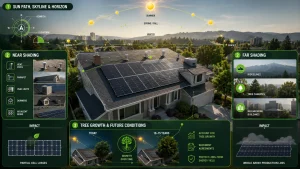
A shade report is never one number. Instead, it stacks several inputs that together predict annual light loss.
Sun Path, Skyline, and Horizon Data
Start with the horizon profile. Sun angles shift by latitude, season, and hour. Consequently, a chimney that costs nothing in June can wipe out a string in December. Good solar shading analysis captures azimuth and elevation for every obstruction on the skyline. After that, it overlays the profile against the annual sun path for those exact coordinates.
Above all, watch winter mornings and late afternoons. Those hours often carry high time-of-use value in California, New York, and Massachusetts.
Near Shading vs. Far Shading
Near shading comes from objects on or beside the array. Vent pipes, parapets, HVAC curbs, dormers, and adjacent rows all qualify. Far shading, on the other hand, comes from ridgelines, tree canopies, and neighboring buildings.
Both matter. However, they behave differently. Near shading creates sharp partial losses that hammer individual cells. By comparison, far shading dims the whole array at once. Therefore, your mitigation strategy changes depending on which one dominates.
Tree Growth and Future Site Conditions
Trees do not stay the same height for 25 years. Because of that, a shade model built only on today’s canopy overstates lifetime yield. So add a growth allowance for fast-growing species. In addition, put trimming agreements in writing. After all, homeowners rarely remember a verbal promise three summers later.
Tools and Methods That Hold Up in 2026

Handheld shade meters still function. Nevertheless, the industry has moved toward remote workflows that deliver tighter accuracy at lower cost.
LiDAR and photogrammetry. Aerial LiDAR produces accurate rooftop geometry and canopy heights without a truck roll. Furthermore, drone photogrammetry fills gaps in rural or newly built areas.
Drone site surveys. One short flight captures obstruction heights, roof planes, and setbacks together. Better still, that imagery becomes documentation for your permit package.
Simulation platforms. PVsyst, HelioScope, and Aurora convert your 3D model into hourly loss data. Even so, the output only reflects the input. In other words, sloppy geometry produces confident nonsense.
Field verification. Send a surveyor when the roof is complex or the system exceeds 25 kW. Remote data speeds up sales. Meanwhile, field data protects engineering.
Row Spacing, GCR, and Commercial Shading Losses
Ground-mount and flat-roof projects add another layer, since the array shades itself.
Ground coverage ratio drives that tradeoff directly. Tighten the rows, and you fit more DC on the site. Tighten them too far, though, and morning row-to-row shading eats the gain. For that reason, run solar shading analysis at several GCR values before locking the layout.
Trackers help as well. Still, backtracking algorithms only work when the terrain model is accurate. So on sloped sites, always model the true grade. Otherwise, flat assumptions on rolling ground create real losses.
How Module-Level Electronics Change the Math

String inverters, optimizers, and microinverters each respond to shade differently.
With a plain string inverter, for instance, one shaded module drags down the entire string through mismatch. Optimizers and microinverters instead limit that damage to the affected module. Because of this, many designers assume MLPE erases shading concerns.
Unfortunately, it does not. MLPE recovers mismatch loss. However, it cannot recover light that never reaches the cell. Your solar shading analysis still sets the production floor. The electronics, meanwhile, decide how much of that floor you keep.
Bifacial modules add one more variable. Specifically, rear-side gain depends on clear ground reflection, so racking and row spacing both influence albedo capture.
Documenting Shade Data for AHJs, Utilities, and Incentives

Design accuracy is only half the job. Documentation is the other half.
Today, many AHJs expect a shade study inside the permit set, especially for battery-paired systems. Meanwhile, several state incentive programs tie payments to modeled production. Consequently, a weak solar shading analysis can delay approval or shrink your award.
Include these items every time:
- Annual and monthly shade loss percentages
- Sun path diagram with the measured horizon
- Obstruction inventory with heights and distances
- Software version and weather dataset used
- Date and method of measurement
In addition, consistent packages speed up interconnection review. Utility engineers simply approve clean submissions faster.
Mistakes That Still Cost Installers Money
First, teams model the roof but skip the parapet. Second, they ignore adjacent construction that finishes before commissioning. Third, they quote a single annual loss figure, which hides seasonal shortfalls.
Another common error involves the sales handoff. Typically, sales runs a quick remote solar shading analysis. Then engineering runs a detailed one. Unfortunately, nobody reconciles the two. As a result, the customer signs a contract built on the optimistic number.
To fix that, apply one rule. One shade dataset moves through sales, design, and as-built. No parallel versions, ever.
Turning Solar Shading Analysis into a Competitive Advantage
Accurate shade work shortens sales cycles. Naturally, customers trust designers who explain seasonal losses in plain language. Additionally, precise data helps you defend pricing against competitors who overpromise.
Lenders notice too. A defensible solar shading analysis supports better financing terms on commercial deals. Across a portfolio, that advantage compounds quickly.
Partner with EnergyScape Renewables for Accurate Solar Shading Analysis
At EnergyScape Renewables, we handle the engineering behind reliable shade modeling. As a result, your crews stay on rooftops instead of chasing revisions. Our team delivers detailed solar shading analysis, PE-stamped plan sets, permitting support, interconnection applications, and site surveys across all 50 states. Specifically, we model near and far shading, verify obstruction geometry, and package everything your AHJ and utility require.
Because we work as an extension of your team, you scale volume without adding headcount. Furthermore, our engineers speak your designers’ language, so revisions move fast.
Want to connect that data to your project pipeline? Then explore Sunscape, a solar CRM and project management platform built for US installers and EPCs.
Ready to tighten your designs? Contact EnergyScape Renewables today, and let’s build shade-accurate projects together.
sjayakanth@energyscaperenewables.com