
Virtual Permitting vs. Manual Review: Building a Repeatable Workflow for Both

How to Handle Virtual and Manual Review Without Losing Time
Every solar installer knows the feeling. You close a deal, order equipment, and schedule your crew — then the permit stalls. Whether the AHJ runs SolarAPP+ or still processes paper applications, the outcome depends on one thing: your solar permitting workflow. A weak process bleeds margin, while a strong one protects it. Yet most installers and EPCs still lack a repeatable system that handles both virtual and manual permitting paths. Fortunately, building that system is not as complicated as it sounds. Therefore, this guide walks you through the key differences, common pitfalls, and practical steps to create a solar permitting workflow that works regardless of how the AHJ operates.
What Virtual Solar Permitting Looks Like in 2026
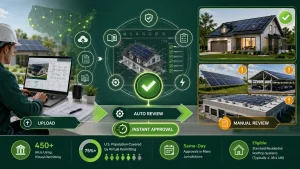
Virtual solar permitting uses automated platforms to review and approve permit applications digitally. Specifically, SolarAPP+, developed by NREL and funded by the Department of Energy, leads this shift across the country. First, the contractor uploads system specs into a portal. Then, the software checks the design against NEC standards and local codes. If everything passes, the permit issues instantly.
As of early 2026, over 450 AHJs across the United States have adopted SolarAPP+ for residential solar permits. Notably, California remains the frontrunner. Fresno, Stockton, and Sacramento County all run the platform, and Senate Bill 379 requires most jurisdictions to offer automated online permitting. In addition, Maryland has moved aggressively — the 2026 Utility RELIEF Act mandates same-day approvals statewide with residential fees capped at $500.
However, virtual permitting is not universal. In fact, the platform only covers standard roof-mounted residential systems, typically under 38.4 kW. As a result, ground-mount, carport, and commercial rooftop installations still require manual plan review in most jurisdictions.
Why Manual Permit Review Still Matters
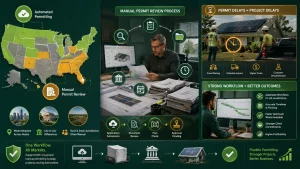
Despite the push toward automation, manual permit review remains the standard in many states. For example, Florida has zero SolarAPP+ adoption. Similarly, Texas runs a hybrid model where some cities use the automated platform while others rely entirely on traditional review. Meanwhile, rural counties and smaller municipalities across the Southeast and Mountain West often lack dedicated solar reviewers. Consequently, applications sit in general queues alongside HVAC and structural permits.
If your solar permitting workflow only accounts for one path, you will inevitably hit a wall the moment you expand into a new market. In other words, an installer who builds a smooth operation in California and then moves into a manual-submission state without adjusting timelines will miss client commitments. Ultimately, that gap between expectation and reality is where most growing EPCs bleed profit.
Building a Repeatable Solar Permitting Workflow for Both Paths
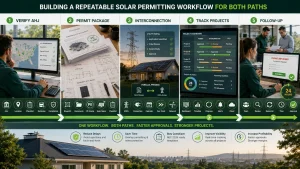
The goal is simple: create one process that flexes for either scenario. Here is how to do it step by step.
First, Verify the AHJ Permitting Path Before Every Project
Start each project by confirming the local AHJ’s submission method. Specifically, does the jurisdiction accept SolarAPP+? Also, does it require digital PE seals, wet-stamped documents, or both? Furthermore, what NEC edition does it enforce? Skipping this step leads to rejected applications and wasted weeks. Therefore, build an internal AHJ tracker in your CRM so your team can reference the requirements for every jurisdiction you serve.
Next, Standardize Your Permit Package Templates
Whether the AHJ uses virtual or manual review, your plan set needs to be accurate and complete. Accordingly, create standardized templates that include structural and electrical PE stamps, single-line diagrams, site plans, equipment spec sheets, load calculations, and FEOC documentation. In essence, a clean, code-compliant permit package passes automated checks and sails through manual review just as well. Moreover, NEC 2026 added new provisions like the rounding rule under Section 690.4(G) and stricter Isc requirements — so your templates should already reflect these updates.
Then, Submit Interconnection Applications Early
Even after the solar permit clears, the utility interconnection application adds more time. For instance, utilities like PG&E, National Grid, and Duke Energy manage backlogs that stretch 60 to 90 days. Because of this, experienced EPCs now overlap the permitting and interconnection timelines by submitting both applications simultaneously. As a result, this one change alone can shave weeks off total project delivery.
Also, Track Every Solar Permit in One Place
Above all, visibility is the backbone of a repeatable solar permitting workflow. When you run jobs across multiple jurisdictions, you need a single dashboard that shows permit status, interconnection deadlines, and PTO milestones for every project. In contrast, spreadsheets fall apart at scale. Instead, a purpose-built CRM keeps the entire pipeline organized and prevents missed deadlines.
Finally, Assign Ownership for Follow-Up
Permit rejections happen. However, the difference between a one-day fix and a three-week delay is who owns the follow-up. Therefore, assign a team member — or a dedicated permitting coordinator — to handle every rejection immediately. They should then identify the reason, coordinate the fix with your design or engineering team, and resubmit within 24 hours.
Common Mistakes That Break Your Solar Permit Process
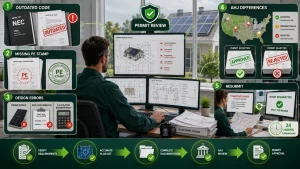
Even experienced installers make avoidable errors that slow down the solar permit process. For instance, submitting plan sets based on outdated NEC editions is one of the most frequent causes of rejection. Additionally, mislabeled module types, inconsistent roof load calculations, and missing PE stamps also trigger automatic flags during both virtual and manual reviews.
Besides that, another common mistake is assuming your home-state workflow transfers to other jurisdictions. In reality, each AHJ enforces its own local amendments, software platforms, and submission formats. Consequently, a permit package that clears review a hundred times in one county can get rejected two states over.
How EnergyScape Renewables Strengthens Your Permitting Workflow
Building a repeatable solar permitting workflow requires two things: engineering precision and operational visibility. Fortunately, EnergyScape Renewables delivers both. Their team provides PE-stamped structural and electrical plan sets across all 50 states, with NEC 2026-compliant designs and FEOC documentation included in every package. Furthermore, with a 99% first-submission approval rate across 188,000-plus projects, EnergyScape keeps your submittals clean whether the AHJ runs SolarAPP+ or manual review. To complement that engineering accuracy, Sunscape Solar offers a CRM built specifically for US solar installers and EPCs that tracks permit status, interconnection deadlines, and PTO milestones in one place. Together, they give your team the foundation for a solar permitting workflow that scales without breaking.
sjayakanth@energyscaperenewables.com