
State Solar Incentives 2026: An Installer’s Closing Playbook
State Solar Incentives in 2026: The Installer’s Playbook for Closing Deals Without the Federal Credit
Quick answer: The 30% federal residential solar tax credit (Section 25D) expired on December 31, 2025. So in 2026, state solar incentives lead the savings story you bring to homeowners — not the federal credit. For US solar installers and EPCs, that means rebuilding every residential proposal around net metering, state rebates, and tax exemptions. Below, we break down what changed and how to turn state-level programs into signed contracts.
What changed for installers in 2026
On July 4, 2025, the One Big Beautiful Bill Act (OBBBA) became law. As a result, Section 25D ended nearly a decade early. There’s no phase-down and no partial credit. So homeowners who buy with cash or a loan now get $0 in federal tax credit in 2026. On a typical $30,000 system, that’s roughly $9,000 in savings gone overnight. You can confirm the details in the IRS guidance on Section 25D.
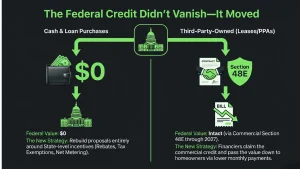
Here’s the part many sales teams miss, though. The federal credit didn’t fully vanish — it moved. Third-party-owned systems (leases and PPAs) still tap the commercial credit under Section 48E, which runs through 2027. In those deals, the financier claims the credit and passes the value along as lower monthly payments. In short, “owned solar plus state incentives” and “TPO financing” are now two separate plays. The strongest installers know exactly when to reach for each.
Why state solar incentives matter more than ever
Because the federal credit was always additive, not the foundation. State and utility programs were never built to replace it. Yet in 2026, they carry far more weight in your proposal math. Net metering, property tax exemptions, sales tax exemptions, and state rebates didn’t go anywhere. So the installer who explains a homeowner’s state solar incentives clearly — in plain dollars — holds a real edge over a competitor still mourning the 30%.
That said, this knowledge gets complicated fast. Every state, and often every utility and AHJ, plays by different rules. Tracking that across a multi-state pipeline from memory simply isn’t realistic. Therefore, your proposal and permitting workflow needs to be built for it from the start.
A state-by-state cheat sheet for your proposals
Here’s how the four biggest markets stack up at a glance:
| Incentive | California | Texas | Florida | New York |
|---|---|---|---|---|
| State tax credit | None | None | None | 25% up to $5,000 |
| Net metering | NEM 3.0 (~$0.04–0.08/kWh) | Utility-dependent | Full retail rate | Strong value stack |
| Property tax | Excluded through 2026 | 100% exempt | Exempt | Exempt |
| Sales tax | Standard rate | Exempt | Exempt (6%) | Exempt |
| Standout | SGIP battery rebate | Local/utility rebates | High sun + retail NEM | NY-Sun + NYSERDA |
California still leads the country in volume, but the pitch has changed. There’s no state credit, and NEM 3.0 cut export rates by roughly 75%. So exported power now earns only about $0.04–$0.08/kWh. That makes battery storage close to mandatory. Fortunately, the SGIP rebate offsets battery costs — around $200/kWh standard, climbing toward $1,000/kWh for equity-resiliency customers.
Texas has no statewide program, which trips up plenty of reps. Instead, incentives sit at the utility and local level, so you’ll quote different numbers in Austin than in San Antonio. Still, the state offers a 100% property tax exemption plus a sales tax exemption, and there’s no state income tax. Without the federal credit, Texas payback now runs about 12–16 years. Therefore, your proposal has to lean on exemptions, financing, and energy independence.
Florida brings strong sun and a clean, simple incentive set. There’s no state rebate, but full retail-rate net metering remains the most valuable lever you can show. Add the property tax exemption and a sales tax exemption, and the numbers hold up well in a no-income-tax state.
New York is the most generous of the four. Homeowners get a 25% state tax credit worth up to $5,000, plus the NY-Sun program and NYSERDA battery incentives. For installers, that’s a deep, stackable toolkit that keeps deals penciling out.
How to put state incentives to work in proposals
First, rebuild your template around the state, not the federal credit. Lead with net metering value. Then layer in exemptions and rebates as concrete dollar figures. Second, attach storage by default in NEM 3.0 markets like California, because the economics now favor it. Third, point homeowners to the DSIRE database for current terms so your numbers stay credible. Also add a short “verify current terms” note, since programs shift often.
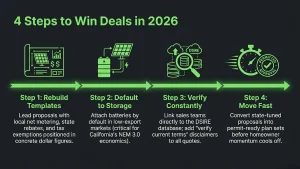
Finally, move fast. The installers winning in 2026 turn a state-tuned proposal into a permit-ready plan set before the homeowner cools off. Our engineering and permitting services are built for exactly that speed, and you can find more market breakdowns on the EnergyScape Renewables blog.
Turn state incentives into closed jobs — faster
State solar incentives only help if you quote them accurately and deliver before momentum fades. That’s where the right back office matters.
EnergyScape Renewables is the operational backbone for installers ready to scale across all 50 states. From sales proposals and site surveys to plan sets, 24-hour PE stamping, permitting, and interconnection, the team ships code-compliant packages with a 99% AHJ approval rate. So a state-tuned proposal becomes a permit-ready design overnight — wherever the job sits and whatever local rules apply.
And because tracking incentive eligibility across dozens of states by hand is impossible, Sunscape gives you the Solar OS to run it all in one place: your pipeline, project data, and documents, organized end to end.
Ready to rebuild your 2026 proposals and close more deals without the federal credit? Start a project with EnergyScape Renewables and Sunscape, and let your back office keep pace with every state.
Frequently asked questions
Is there still a federal solar tax credit for homeowners in 2026?
No. The Section 25D residential credit expired on December 31, 2025 under the OBBBA. Cash and loan purchases now receive no federal credit. Only third-party-owned systems (leases and PPAs) still access federal value through the commercial 48E credit, which the provider claims.
Which states have the best solar incentives in 2026?
New York stands out among major markets with its 25% state credit (up to $5,000) plus NY-Sun. Outside the big four, South Carolina (25% credit, $35,000 cap), Hawaii (35% up to $5,000), and Massachusetts (SMART program) are also strong. The best states pair real incentives with retail-rate net metering.
Do state incentives stack with lease or PPA financing?
It depends on ownership. In a lease or PPA, the system owner usually claims owner-based incentives like the 48E credit and SRECs, then passes savings through your customer’s rate. Customer-side benefits like net metering and property tax exemptions still apply. Always confirm program by program.
How should installers update proposals now that the federal credit is gone?
Rebuild the savings story around net metering, state rebates, and tax exemptions in real dollars. Attach storage where export rates are low. Then keep program data current through DSIRE.
sjayakanth@energyscaperenewables.com