
Solar Interconnection Critical Path: Stop Queue Delays in 2026
Solar Interconnection Critical Path: Why Grid Connection Sets Your 2026 EPC Timeline
Your team has a commercial solar job signed. Equipment is locked. Your construction crew stands ready. But here’s what most solar EPCs miss during project planning: your solar interconnection critical path will outlast your construction timeline by 12-18 months.
This isn’t theory. Welcome to how grid connection works in 2026.
For the past decade, solar installers believed permitting was the longest project phase. That assumption fundamentally changed. Today, interconnection—not construction—sets your critical path. The interconnection queue sits between your final inspection and Permission to Operate (PTO), and it’s where projects stall for months after construction wraps.
Understanding your solar interconnection path isn’t optional anymore. It’s how you protect cash flow, customer satisfaction, and tax credit eligibility.
Understanding the Solar Interconnection Critical Path in 2026
What Is Your Solar Interconnection Critical Path?
Your project’s critical path is the longest sequence of dependent tasks that determines your final completion date. In solar projects, this used to mean: design → permitting → construction → commissioning.
In 2026, that sequence includes a major addition: interconnection studies, utility review, and Permission to Operate approval sit on the critical path for 12-24 months after construction finishes.
Think of it this way: your crew installs panels and wiring. Final inspection passes. But your system cannot legally generate power until the utility approves interconnection. The utility’s approval timeline isn’t 4 weeks—it’s often 16+ months, depending on your region.
The Grid Connection Queue: 2,000+ GW of Projects Waiting
The numbers are staggering. Over 2,000 GW of generation capacity sits in interconnection queues across U.S. ISOs and RTOs. That’s more than double the entire U.S. power fleet.
What does that mean for your solar interconnection critical path? Long waits. Regional analysis shows:
- PJM Region: More than 60 GW remain under study for 2026
- MISO Region: Over 170 GW of solar, wind, and storage awaiting interconnection
- ERCOT Region: Nearly 100 GW of renewables queued
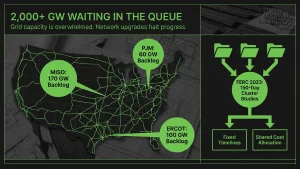
These aren’t failed projects. They’re projects where grid capacity simply doesn’t exist yet. The utility is studying network upgrades needed to safely connect the system. During that study period—which often exceeds 18 months—your customer’s system sits dark.
Check your region’s queue status (external link to FERC Order 2023-A).
FERC Order 2023 and Your Solar Interconnection Critical Path
How FERC Order 2023 Changed Interconnection
In July 2023, the Federal Energy Regulatory Commission issued Order No. 2023 to address interconnection delays. The rule became effective November 6, 2023. Transmission providers had until April 3, 2024, to file compliance plans.
The centerpiece reform: cluster studies instead of individual project processing. Projects in your region now move through interconnection studies in batches, sharing costs and timeline benefits.
FERC Order 2023 also introduced:
- 150-day deadlines for cluster study completion (with financial penalties for delays)
- “First-ready, first-served” processing (projects that prove readiness move forward faster)
- Proportional cost allocation (your project doesn’t bear all network upgrade costs)
These reforms can reduce your solar interconnection critical path by 20-30% once fully implemented across all transmission providers.
The Catch: Regional Implementation Still Varies
FERC Order 2023 compliance filings came due in May 2024. But implementation remains fragmented:
- PJM: FERC pushed back mid-2025, requiring additional revisions
- MISO: Cluster studies accelerating, but cost-allocation disputes slow progress
- ERCOT: Operates outside FERC jurisdiction; has its own rules
- Regional utilities: Non-RTO areas vary widely in adoption
This matters for your solar interconnection path: don’t assume FERC Order 2023 benefits apply equally in your region. Call your utility and confirm their specific cluster study timeline.
Why Your Solar Interconnection Critical Path Outpaces Construction
Three Reasons Interconnection Becomes Your Bottleneck
1. The Queue Has Massive Volume
Over 90% of interconnection applications contain errors requiring revision. A single resubmission adds 6-8 weeks to your timeline. Only 14% of projects historically complete the interconnection process successfully, according to Lawrence Berkeley National Laboratory research.
That means most projects face at least one revision cycle. Your solar interconnection path extends every time an application bounces back.
2. Study Timelines Are Fixed, Not Flexible
Once your project enters a cluster study window, the transmission provider studies all projects in that group on the same timeline. If one project needs additional information, the entire cluster can delay.
Your crew cannot accelerate final inspection if the utility is three months into a cluster study. The study timeline doesn’t flex around your construction schedule.
3. Network Upgrade Complexity Adds Months
If the utility determines that network upgrades are needed to safely integrate your system, those upgrades must be completed before you receive Permission to Operate. A single distribution system upgrade adds 12-24 months to your solar interconnection critical path.
Protecting Your July 4, 2026 ITC Safe Harbor Deadline
Why the ITC Deadline Pressures Your Schedule
Commercial solar projects must begin construction by July 4, 2026, to lock in the full 30% Investment Tax Credit under Section 48E. Miss that date, and the project must be fully placed in service by December 31, 2027, to qualify for any credit at all.
That deadline is now—less than 12 months away.
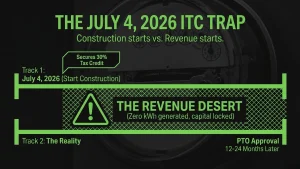
But here’s the scheduling trap: starting construction and receiving Permission to Operate are different dates. You can start construction by July 4 and still wait 18+ months for PTO approval.
Your solar interconnection critical path now runs parallel to your ITC deadline, not after it.
Strategic Approach: Parallel Processing for Your Solar Interconnection Critical Path
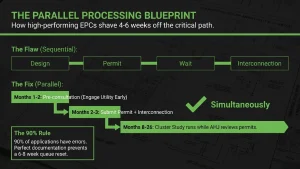
High-performing EPCs file interconnection applications in parallel with permit submittals, not sequentially. This overlap shaves 4-6 weeks off your total timeline.
Sequence that protects your solar interconnection critical path:
- 1-2: Design phase; call utility for interconnection pre-consultation
- 2-3: Submit permit AND interconnection application simultaneously
- 3-6: Utility reviews both in parallel; AHJ reviews permit
- 6-8: Permit approval; interconnection application enters cluster study
- 8-26: Cluster study and utility review (on solar interconnection critical path)
- 26+: Network upgrades (if required); final inspections; PTO approval
Notice: your solar interconnection critical path doesn’t wait for construction to finish. It runs independently.
Three Ways to Optimize Your Solar Interconnection Critical Path
1. Interconnection Application Quality Prevents Delays
Grid operators report that 90%+ of applications contain errors. These errors trigger restudies that delay the entire queue.
Prevent interconnection application rejection:
- Validate system size, AC ratings, and equipment specifications against utility standards
- Include complete SCADA requirements and protection scheme documentation
- Provide accurate non-synchronous resource models for solar equipment
- Confirm NEC compliance before submission
A single rejected application adds 6-8 weeks to your solar interconnection critical path. Perfect documentation prevents that delay.
2. Early Utility Engagement Shifts Queue Priority
Calling the utility during design phase—before construction even starts—signals readiness. Utilities process “first-ready, first-served” under FERC Order 2023.
Projects that demonstrate preparation move forward faster.
Engage your utility early:
- Discuss cluster study windows and timing
- Confirm equipment compatibility and protection standards
- Ask about current queue position and expected study start date
- Clarify network upgrade risks in your specific area
This conversation takes 30 minutes. It can save 4-6 weeks on your solar interconnection critical path.
3. Financial Readiness Deposits Speed Cluster Entry
FERC Order 2023 requires financial security (cash, letters of credit, or surety bonds) at specific phases. Projects that meet financial requirements move into cluster studies faster.
Your customer needs to understand this cost upfront. Don’t let it surprise them mid-project.
The Gap Between Construction Completion and PTO Approval
Why Your System Can’t Generate Revenue Until PTO
Final inspection approval and Permission to Operate are not the same thing.
Final inspection means the AHJ approved your installation work. PTO means the utility approved your system to connect to the grid.
Average timelines (varies by utility):
- Final inspection to utility review: 2-4 weeks
- Utility utility witness testing and commissioning: 4-8 weeks
- Utility final approval and PTO issuance: 2-4 weeks
- Total: 8-16 weeks in the best case
In congested regions with network upgrades required, that timeline extends to 12-24 months.
Your solar interconnection critical path runs during these months. Then your crew finishes work. Atlast your customer sees an installed system. But it generates zero kilowatt-hours until PTO arrives.
That gap is where projects lose cash, customer satisfaction, and sometimes tax credit eligibility.
Optimize Your Solar Interconnection Critical Path
Your solar interconnection critical path determines your 2026 schedule. Don’t leave it to chance.
Fast-Track Your Interconnection with PE-Stamped Plan Sets
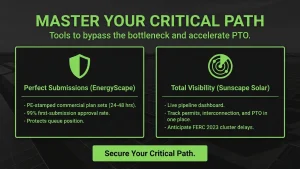
EnergyScape Renewables delivers PE-stamped commercial solar plan sets in 24-48 hours—compliant with NEC 2026 and accepted by AHJs across all 50 states. A perfect engineering package gets through utility review faster, protecting your solar interconnection path from the start.
99% first-submission approval rate across 188,000+ projects.
Track Your Solar Interconnection Critical Path From Day One
Sunscape Solar keeps your entire project pipeline visible—permit submission, interconnection filing, utility review, and PTO approval—all in one dashboard. See where each project stands, anticipate queue delays, and never miss an interconnection milestone.
Built for US solar installers and EPCs running commercial volume.
Frequently Asked Questions
Q: When should I file my interconnection application?
A: File in parallel with your permit submittal, not after permit approval. This overlap shaves 4-6 weeks off your solar interconnection critical path.
Q: How does FERC Order 2023 affect my solar interconnection critical path?
A: FERC Order 2023 uses cluster studies (grouping projects together) and 150-day study deadlines, reducing queue time by 20-30% once fully implemented in your region.
Q: What happens if my interconnection application gets rejected?
A: A rejected application restarts your queue position. A single resubmission cycle costs 6-8 weeks on your solar interconnection critical path.
Q: Can I start construction before receiving Permission to Operate?
A: Yes—you must start construction by July 4, 2026, to protect your 30% ITC. But PTO can take 12-24 months after construction. Plan for this gap.
Q: How long does the average interconnection study take in 2026?
A: Cluster studies typically take 150 days under FERC Order 2023, but your solar interconnection critical path extends 18-24 months when network upgrades are required.
sjayakanth@energyscaperenewables.com