
Permit-Ready Solar Plan Sets: The 7 Sections Every AHJ Requires
Stop Losing Permits: The Hidden Gap in Your Solar Plan Sets
Getting a solar project through permitting feels like navigating a maze with constantly shifting walls. You submit what you think are complete solar plan sets, only to receive rejections filled with confusing comments from your Authority Having Jurisdiction (AHJ). Days turn into weeks. Revenue stalls. Moreover, your team spends countless hours revising drawings that should’ve been right the first time.
Here’s the reality: most solar installers and EPCs miss critical sections when assembling their permit solar plans. In fact, these gaps aren’t accidents—they’re systematic oversights that come from unclear AHJ expectations and fragmented drawing processes. Furthermore, the good news is encouraging. Once you understand the 7 non-negotiable sections every AHJ requires in your solar plan sets, you’ll eliminate rejections and accelerate your permitting timeline dramatically.
The 7 Essential Sections Every AHJ Requires in Your Solar Plan Sets
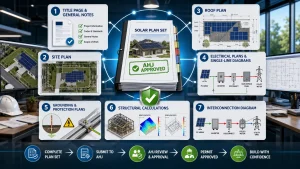
1. Title Page and General Notes – Your First Impression Matters
Your solar plan sets should open with a clear title page. First, include the project address, system size, component specifications, and permit numbers. Additionally, general notes belong here too. These notes explain your design approach and reference relevant building codes.
AHJs use this section immediately when reviewing your submission. Specifically, they verify permit information and understand your project scope before reviewing technical drawings. Therefore, missing or incomplete general notes send your solar plan sets back for revisions within days. In fact, this simple oversight delays your timeline significantly.
2. Site Plan – Show Where Everything Lives
The site plan reveals roof dimensions, building footprint, solar array location, and surrounding structures. Furthermore, you should also show electrical service entrance, disconnect locations, and conduit routing on the roof. This comprehensive approach prevents confusion during AHJ review.
Moreover, many installers miss setback requirements right here. Different municipalities demand specific distances from roof edges, and consequently, your solar plan sets must clearly indicate compliance with local setback codes. As a result, this section prevents costly roof modifications during installation. Additionally, overlooking setback requirements is one of the most common reasons permits get rejected.
3. Roof Plans – The Blueprint for Physical Installation
Roof plans display detailed array layouts with panel rows, racking dimensions, and attachment points. Additionally, mark roof pitch, structural elements, and penetration locations with precision. Furthermore, clearly label each panel string and its corresponding electrical section.
Your roof plans need precise measurements and material specifications. Specifically, AHJs review this section carefully because installation safety depends on accurate details. Therefore, solar plan sets lacking dimensioned roof plans get rejected consistently. In addition to dimension accuracy, you’ll want to include all structural attachment points with proper spacing calculations.
4. Electrical Plans and Single-Line Diagrams – Connect All Components Properly
This section shows your complete electrical system. First, include inverter location, disconnect switches, combiners, and breaker configurations. Moreover, your electrical plans must follow National Electrical Code (NEC) standards without exception. Additionally, any deviation from NEC requirements creates immediate rejection risk.
Single-line diagrams break down circuit protection clearly. Furthermore, they show amperage ratings, wire gauges, and equipment specifications in detail. Consequently, solar plan sets without detailed electrical plans fail NEC compliance reviews. That said, your AHJ won’t approve systems that don’t show proper electrical design. In fact, electrical plan completeness directly impacts your approval timeline.
5. Grounding and Protection Plans – Safety First, Always
Grounding systems protect both equipment and occupants from electrical hazards. Furthermore, your solar plan sets must document grounding rod locations, conductor sizing, and bonding connections accurately. Additionally, include equipment grounding details and lightning protection paths throughout the design.
This section addresses electrical safety directly. Notably, AHJs scrutinize grounding plans closely because improper grounding causes fires and electrocution hazards. Therefore, solar plan sets missing grounding details generate automatic rejections. Moreover, many installers underestimate this section’s critical importance to overall system safety.
6. Structural Calculations – Prove Your Design Works Everywhere
Structural engineer stamps validate racking loads and attachment methods conclusively. Furthermore, your solar plan sets need calculations showing wind load capacity, snow load capacity, and seismic considerations. Specifically, these calculations vary significantly by location.
Different jurisdictions demand different approaches to structural analysis. For example, California requires seismic calculations that Minnesota doesn’t. Additionally, your structural calculations must address local conditions specifically. Consequently, solar plan sets with generic structural stamps fail permit review consistently. In fact, location-specific calculations are non-negotiable for approval.
7. Interconnection Diagrams – Show How You Connect to the Grid Safely
This final section proves your system integrates safely with utility infrastructure. Moreover, include utility meter details, net metering configuration, and anti-islanding protection specifications clearly. Additionally, your interconnection diagrams must match your local utility’s interconnection requirements exactly.
Many installers underestimate this section’s importance to project completion. Notably, utility companies provide specific interconnection requirements. Furthermore, your solar plan sets must follow them exactly. Consequently, missing or incorrect interconnection diagrams cause utility rejection, which stops your entire project dead in its tracks. Therefore, this section deserves careful attention during design.
What Most Solar Installers Are Missing Right Now
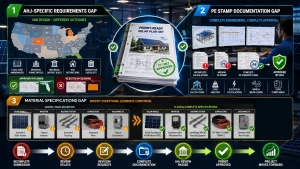
Incomplete AHJ-Specific Requirements Hold Projects Back
Different municipalities interpret building codes differently across the country. Furthermore, your solar plan sets need customization for each AHJ you work with. In addition to base code requirements, many jurisdictions have local amendments. Additionally, some areas have historical district regulations or HOA restrictions that override standard requirements.
This disconnect between your solar design documents and local requirements causes most rejections. For instance, a design that passes in Florida fails in Colorado without modification. Consequently, spend time understanding each jurisdiction’s unique expectations before you finalize your solar plan sets. Moreover, this upfront research prevents expensive revision cycles later.
Inadequate PE Stamp Documentation Delays Approvals
Professional Engineer stamps carry legal weight in the permitting process. However, PE stamps without supporting calculations don’t satisfy AHJ requirements. Furthermore, your solar plan sets need detailed PE-stamped calculations plus clear professional seals on all drawing sheets.
Make sure your PE’s stamp covers every section requiring professional oversight. Additionally, partial stamping creates gaps that AHJs catch during review. Consequently, coordinate with your PE early to ensure complete coverage. In fact, this communication prevents approval delays significantly.
Poor Documentation of Material Specifications Creates Confusion
AHJs need exact product information for verification purposes. Furthermore, your solar plan sets should include inverter model numbers, panel specifications, racking systems, and conductor types clearly. Additionally, generic component descriptions create confusion and require clarification requests.
Specify everything in your solar design documents. Notably, this clarity accelerates review and reduces revision cycles significantly. For example, instead of writing “standard solar panels,” specify “Silfab Excellence 410W monocrystalline panels.” Therefore, precision eliminates ambiguity that reviewers must otherwise resolve.
Moving Forward: Your Action Plan for First-Time Approvals

Creating compliant permit solar plans requires attention to detail and local knowledge. First, start by requesting each AHJ’s specific checklist for requirements. Additionally, map your solar plan sets sections directly to those requirements systematically.
Use checklists before every submission. Moreover, verify every required element appears in your solar design documents. Furthermore, have your PE review all sections for completeness and accuracy. Additionally, consider having another engineer perform a final quality check. As a result, this double-check catches errors before submission. Consequently, your approval timeline accelerates dramatically.
Document your process thoroughly. Once you establish a winning format for your solar plan sets in one jurisdiction, adapt it for other markets. Furthermore, build templates that reduce future revision cycles. Additionally, maintain separate versions for different climate zones and local requirements. Therefore, future projects start with a proven framework.
Let EnergyScape Renewables Handle Your Solar Plan Sets
Creating permitting-ready solar plan sets demands expertise in engineering, code compliance, and local regulations. Notably, that’s exactly where EnergyScape Renewables excels. Furthermore, we specialize in professional PE-stamped solar plan sets, electrical designs, and structural calculations tailored to your local AHJ requirements.
Our team handles permitting complexity so you can focus on installations. Moreover, we deliver solar design documents that pass first-time approval, keeping your projects moving forward. Additionally, our Sunscape Solar CRM platform streamlines your entire permitting workflow from design through completion. For instance, you’ll track every permit submission and approval directly in the system.
Stop losing time and revenue to rejected solar plan sets. Instead, partner with EnergyScape Renewables and transform your permitting process into a competitive advantage. Furthermore, visit Sunscape Solar to see how our integrated platform supports your workflow. Ultimately, successful permitting starts with complete, accurate solar plan sets.
sjayakanth@energyscaperenewables.com