
Top 5 Site Survey Errors That Lead to Failed AHJ Inspections — and How to Avoid Them
How a Weak Solar Site Survey Leads to Failed AHJ Inspections
Every solar pro knows the sting of a red-tagged job. You schedule the inspection, the AHJ shows up, and one missed detail sends the project back to square one. Often, the root cause traces straight back to the field. A rushed site assessment creates gaps that inspectors catch weeks later. The good news? Most of these problems are easy to prevent. With a tighter solar site survey process, clear documentation, and a few smart checks, you can pass inspections on the first attempt. Below, we break down the top five errors that crews make every day. More importantly, we show you the practical fix for each one.
How Site Survey Errors Snowball Into Compliance Issues
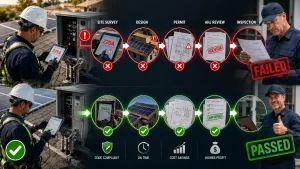
Here’s the hard truth: the inspector rarely sees your effort. They see the result. A single wrong measurement on site can ripple through the entire design. For example, a misread busbar rating leads to a non-compliant interconnection. That error then shows up on the plan set, the permit, and finally the inspection. By that point, the fix is expensive and slow.
This is why front-end accuracy matters so much. A clean solar site survey protects every downstream step. In contrast, a sloppy one quietly plants problems you won’t notice for weeks. So, treat the survey as the foundation of compliance, not just a quick visit.
5 Site Survey Mistakes That Cause Failed AHJ Inspections
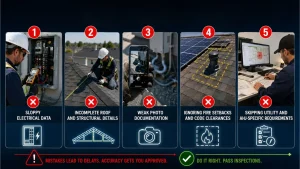
Error 1: Sloppy Electrical Data During the Solar Site Survey
First, let’s talk electrical. Many failed AHJ inspections start with bad service measurements. Techs often record the wrong main breaker rating or skip the busbar value altogether. As a result, the system design violates the NEC 120% rule. Then the plan set bounces back, and your timeline slips.
To avoid this, photograph the main service panel clearly. Capture the breaker rating, the busbar label, and the meter. Moreover, note whether the panel is bonded or sub-fed. These small details drive your interconnection method. In short, accurate electrical data keeps the design code-compliant from day one.
Error 2: Incomplete Roof and Structural Details
Next comes the roof. Structural gaps are a leading reason behind failed AHJ inspections. Surveyors sometimes guess rafter size or skip spacing measurements entirely. Consequently, the engineer cannot verify load capacity, and the PE stamp stalls.
Instead, measure rafter dimensions, spacing, and span on site. Additionally, record the roof material, layer count, and overall condition. For instance, a second layer of shingles changes both the attachment hardware and the load math. A complete structural picture lets your team produce a stamped plan set without endless back-and-forth.
Error 3: Weak Photo Documentation in the Field Survey
Photos tell the story your notes simply cannot. However, blurry or missing images create huge blind spots. When the office lacks clear shots, they fill the blanks with assumptions. Later, those assumptions clash with reality, and the inspector spots the difference.
Therefore, build a photo checklist into every solar site survey. Capture the panel, attic, roof planes, conduit routes, and equipment spots. Also, take both wide shots and close-ups of each label. As a result, your design team works from facts, not guesswork.
Error 4: Ignoring Fire Setbacks and Code Clearances
Fire code trips up plenty of crews. AHJs enforce strict setbacks around ridges, valleys, and walkways. Unfortunately, many surveys skip these clearances. Then the layout fails review because panels sit too close to the edge.
To stay safe, mark every setback during the site visit. Measure ridge gaps, eave distances, and access pathways. Furthermore, check local amendments, because rules shift from one jurisdiction to the next. Ultimately, planning setbacks early prevents a costly redesign down the road.
Error 5: Skipping Utility and AHJ-Specific Requirements
Finally, every jurisdiction plays by its own rulebook. Some AHJs demand exact placard wording. Others want rapid-shutdown labels in very specific spots. Meanwhile, utilities set their own meter and disconnect standards. When crews overlook these items, failed AHJ inspections quickly follow.
So, research the local AHJ and utility before the truck rolls out. Confirm placard rules, disconnect placement, and labeling standards up front. In addition, keep a living checklist for each region you serve. That single habit turns a chaotic solar site survey into a repeatable, code-ready routine.
The True Cost of Failed AHJ Inspections

A failed inspection can look like a minor hiccup. In reality, it drains both money and momentum. First, you pay for a second truck roll and extra labor hours. Then the homeowner waits longer for activation, which hurts your reviews. Meanwhile, your crew falls behind on the next job in line.
The damage spreads well beyond one project. Repeated failures flag your company with the local AHJ. Consequently, future submittals face tougher scrutiny. A clean record, on the other hand, builds trust and speeds approvals. Therefore, fixing your solar site survey pays off on every single install.
Build a Repeatable Solar Site Survey Checklist

Beyond fixing single errors, smart installers standardize the entire workflow. A strong checklist keeps every tech on the same page. First, it lists the required photos and measurements. Next, it flags region-specific code items. Finally, it forces a quick quality review before the crew leaves the property.
This approach shrinks rework and speeds up permitting. Plus, it protects your reputation with homeowners and inspectors alike. Over time, a consistent solar site survey becomes a genuine competitive edge.
Pass More Inspections With EnergyScape Renewables
Strong field data starts every successful project. Still, even sharp crews need engineering backup to close the loop. That’s exactly where EnergyScape Renewables comes in. Our team turns your solar site survey into stamped, code-ready plan sets that sail through review.
We handle PE stamping, permit-ready plan sets, interconnection applications, and permitting across all 50 states. As a result, you spend less time chasing corrections and more time installing. Moreover, our engineers know the AHJ and utility quirks in every region you serve.
Want to manage surveys, designs, and approvals in one place? Pair our services with a modern platform like Sunscape Solar to track each project from survey to PTO. Together, these tools help you cut failed AHJ inspections and grow with confidence. Reach out to EnergyScape Renewables and streamline your next plan set today.
sjayakanth@energyscaperenewables.com